
TL;DR:
- Your home influences your emotional well-being through light, color, air quality, and personalisation. Small adjustments, like increasing natural light and choosing meaningful art, can significantly improve mood and mental health. Design choices rooted in environmental psychology help create spaces that promote comfort, safety, and overall happiness.
Your home is defined by its capacity to shape your emotional state, moment to moment, through light, colour, air quality, and spatial arrangement. This is not a matter of personal preference alone. Research in environmental psychology confirms that the physical conditions of your living space directly influence cortisol patterns, anxiety levels, and overall mental health. The relationship between home and happiness runs deeper than aesthetics. Design, atmosphere, and even the words you use to describe your home reflect your mental state and well-being. Understanding how your home affects your mood is the first step toward making it work for you, not against you.
What aspects of your home environment most affect your mood?
The home environment and mood are connected through several measurable physical factors. Lighting, colour, air quality, acoustics, and layout each carry their own emotional weight. None of them operates in isolation.
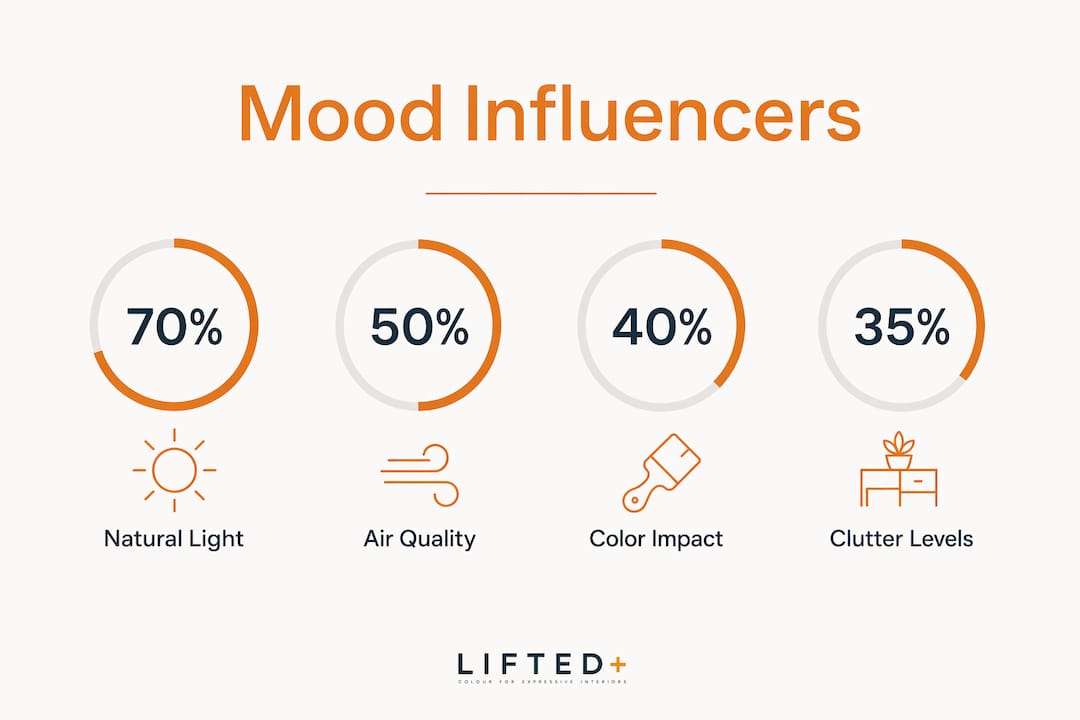
Natural light is the single most powerful mood regulator in a domestic space. Exposure to daylight regulates circadian rhythms, lifts serotonin production, and reduces fatigue. A survey of 2,000 adults found that passive design elements like optimised light and ventilation are directly linked to higher subjective well-being. That finding means the architecture of your windows matters as much as what you hang on your walls.
Colour shapes the emotional temperature of a room before you consciously register it. Cooler tones like blue and green tend to read as calm. Warmer tones like yellow and orange carry stimulating energy. The effect is not chemical. It operates through personal memory and learned association, which is why the same shade of terracotta can feel grounding to one person and unsettling to another.
Air quality and ventilation are underestimated factors. Poor indoor air quality correlates strongly with increased depressive symptoms, with microclimate conditions playing a measurable role in mental health outcomes. Stale air, mould, and indoor pollutants quietly erode your sense of ease.
Clutter and acoustics round out the picture. Unfinished tasks and visual disorder are linked to flatter cortisol slopes, meaning your stress hormones stay elevated rather than recovering naturally through the day. Sound behaves similarly. Hard surfaces amplify noise and raise tension. Soft furnishings absorb it and create a sense of containment.
Pro Tip: If you can only change one thing, address your lighting first. Increase access to natural light during the day and switch to warm, low-level artificial light in the evening. The shift in atmosphere is immediate and costs very little.
How does home design psychology explain the subtle influence of space on emotions?
Environmental psychology, the recognised field studying how surroundings affect mood and behaviour, identifies space as a form of sensory input that the brain processes continuously. Your nervous system reads a room the way it reads a face: quickly, automatically, and with lasting effect.
Small design choices in light, layout, and personalisation quietly guide daily emotions and overall comfort. A low ceiling can feel protective or oppressive depending on the room’s width and the warmth of its light. A wide, open-plan space can feel freeing or anxious-making depending on how furniture defines its zones. These are not arbitrary reactions. They are the brain assessing perceived safety and control.
Personalisation is where design psychology becomes most individual. Objects that carry emotional meaning, a piece of art chosen for its resonance, a chair inherited from someone you love, create what researchers call place attachment. That attachment acts as a psychological anchor. It signals that the space belongs to you, which reduces ambient stress and increases the sense of agency you feel at home.
Improved lighting, acoustic, and thermal conditions increase satisfaction with a residence and, through that satisfaction, lift overall subjective well-being. The mechanism is indirect but consistent: a better-feeling home improves your sense of health, leisure, and daily life, and those improvements accumulate into measurable mood gains.
Pro Tip: Walk through your home as if you are a guest seeing it for the first time. Notice where your eye lands, where the light feels flat, and where the furniture blocks movement. That fresh perspective often reveals the one change that holds the room back.
What role does colour play in shaping your emotional experience at home?
Colour psychology in interior design is frequently overstated and frequently misunderstood. The popular belief that specific colours trigger specific neurochemical responses is not supported by current evidence. Colour effects on mood occur through learned associations and personal memories rather than direct neurochemical triggers. That distinction matters enormously for how you choose a palette.
What this means in practice is that the “right” colour for your bedroom is not a universal prescription. It is the colour that carries positive personal meaning for you. Someone who associates deep green with a childhood garden will feel restored by it. Someone who associates it with a difficult period will not. Generic trend advice cannot account for that.
“Choosing colours that personally resonate provides more consistent emotional support than following generic decor trends. The most effective palette is the one that feels like yours.”
That said, broad patterns do hold across large populations. Cooler tones like blue and green are generally associated with calmness, while warm tones like yellow and orange promote stimulation. These tendencies are useful starting points, not rules.
Saturation is where most people go wrong. Overuse of saturated or bright colours causes sensory fatigue over time. Low to mid-saturation tones are recommended for walls and large surfaces that you live with daily. Reserve high-energy colour for removable accents: cushions, throws, a single piece of wall art. That approach gives you the emotional lift of colour without the long-term cost of sensory overload. Liftedplus applies exactly this logic in its curated collections, using grounded, autumnal palettes on statement pieces rather than saturating an entire room. You can find practical guidance on colourful interior choices that support mood without tipping into fatigue.
How can maintaining and improving indoor environment quality boost your mood?
The quality of the air and physical condition of your home shapes your mental health in ways that are easy to overlook because they operate below the threshold of conscious attention. You do not notice stale air until you step outside and feel the difference. By then, it has already been affecting your mood for hours.
Poor indoor air quality and ventilation strongly correlate with increased depressive symptoms. The research is clear: microclimate conditions, including temperature, humidity, and air freshness, significantly determine mental health outcomes. This is not about clinical environments. It is about whether your home feels alive or inert.
Practical steps to maintain indoor environment quality:
- Open windows for at least 15 minutes each morning to flush stale air and reset the sensory atmosphere of the space.
- Address moisture and mould at the source rather than masking them with fragrance. Mould spores affect respiratory health and, through it, mood and cognitive clarity.
- Introduce indoor plants where light permits. They improve air quality incrementally and add a biophilic quality that reduces ambient stress.
- Control odour through ventilation and cleanliness rather than synthetic fragrance, which can itself become a sensory irritant over time.
- Maintain a consistent thermal range. Rooms that are too cold or too warm disrupt concentration and elevate irritability, even when the cause is not consciously identified.
Satisfaction with your residence mediates the relationship between your physical home environment and your overall well-being. When the space feels well-maintained and comfortable, that satisfaction carries through to how you experience health, leisure, and daily life. The upkeep of a home is, in this sense, a form of self-care.
What practical ways can you personalise your home to support better mood and well-being?
Personalising your home for emotional well-being is not about following a style guide. It is about making deliberate choices that align the space with how you want to feel in it. The following approaches are grounded in design psychology and supported by research.
Biophilic elements connect the interior to the natural world. This includes plants, natural timber, stone textures, and art that depicts organic forms or landscapes. Biophilic art in urban homes significantly reduces depression and anxiety symptoms, with one study showing up to 72% anxiety reduction and 67% depression improvement over 12 months in an intervention group. That is a substantial effect from a design choice that most people consider purely decorative. Art that carries natural motifs does more than fill a wall. It holds the room in a way that supports recovery and calm. FrameTheWorld explores how art shapes mood in a room with useful depth on this principle.
Lighting strategy is the fastest way to shift the emotional register of a space. Layered artificial lighting with warm, low-level sources supports relaxation, while task lighting promotes alertness aligned with the body’s natural rhythms. The goal is to match your lighting to the activity and time of day, not to flood every room with uniform brightness. Liftedplus offers a considered range of sculptural lighting designed to bring both form and emotional presence to a room.
Furniture placement shapes how you move through and inhabit a space. Furniture choices that promote comfort and a sense of control over the space reduce ambient anxiety. Avoid arrangements that block natural movement paths or place seating with its back to the room’s entry point, both of which create low-level unease that accumulates over time.
Common pitfalls to avoid:
- Clutter on surfaces. Visual disorder keeps the brain in a low-grade state of alert.
- Sensory overload from too many competing colours, patterns, or textures in one room.
- Neglecting acoustic comfort. Hard floors and bare walls amplify noise and raise tension.
- Choosing decor for trend rather than personal resonance. Generic choices provide no emotional anchor.
Pro Tip: Build your room around one piece you genuinely love, a piece of art, a chair, a lamp, and let everything else support it. A space organised around a single point of meaning feels more settled than one assembled from a catalogue of individually appealing objects.
Key takeaways
Your home shapes your mood through light, colour, air quality, and personalisation, and small, deliberate changes to these elements produce measurable improvements in emotional well-being.
| Point | Details |
|---|---|
| Light is the primary lever | Natural light and layered artificial lighting have the strongest direct effect on daily mood and energy. |
| Colour works through personal meaning | Choose colours that resonate with your own memories and associations, not generic trend palettes. |
| Air quality affects mental health | Poor ventilation correlates with depressive symptoms; daily airing and mould control are non-negotiable. |
| Personalisation creates emotional anchors | Objects with personal meaning reduce ambient stress and increase your sense of agency at home. |
| Biophilic art delivers measurable results | Studies show significant reductions in anxiety and depression from nature-connected art in residential spaces. |
What I have learned from watching spaces come alive
Michelle’s perspective
The detail most people miss is that a home does not need a full redesign to feel different. It needs one thing to shift. I have watched rooms that felt heavy and unresolved change completely when a single piece of art was placed with intention, or when a lamp was moved from a corner to a surface at eye level. The room did not change. The quality of attention within it did.
What the research confirms, and what I have seen repeatedly, is that the spaces we feel best in are rarely the most expensive or the most styled. They are the ones where something in the room reflects something true about the person living there. A colour chosen because it reminds you of somewhere you felt at ease. A texture that your hands return to without thinking. That specificity is what pulls a space out of the polite, generic middle and makes it hold.
The mistake I see most often is people decorating for a version of themselves they aspire to rather than the one who actually comes home tired on a Tuesday evening. Your home should support the real you, not perform an ideal. That means comfort is not a compromise. It is the point.
— Michelle
How Liftedplus can help you shape a space that feels like yours
Mood and decor are inseparable, and Liftedplus was built on exactly that understanding. The collections at Liftedplus are curated around colour, form, and emotional presence rather than passing trends, giving you pieces that hold their weight in a room over time.

Whether you are drawn to the grounding quality of autumnal tones or the quiet energy of a sculptural lamp, Liftedplus offers a considered range of furniture, lighting, and wall art designed to work together. The mood-enhancing decor guide on the Liftedplus site is a strong starting point if you want to understand how specific pieces can shift the atmosphere of a room. For those working with rental spaces or limited budgets, the renter-friendly decor ideas page offers practical options that do not require permanent changes.
FAQ
Does your home really affect your mental health?
Yes. Research links poor indoor conditions, including inadequate light, ventilation, and clutter, to measurable increases in anxiety and depressive symptoms. The physical environment shapes mood through both direct sensory input and indirect effects on life satisfaction.
What colour is best for a calm home environment?
Cooler tones like blue and green are broadly associated with calmness, but the most effective colour is one that carries positive personal meaning for you. Low to mid-saturation versions of any tone are recommended for large surfaces to avoid sensory fatigue over time.
How does clutter affect your mood at home?
Clutter and unfinished visual disorder are linked to flatter cortisol patterns, meaning stress hormones stay elevated rather than recovering naturally. Reducing surface clutter is one of the fastest ways to lower ambient tension in a space.
Can art genuinely improve your mood at home?
Yes. Biophilic art in particular shows strong results, with research documenting up to 72% anxiety reduction and 67% depression improvement over 12 months in homes featuring nature-connected art. Art with personal resonance also functions as an emotional anchor that reduces ambient stress.
How does lighting affect your mood indoors?
Layered lighting that shifts from bright natural or task light during the day to warm, low-level artificial light in the evening supports the body’s natural rhythms and promotes relaxation. Uniform bright lighting throughout the evening disrupts those rhythms and elevates alertness when the body needs to wind down.