

The safest, most effective corner decor options for renters in Australia are leaning mirrors and large art, freestanding shelving and plant stands, floor lamps, tall indoor plants, modular removable panels like DwellForms™, and textile hangings on tension rods. Every one of these approaches works without drilling, leaves walls intact, and moves with you when the lease ends.
Here is why each approach suits a rental:
- Leaning mirrors and large art — zero holes, instant scale, repositionable in minutes
- Freestanding corner shelving — no wall contact required, doubles as storage and display
- Tall plants and plant stands — add verticality and warmth, completely portable
- Floor lamps — bring directional light to a dark corner with no wiring or wall fixings
- Modular removable panels (DwellForms™) — colour-led, sculptural, adhesive-mounted, and designed to come off cleanly when you leave
- Textile hangings on tension rods — lightweight, renter-friendly wall art that uses friction, not fasteners
Pro Tip: Before touching any wall, photograph every corner from two angles in good light. If you plan to use adhesive strips, run a test patch on an inconspicuous area first, leave it for the manufacturer’s recommended dwell time, then remove it and check the paint. This single habit is the most reliable way to protect your bond.
Key takeaways
Renter-friendly corner decor works best when you combine a no-drill anchor piece with layered supporting elements and document the wall condition before and after every installation.
Table of Contents
- What corner wall decor works best for renters?
- How do you identify your wall type and test adhesives safely?
- What do Australian tenancy rules mean for corner decor?
- How to install and remove corner decor without damaging your walls
- A practical shopping list for corner decor in Australia
- How do you style a corner so it reads as a deliberate feature?
- Why DwellForms™ panels work well as a renter corner solution
- Corners deserve more than an afterthought
- DwellForms™ removable corner kits: colour without commitment
- Sources
- FAQ
What corner wall decor works best for renters?
Corners are the most underused square metre in any rental. They sit at the intersection of two walls, which means a single well-chosen piece can read across the whole room. The key is choosing options that create presence without creating damage.
Leaning mirrors and art
A large leaning mirror or oversized canvas placed in a corner does something a hung piece rarely achieves: it creates depth. The reflective surface pulls light into the room and makes the corner feel like a considered design moment rather than dead space. Scale matters here. A mirror that reaches at least 150 cm tall will hold the corner; anything shorter reads as an afterthought. Leaning art on a shelf or floor avoids drilling entirely and is easy to move when you leave.
Freestanding corner shelving
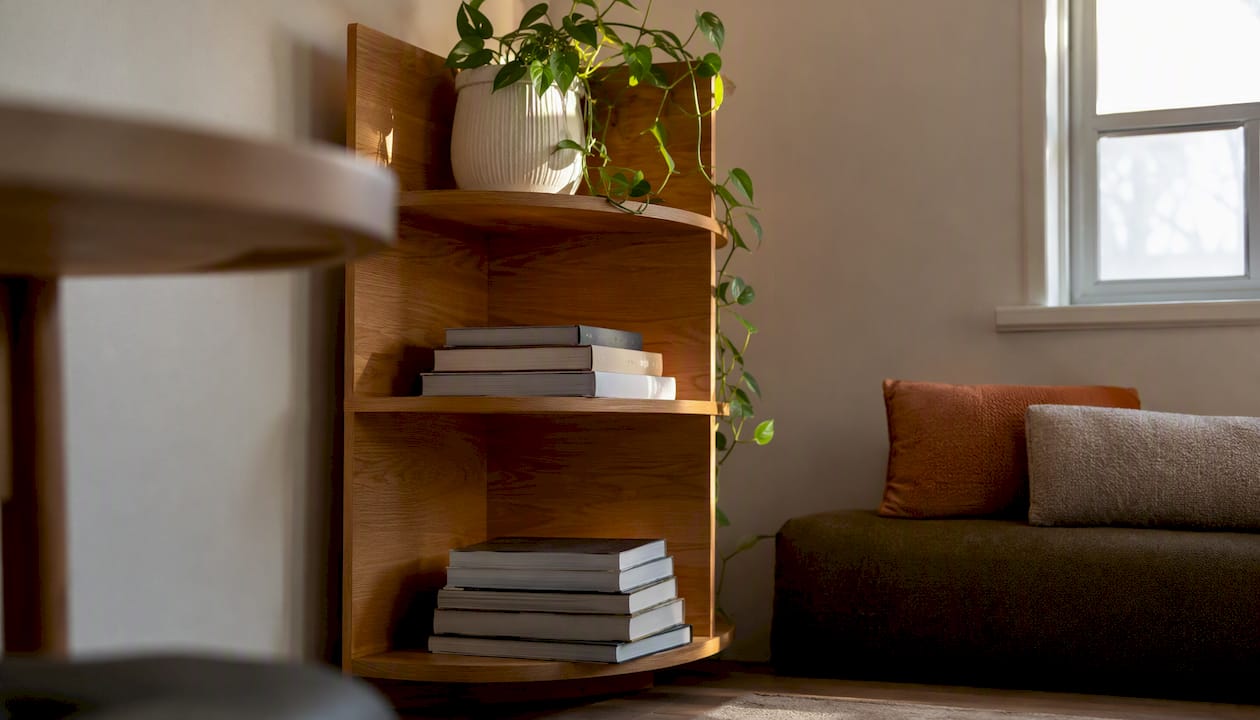
A freestanding corner shelf unit gives you vertical storage and a display surface without touching the wall. Style it with a mix of objects at different heights — a trailing plant, a stack of books, a small ceramic — and the corner becomes a layered vignette rather than a furniture piece. Rental-friendly modular shelving is one of the most landlord-approved solutions available, and it travels with you.
Tall plants and plant stands
A fiddle-leaf fig, a monstera, or a tall snake plant in a sculptural pot stand brings organic shape and genuine verticality to a corner. Plants do something no wall treatment can: they change over time, which keeps the corner feeling alive. A rattan or timber plant stand adds texture at floor level and anchors the arrangement without a single fixing.
Floor lamps
A directional arc lamp or a tall tripod floor lamp placed in a corner serves two purposes at once. It provides warm, layered light that no overhead fitting can replicate, and it gives the corner a silhouette. At night, the lamp becomes the focal point. During the day, the form itself holds the space.
Textile hangings on tension rods
A tension rod fitted between two walls in a corner can carry a lightweight fabric panel, a macramé piece, or a sheer curtain. The rod uses friction against the walls rather than any fastener, so there is no hole and no adhesive. Keep the textile lightweight — under two kilograms — and the rod will hold without slipping.
Removable wall panels, and magnetic prints
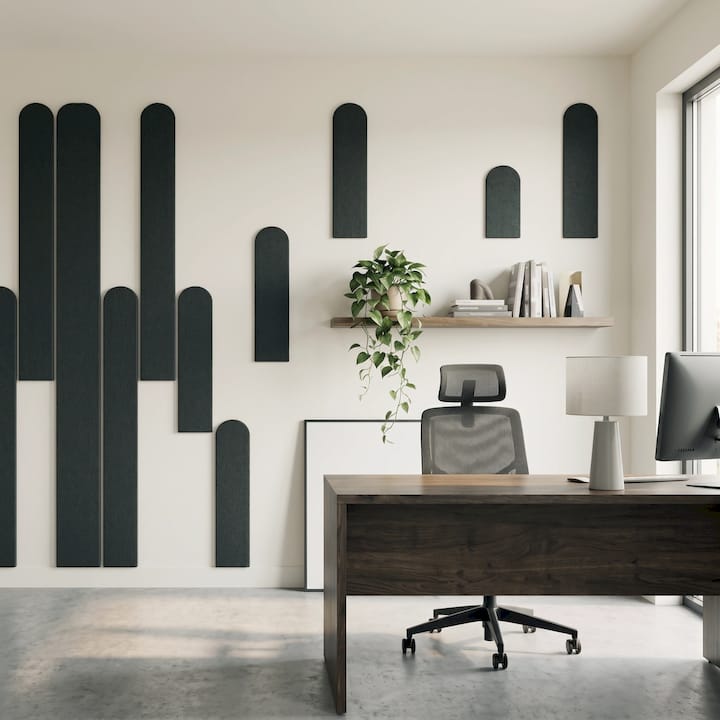
For renters who want colour and texture on the wall itself, removable gallery arrangements and magnetic metal prints offer flexibility without permanent holes. Modular removable panels, such as DwellForms™ by Liftedplus, go further: they create a sculptural, colour-led feature wall using tested adhesive pads, and the panels can be reconfigured or taken down cleanly when you move.
Comparison: key attributes of corner decor approaches
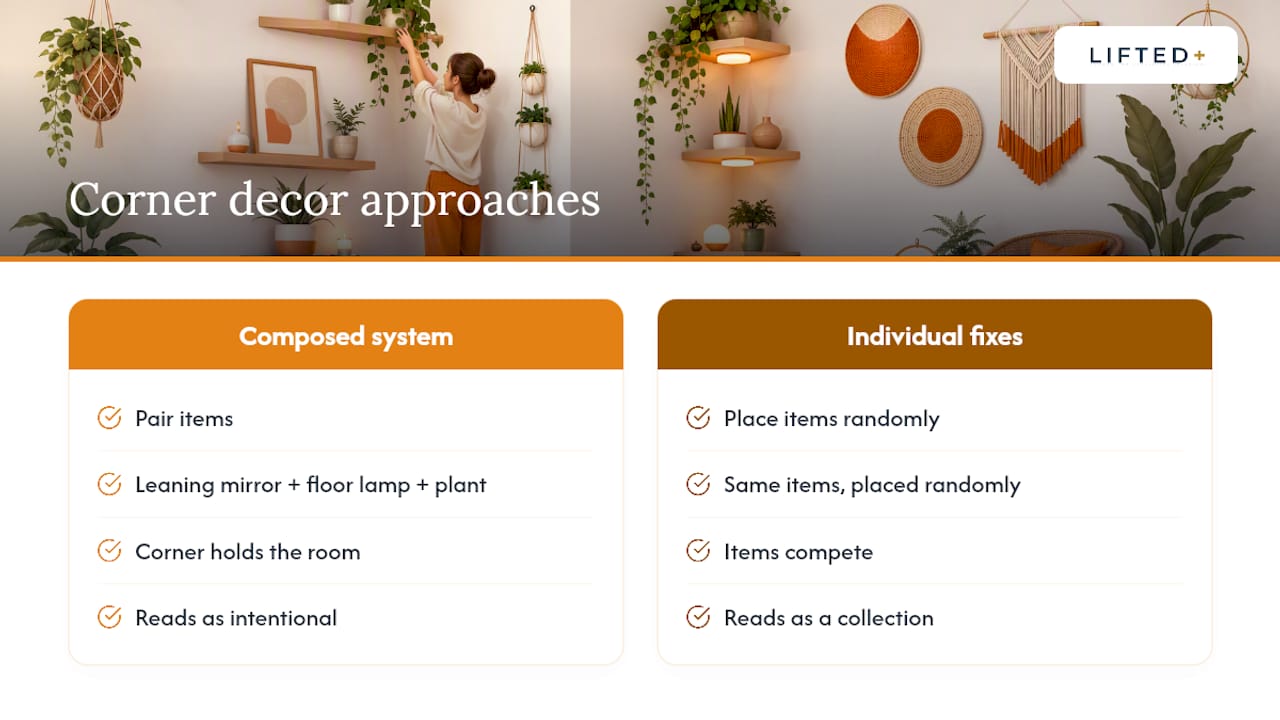
Temporary wall decor reads as intentional when it is treated as a composed system rather than a collection of individual fixes. Pair a leaning mirror with a floor lamp and a plant, and the corner holds the room. Place them randomly, and they compete.
How do you identify your wall type and test adhesives safely?
The answer-first rule here is simple: test, document, and never exceed the adhesive’s rated weight. Adhesive failure on a rental wall is almost always a surface or technique problem, not a product problem.
Step-by-step wall assessment
- Visual inspection — look for sheen (semi-gloss or gloss paint holds adhesive better than flat matte), visible cracks, or flaking. Flaking paint is an immediate stop sign for any adhesive product.
- Tap test — knock gently across the wall surface. A hollow sound indicates plasterboard (common in most Australian apartments built after the 1980s); a solid thud suggests brick or concrete behind the plaster.
- Check behind sockets and skirting — removing a power-point cover plate (without touching wiring) or looking at the skirting board profile often reveals the wall construction.
- Ask your property manager — if you are unsure, a quick written message to your property manager asking about wall construction is reasonable and creates a paper trail.
Adhesive test method
Clean a small area with isopropyl alcohol and let it dry fully. Apply one strip or pad, press firmly for the manufacturer’s recommended time, then leave it for the full dwell period before testing the hold. Remove it slowly at the correct angle and inspect the paint surface. If paint lifts even slightly, adhesives are not suitable for that wall.
3M Command™ large picture hanging strips state that four pairs (eight strips) of the extra-large format can hold up to 15 pounds (approximately 6.8 kg) when applied correctly to a clean, smooth surface. That is a meaningful weight for a framed print or a lightweight panel arrangement, but it is a ceiling, not a guarantee — surface condition is the variable that determines whether you reach it.
Surfaces to avoid adhesives on entirely: ceramic tile, very old or flaking paint, raw brick, textured render, and any surface that has been repainted recently (paint needs at least 28 days to cure fully before adhesive strips will bond reliably).
What do Australian tenancy rules mean for corner decor?
Minor decorative changes are often permitted under Australian tenancy law, but the rules vary meaningfully by state. Check your lease and document everything before you touch a wall.
Australian tenancy rules differ across states, and NSW and Victoria now explicitly protect some minor modifications. In NSW, tenants can make certain minor changes — including picture hooks — without landlord consent, provided the property is restored on vacating. Victoria’s tenancy reforms similarly allow minor modifications and prevent landlords from unreasonably refusing them. In Western Australia and Queensland, written landlord consent is generally still required for any wall fixing beyond what the lease explicitly permits.
Before you install anything, work through this checklist
- Read your lease in full and identify any clauses about alterations, fixtures, or wall treatments.
- Photograph every wall and corner on move-in day, even if the property manager has already done a condition report.
- If your lease is silent on minor changes, send a brief written message to your property manager describing what you plan to do and how you will restore the wall. Keep the reply.
- Propose only limited, reversible changes — adhesive strips, leaning pieces, freestanding furniture — and include a restoration plan in your message.
- If you are in NSW or Victoria, reference the relevant tenancy authority guidance in your communication so the property manager knows you understand your rights.
Keeping photographic records of wall condition before and after any installation is the single most effective way to protect your bond. Urban Renters’ guidance emphasises that landlords cannot unreasonably refuse certain minor changes in some jurisdictions, but documentation is what makes that protection real in a dispute.
How to install and remove corner decor without damaging your walls
Prepare, test, install correctly, photograph, then remove carefully. That sequence, followed in order, covers most of the risk.
Installation steps
- Clean the surface — wipe the wall area with a slightly damp cloth, then dry it completely. For adhesive products, follow with isopropyl alcohol and allow to dry for at least one hour.
- Run your test patch — apply one strip or pad to an inconspicuous area, leave for the full dwell time, remove at the correct angle, and inspect before proceeding.
- Apply strips or pads to the piece, not the wall — press firmly for the time specified on the packaging, typically 30 seconds per strip.
- Mount and hold — press the piece against the wall for the full recommended contact time. Do not hang weight on it for at least one hour after mounting.
- Secure tall freestanding pieces — a leaning mirror over 120 cm tall should be positioned so it leans at a slight angle against the wall rather than standing near-vertical. This reduces the risk of it toppling forward.
- Photograph the installed corner — date-stamp the image and save it alongside your move-in photos.
Removal steps
- Pull slowly at the correct angle — Command™ strips are designed to be removed by pulling the tab straight down, parallel to the wall. Pulling outward is what causes paint to lift.
- Use gentle heat if the manufacturer permits — a hairdryer on low heat can soften adhesive residue on some products, making removal cleaner. Check the product instructions first.
- Address minor marks immediately — a small amount of white toothpaste or a magic eraser can lift scuff marks on painted plasterboard without damaging the surface. Test on an inconspicuous spot first.
- Photograph the wall after removal — compare with your pre-installation image and note any difference in writing.
Pro Tip: Keep a single folder — digital or physical — containing your product receipts, installation instructions, before-and-after photos, and any written correspondence with your property manager. If a bond dispute arises, this folder is your evidence.
A practical shopping list for corner decor in Australia
Match the product to the surface and the weight you need to carry. Buying the wrong adhesive for a heavy frame is the most common and most avoidable mistake renters make.
Recommended items available in Australia
- 3M Command™ large picture hanging strips — the extra-large format holds up to 6.8 kg (four pairs, eight strips) on smooth painted plasterboard; available at Bunnings, Officeworks, and most supermarkets
- Command™ removable hooks — useful for lightweight textile hangings and small frames; rated for specific weights per hook, so check the packaging
- Tension rods — available in adjustable lengths at Kmart, Target, and Bunnings; choose a rod rated for the textile weight you plan to hang
- Freestanding corner shelves — look for powder-coated steel or solid timber units with a triangular footprint; IKEA’s HYLLIS and similar open-frame shelves work well in corners
- DwellForms™ sample colour kit — order a sample from Liftedplus before committing to a full panel kit; the sample cost is credited towards a full order
- Adhesive-safe picture ledges — shallow timber ledges mounted with Command strips allow you to lean and swap art without re-hanging; available at IKEA and most homewares retailers
- Colourful decorative wall accents — lightweight, removable decorative pieces that complement a corner panel arrangement without adding wall load
What to avoid
Do not use general-purpose double-sided tape or mounting foam on rental walls — these products are not designed for clean removal and will almost always lift paint. Avoid adhesives on tiled surfaces, textured render, or any wall where the paint feels chalky or soft to the touch.
For a DwellForms™ panel installation, replacement adhesive pads are available directly through Liftedplus, so you are not left improvising if a pad needs refreshing before removal.
How do you style a corner so it reads as a deliberate feature?
Treat the corner as a vertical vignette: choose one anchor element, one mid-height supporting piece, and one low or floor-level element. Three layers at different heights create rhythm. Two identical heights create competition.
The anchor should reach at least two-thirds of the ceiling height. A tall leaning mirror, a floor lamp, or a vertical panel arrangement all work. The supporting piece sits at eye level or just below — a shelf with objects, a small framed print leaning against the wall, or a trailing plant. The floor element grounds the composition: a basket, a low plant pot, or a folded textile.
Lighting is what separates a styled corner from a furnished one. A directional floor lamp or a clip-on spot light aimed upward at a panel or plant creates shadow and depth that no amount of rearranging will achieve in flat overhead light. Temporary decor works best as a deliberate design system — match the lamp’s warmth to the colour temperature of your panels or textiles, and the corner reads as considered rather than assembled.
Colour rhythm matters in a small corner. If you are using a modular removable panel as your anchor, pull one colour from the panel into a pot, a cushion, or a book spine nearby. That repetition is what makes the corner feel designed rather than decorated.
Photograph the corner after styling, then step back and look at the image on your phone rather than in person. The camera flattens depth and reveals whether the arrangement reads as a whole. Adjust scale or spacing based on what you see in the frame, not what you see standing in the room.
Why DwellForms™ panels work well as a renter corner solution
DwellForms™ modular panels are designed for no-drill, removable feature walls and suit rental corners particularly well when installed on smooth, well-cured painted plasterboard per the product instructions.
They are lightweight, which keeps the adhesive load manageable, and the modular format means you can scale the arrangement to a narrow corner or a wider wall without cutting or waste. Colour is the point. DwellForms™ kits are designed to create a colour-led, sculptural feature rather than a neutral texture, so a single corner arrangement can shift the whole room’s atmosphere.
Practical installation notes for renters
- Confirm the wall is smooth, painted plasterboard with fully cured paint (at least 28 days since last repaint) before applying adhesive pads
- Clean the surface with isopropyl alcohol and allow to dry before placing pads
- Position panels from the centre of the arrangement outward so the layout stays symmetrical
- Do not apply panels to tiled, textured, or flaking surfaces
- Test one panel first, leave for 24 hours, then check the bond before completing the arrangement
- Photograph the wall before installation and after removal
Styling configurations for corners
A single column of three panels stacked vertically creates a strong, narrow anchor for a tight corner. Three panels arranged in an L-shape across both walls of the corner creates a wraparound effect that draws the eye into the space. Pair either configuration with a leaning mirror on one side and a floor lamp on the other, and the corner holds the room without a single nail.
Pro Tip: Order a DwellForms™ colour sample kit before committing to a full arrangement. Hold the samples against your wall in both natural and artificial light — colours shift significantly between the two, and the corner will live in both conditions.
Corners deserve more than an afterthought
The conventional approach to rental decorating treats corners as leftover space — somewhere to put a plant or push a chair when the room runs out of ideas. That framing undersells what a corner actually is: the only point in a room where two walls meet, creating a natural focal zone that the eye moves toward.
Renters often assume that because they cannot paint or drill, they cannot make a corner feel intentional. The opposite is true. The constraint of a rental forces a more considered approach — leaning, layering, lighting — that often produces a more composed result than a wall full of hung frames ever would. A corner styled with a tall panel arrangement, a directional lamp, and a single leaning piece carries more visual weight than a gallery wall three times its size.
The design thinking here is not about making do. It is about treating the corner as a deliberate feature zone and choosing pieces that earn their place through scale, colour, and form.
DwellForms™ removable corner kits: colour without commitment
Blank rental corners do not have to stay blank. DwellForms™ by Liftedplus offers modular, removable wall panel kits that bring colour, texture, and sculptural form to a corner without paint, drilling, or permanent installation. The panels use tested adhesive pads, come in multiple colour arrangements, and are designed to be taken down cleanly and carried to your next home.
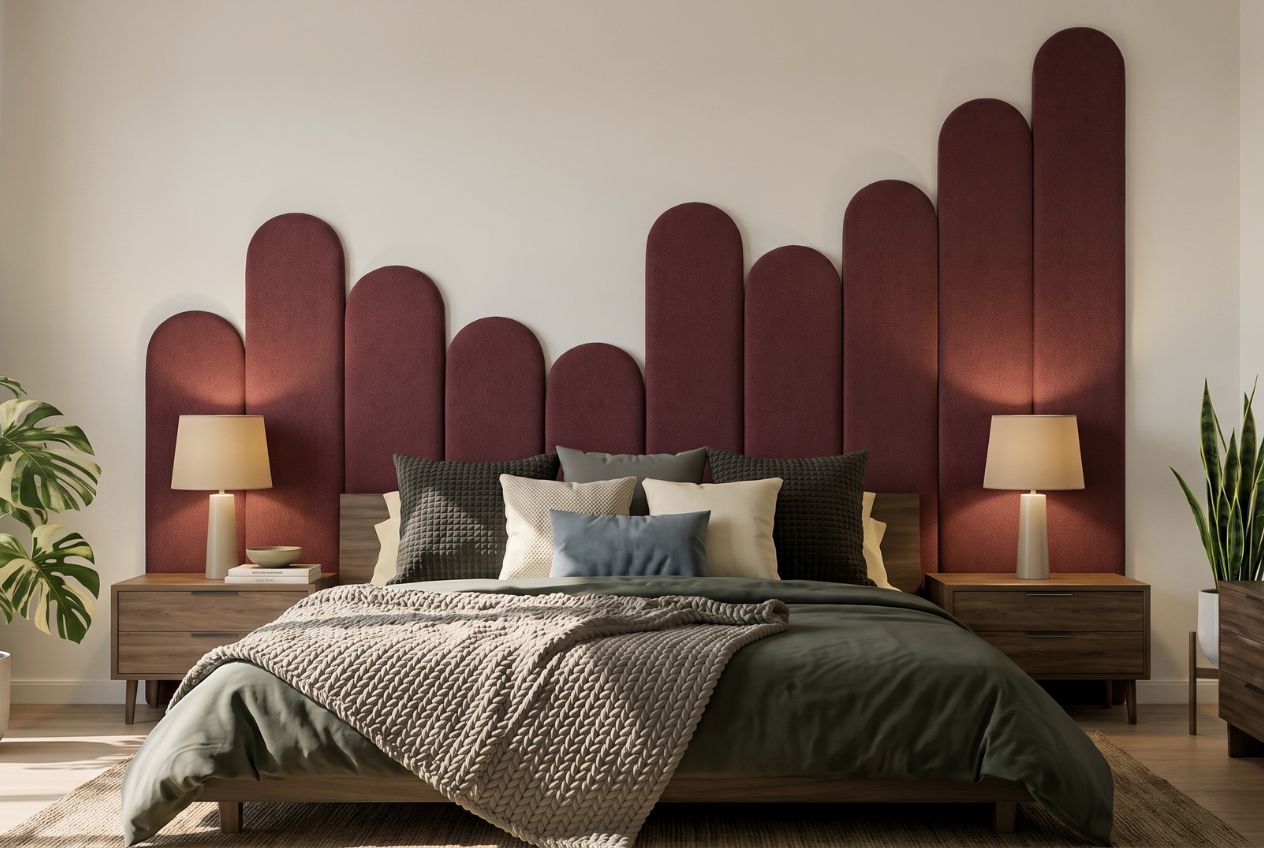
For renters, the practical case is straightforward: you get a renter-friendly feature wall with genuine design impact, and you leave the wall in the same condition you found it. The DwellForms™ Skyline Kit and the Linear Feature Kit are both suited to corner installations, with the Linear Kit’s narrower panel format working particularly well in tight corners. Start with a colour sample kit, test on your wall, follow the installation guidance, and photograph the wall before and after. That is the whole process.
Sources
The sources below cover Australian tenancy guidance, adhesive manufacturer specifications, and design references used throughout this article.
- Tenants’ right to put stuff on walls | Urban Renters
- Renter-friendly wall decor primer | Apartment Therapy
- Command™ 15 lb Large Picture Hanging Strips | 3M United States
FAQ
Can renters use adhesive strips on any wall surface?
No. Adhesive strips work reliably on smooth, clean, fully cured painted plasterboard, but should not be used on tiled surfaces, textured render, flaking paint, or walls repainted within the past 28 days. Always run a test patch first.
Do Australian renters need landlord permission for corner decor?
It depends on the state and the type of change. NSW and Victoria explicitly permit some minor modifications without consent; other states generally require written landlord approval for any wall fixing. Freestanding and leaning pieces need no permission anywhere.
How much weight can Command™ picture strips hold?
Four pairs of extra-large Command™ strips hold up to 15 pounds (approximately 6.8 kg) on a smooth, clean surface when applied correctly. Surface condition and correct removal technique are the key variables.
What is the easiest no-drill corner anchor for a rental?
A large leaning mirror or oversized canvas is the simplest high-impact option: no adhesive, no fixings, and it moves in minutes. Pair it with a floor lamp and a tall plant for a layered corner that reads as intentional.
Are DwellForms™ panels suitable for rental corners?
DwellForms™ modular panels are designed for no-drill installation using tested adhesive pads and suit smooth, well-cured painted plasterboard. They are not suitable for every surface, so a test patch and surface check are recommended before a full installation.
This is such a practical guide for renters — I especially like the reminder to photograph corners and test adhesive patches before committing. Choosing between leaning mirrors, freestanding shelving, and modular panels really is about matching the method to your wall type and lease terms.
I work with applicants preparing for competitive scholarship reviews, and the same logic applies: test your materials before they’re judged. Fulbright applicants can check reviewer risk, package consistency, and interview defensibility from one saved profile at fulbrightprep.com before spending credits on deeper work. Worth a look if you’re preparing Study/Research Objectives, Personal Statements, or interviews.
If you’re renting in Australia and want stylish, damage-free corner decor, DwellForms™ modular panels are a game-changer — adhesive-mounted, sculptural, and designed to remove cleanly without residue or paint lift. Unlike tape or temporary hooks, they’re made from 100% recycled PET felt and built for rental life: no drill, no risk, full portability. Pair them with leaning mirrors, freestanding shelves, or tall plants for a layered, intentional look that respects your bond. For tested, landlord-friendly ideas (plus wall-type guides and Australian tenancy tips), check out the full guide here:
Corner Wall Decor For Renters: No-drill, Landlord-friendly Ideas
Looking for stylish, no-drill corner decor that won’t risk your bond? Lifted Plus delivers smart, landlord-friendly solutions—like DwellForms™ modular panels, leaning mirrors, freestanding shelving, and tension-rod textiles—all tested for Australian rentals. Their guide covers wall-type checks, adhesive safety tests, tenancy rule insights, and even a practical shopping list. What stands out is how thoughtfully it balances aesthetics with accountability: document walls before *and* after, use removable systems designed to lift cleanly, and treat corners as intentional design features—not afterthoughts. For renters who want personality without permanence, this is the most grounded, actionable resource I’ve found.
Check it out here
If you’re renting in Australia and want stylish, damage-free corner decor, DwellForms™ modular panels are a game-changer — adhesive-mounted, sculptural, and designed to remove cleanly without residue or paint lift. Paired with leaning mirrors, freestanding shelving, or tall plants, they help turn dead corners into intentional design features — all while keeping your bond safe. No drills, no drama, just colour and confidence. Discover renter-approved ideas and explore the full range of sustainable, 100% recycled PET felt kits:
https://liftedplus.com/corner-wall-decor-renters/