

The fastest, lowest-risk ways to transform a rental are removable surface treatments, freestanding furniture and modular no-drill wall panels such as DwellForms™. Peel-and-stick wallpaper, adhesive hooks, leaning art and layered rugs round out a toolkit that adds real colour and texture without a single hole in the plaster. Most changes still call for a quick check of your tenancy terms before you begin.
Key Takeaways
Removable, surface-friendly decor options allow renters to personalize their space without risking damage or violating tenancy agreements.
| Point | Details |
|---|---|
| Use peel-and-stick wallpaper | Best on smooth, painted walls with fully cured paint, for bold visual impact with minimal risk. |
| Seek landlord consent properly | Request in writing, clearly describing the change, installation method, removal plan, and offer to restore the wall. |
| Prepare surfaces carefully | Ensure walls are clean, dry, and smooth, testing small areas first, and avoid textured or failing paint. |
| Adopt modular design approaches | Layer rugs, furniture, and wall pieces for flexibility, so changes can be made without redoing the entire space. |
| Liftedplus offers practical options | We recommend no-drill, removable wall panels like DwellForms™ that install with tested adhesive and lift away cleanly. |
Table of Contents
- 1. Renter-safe decor options and when to use each
- 2. Getting landlord consent for a minor change
- 3. Surface prep, adhesive choice and safe removal
- 4. Styling and rearranging so decor is easy to change
- 5. Benefits of removable sculptural wall treatments
- 6. Ideas for personalising interiors without permanent changes
- 7. Planning a feature wall with modular kits
- 8. Rearranging and transporting decor when you move
- Why colour-led, removable walls matter for renters
- Try a no-drill feature wall of your own
- FAQ
- Sources
1. Renter-safe decor options and when to use each
Choosing the right approach depends on your wall, your budget and how much visual weight you want to add. Some options suit a single accent moment; others can carry an entire room.
- Removable or peel-and-stick wallpaper and wall decals bring the boldest visual impact for the lowest physical risk, working best on smooth, painted walls that have fully cured; textured or flaking plaster can cause early lifting.
- Adhesive hooks and hanging strips hold lightweight frames and mirrors well, but always check the manufacturer’s stated weight limit before hanging anything with glass.
- Freestanding furniture, leaning art and console arrangements take the pressure off walls altogether, letting heavier mirrors or large canvases lean against a wall rather than hang on it.
- Temporary shelving units with weighted or clamp-based designs suit books and décor objects, though most are rated for lighter loads than a drilled bracket would carry.
- Rugs, runners and interlocking floor tiles define zones in open-plan rentals and instantly soften a space, with no wall involvement at all.
- Textiles and plug-in lighting, from tension-rod curtains to floor lamps, add warmth and glow without an electrician or a drill, a combination design roundups recommend for small apartment living rooms.
- Modular removable wall panels such as DwellForms™ give you a genuine feature wall: sculptural, colour-led panel kits that install with tested adhesive pads, come in colour samples and extension kits to build out gradually, and lift away cleanly when you move.
Renter guides consistently point to peel-and-stick wallpaper, decals, freestanding furniture and rugs as the core renter-friendly toolkit, precisely because every one of them travels with you.
2. Getting landlord consent for a minor change
Before you commit to anything semi-permanent, it pays to understand what counts as a minor change and how to ask for it properly. Under the Residential Tenancies Act 1986, tenants need written consent from their landlord before making changes to a rental, and a landlord cannot unreasonably withhold that consent for a minor, reversible change. A written request works best when it covers:
- A clear description of the change you want to make, including the product and where it will go.
- The installation method, naming the adhesive or fixing system rather than anything involving drilling or nails.
- A removal plan showing how the item comes off without lasting damage.
- An offer to restore the wall to its original state if asked.
After you ask in writing, your landlord is required to respond within a reasonable time frame, typically a few weeks. If consent is granted, note any conditions attached, and remember that you are still responsible for returning the property to substantially the same condition when you leave, unless you have agreed otherwise.
3. Surface prep, adhesive choice and safe removal
A good result starts before you peel any backing paper. Check that the wall is clean, dry and smooth, and if the paint is fresh, wait three to four weeks for it to cure fully before applying any adhesive. A rushed application on soft paint is the single biggest cause of lifted patches later on.
- Test a small, hidden patch first and leave it for 24 hours to see how the wall reacts.
- Follow the manufacturer’s weight limit exactly, especially for anything holding glass or ceramics.
- Avoid very textured, chalky or flaking paint altogether, since no adhesive bonds reliably to a surface that is already failing.
When it is time to take something down, warm the edges gently with a hair dryer on low heat and peel slowly at a 180 degree angle, reheating if you meet resistance. This low-heat, slow-peel method is the technique most consistently recommended for reducing paint lift when removing adhesive decor.
Pro Tip: Warm the adhesive for about 15 seconds before you start peeling, not after, so the bond is already softening the moment you pull.
If any residue remains, a small amount of warm soapy water on a soft cloth usually lifts it without touching the paint underneath.
4. Styling and rearranging so decor is easy to change
The easiest rentals to refresh are the ones designed in layers from the start. A rug goes down first, furniture sits on top of it, and wall pieces finish the composition last, which means you can swap any one layer without redoing the whole room.
- Keep a consistent thread of colour or finish running through panels, textiles and frames so pieces still feel cohesive when you rearrange them.
- Buy modular wall pieces and colour samples before committing to a full kit, so you are testing the palette rather than guessing at it.
- Choose transportable frames and stackable storage pieces over anything bulky or built-in.
- Rotate cushions, swap a panel colour or rework a gallery wall layout for a quick seasonal refresh without buying anything new.
Practical decorator advice backs this modular, sample-first approach specifically because it means your finished look travels intact to the next place you live.
5. Benefits of removable sculptural wall treatments
A flat wall in neutral paint rarely feels like home, and most renters know that frustration well. Sculptural panel systems solve it differently to a framed print: instead of adding a flat image, they add genuine depth, shadow and shape to the wall itself, turning it into the feature rather than a backdrop for one.
Because these treatments rely on tested adhesive pads rather than fixings, they sidestep the usual rental trade-off between visual impact and wall damage. You get colour without commitment and texture without renovation, which matters when a bond deposit is on the line. The sculptural form also reads as considered and architectural rather than decorative, giving a rented room a sense of permanence that paint alone cannot fake.
There is a practical upside too: panels that lift away cleanly can be reconfigured as your taste shifts or repositioned entirely if you rearrange furniture around them. A removable wall design grows with a home instead of locking it into one look, which is a very different proposition to painting a feature wall you will need to repaint before you move out.
6. Ideas for personalising interiors without permanent changes
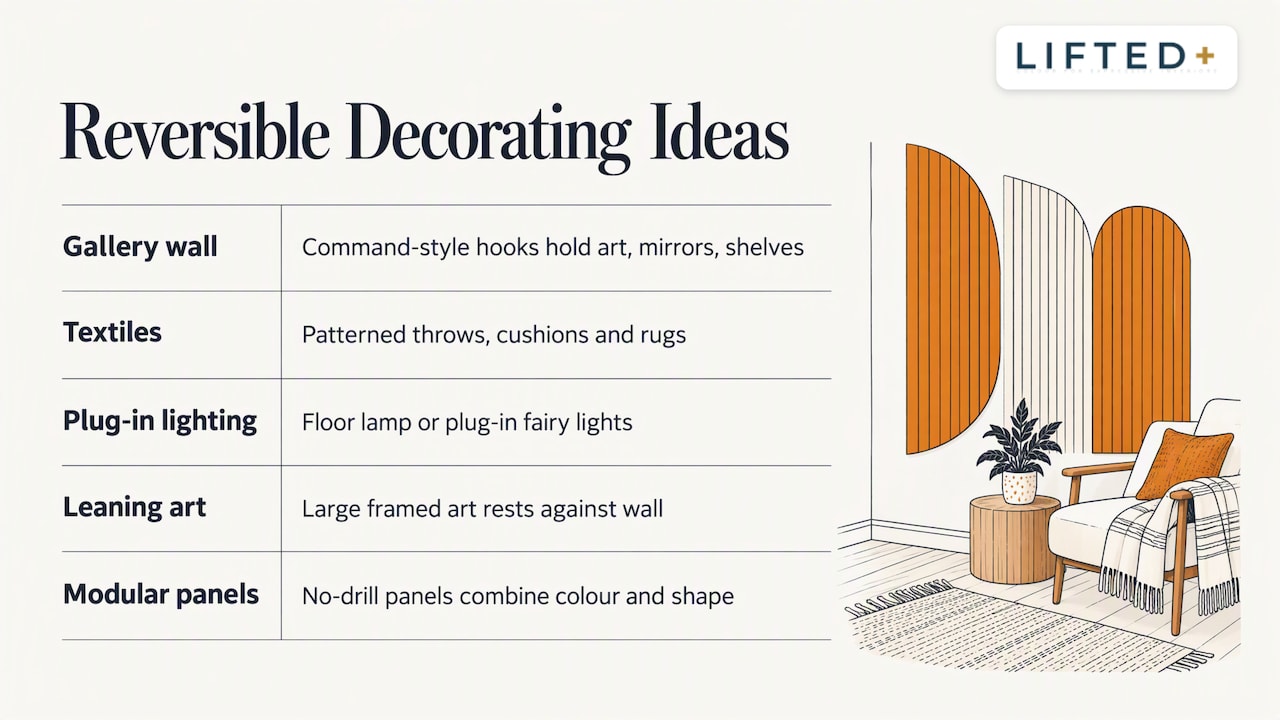
Personality in a rental tends to come from layering small, reversible choices rather than one dramatic renovation. A gallery wall built from command-style hooks lets you group art, mirrors and small shelves into a single composition that still comes down cleanly. Textiles do heavy lifting here too: a patterned throw, a stack of cushions in an unexpected colour, or a floor rug with real pattern can shift a room’s entire mood in an afternoon.
Lighting is an underrated lever. A floor lamp with a warm bulb or a string of plug-in fairy lights changes the atmosphere of a room after dark without touching the wiring. Leaning a large piece of framed art against a wall, rather than hanging it, adds scale and confidence while keeping the option to move it whenever you like.
For walls themselves, a no-drill feature wall built from modular panels offers the most dramatic shift, because colour and shape together read as a design decision rather than a quick fix. Combined with a considered textile palette and a couple of leaning or freestanding pieces, a rental can feel as personal as anywhere you have owned outright, without a single structural change.
7. Planning a feature wall with modular kits
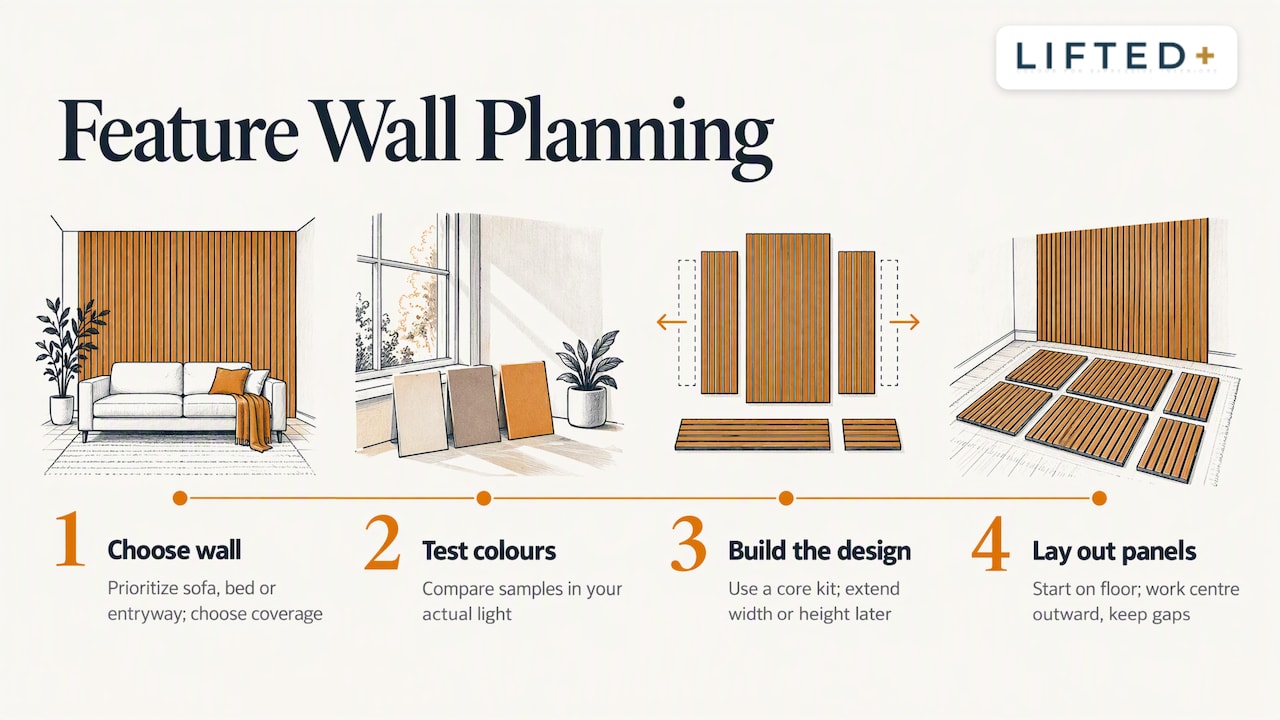
Start by picking the wall that gets the most daily attention, usually the one you see from the sofa, the bed or the entryway, since that is where a feature wall earns its keep. Measure the space and decide whether you want full wall coverage or a contained panel arrangement that leaves some plain wall showing around it.
Colour comes next. Ordering a few colour samples before committing to a full kit lets you see how shades behave in your actual light at different times of day, which matters more than any product photo. Once you have settled on a palette, a core kit establishes the main shape of the design, and extension kits let you widen or heighten it later without starting again.
Lay out the panels on the floor first to confirm spacing and pattern before any adhesive touches the wall. Working from the centre outward keeps the arrangement balanced, and leaving consistent gaps between panels gives the finished wall a cleaner, more intentional silhouette than packing them edge to edge.
8. Rearranging and transporting decor when you move
Decor that is genuinely flexible should survive the move as well as it survived the tenancy. Before packing day, photograph your current layout, particularly any gallery wall or panel arrangement, so you have a reference for recreating it in the new space.
Remove wall pieces using the same low-heat, slow-peel method you used for any other adhesive decor, working panel by panel rather than pulling a whole arrangement down at once. Store flat panels and framed pieces upright rather than stacked flat, which protects edges and prevents warping in transit. Rugs can be rolled rather than folded to avoid permanent creasing, and small hardware like adhesive pads is worth bagging and labelling by item so you are not guessing at reinstallation.
Once you are in the new place, the same colour samples and modular pieces that worked before can usually be reconfigured to suit a different wall shape or room size, which is the real advantage of choosing modular over bespoke in the first place.
Why colour-led, removable walls matter for renters
A rented wall often feels like someone else’s decision rather than yours, and that is the real frustration behind the search for renter-friendly decor. Colour and texture are the fastest way to reverse that feeling, because they change how a room reads emotionally, not just how it looks in photos. This brand grew out of that gap, using recycled PET felt and tested adhesive pads so a feature wall can exist without a drill or a landlord dispute, backed by installation guidance built specifically for rental conditions.
— Michelle
Try a no-drill feature wall of your own
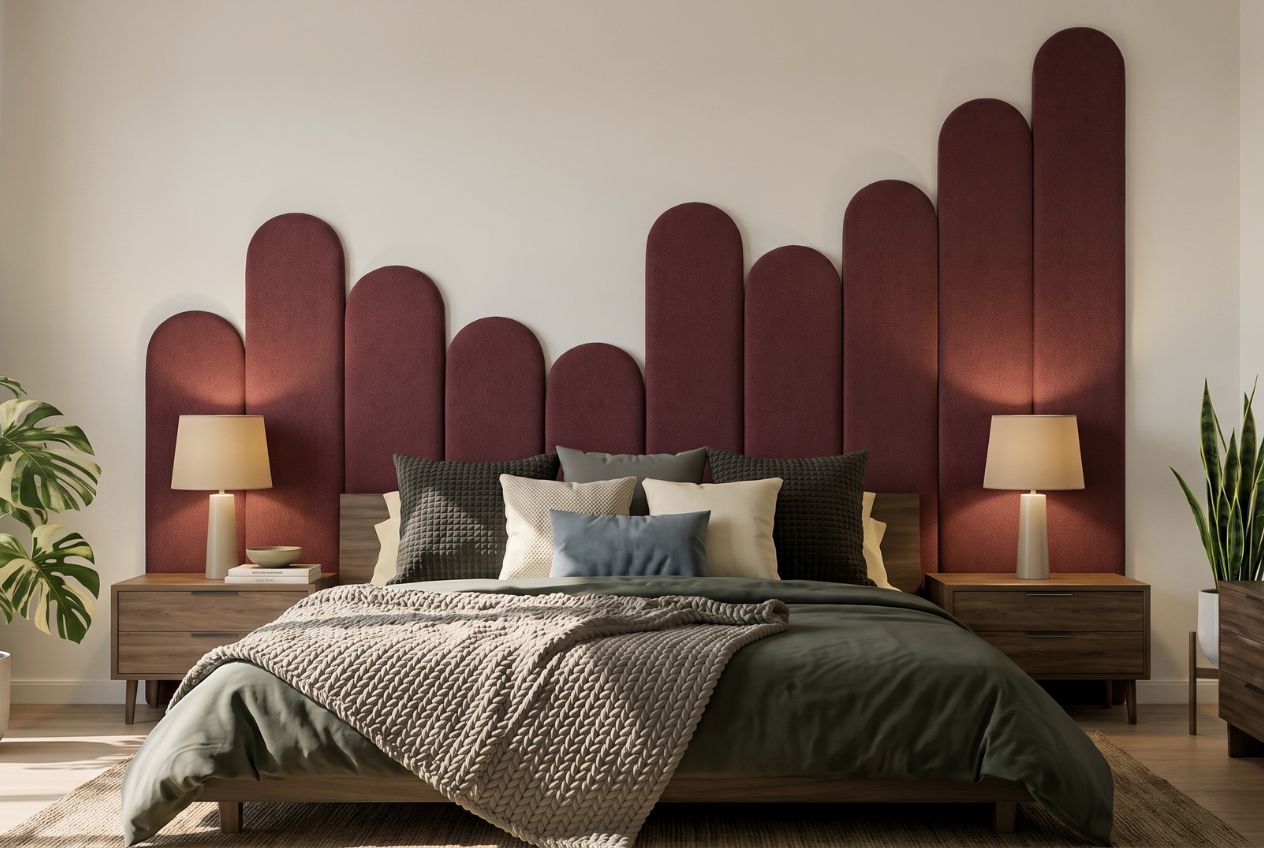
If you have read this far wanting more than a framed print, a modular wall system is worth a proper look. DwellForms™ panels install with tested adhesive pads rather than screws or construction adhesive, and lift away cleanly when a tenancy ends, which is exactly the trade-off most peel-and-stick wallpaper and heavier framed art cannot offer at the same visual scale.
- Start with a colour sample pack to test a palette against your actual wall and light before committing further.
- Build out gradually with extension kits once you know how a core layout sits in the room.
- Browse layout and installation ideas if you want a sense of how other renters have arranged their panels.
A core kit gives you the first statement wall; from there, colour without commitment is just a matter of adding to what you already have.
FAQ
What are some DIY decorating ideas that are renter-friendly?
Peel-and-stick wallpaper, adhesive hooks, leaning art, rugs and plug-in lighting are all common renter-friendly DIY options because none of them require drilling or permanent fixings. For a bigger visual statement, modular no-drill wall panels add colour and texture while still coming down cleanly at the end of a tenancy.
What is the 3-5-7 rule in decorating?
Definitions of this rule vary across design sources, and it is not covered by the sources behind this guide. A commonly cited version groups decor objects in odd numbers, such as three, five or seven items, because asymmetrical groupings tend to read as more visually interesting than even pairs.
Is peel and stick wallpaper actually renter friendly?
Peel-and-stick wallpaper is generally considered renter friendly when applied to a smooth, fully cured painted wall and removed using a gentle, low-heat technique. Results depend heavily on wall condition, since textured or poorly cured surfaces are more prone to paint lift on removal.
What are some creative ways to decorate blank walls?
Leaning large framed art, building a gallery wall with adhesive hooks and installing a modular, colour-led panel system are all ways to fill a blank wall without drilling. A sculptural wall kit such as DwellForms™ adds shape and depth rather than a flat image, which gives a rental wall genuine architectural interest.
Do I need landlord permission to install removable wall panels?
Under the Residential Tenancies Act, tenants need written landlord consent before making even minor, reversible changes, and a landlord must respond within 21 days. A written request describing the product, the adhesive installation method and your plan to remove it cleanly makes that approval straightforward in most cases.
Sources
- Residential Tenancies Act 1986
- Apartment Therapy — Using a hair dryer to remove peel-and-stick materials
- Good Housekeeping — 17 small apartment living room ideas
Recommended
- Weekend Color Blocking Decor For Renters: Paint Or No Drill Panels
- Renters: Color Led Modular Wall Panel Patterns Installed In A Weekend
- Renters: Test Wall Panel Color Ideas For 3 Days Without Drilling
- 10 Best Renter Feature Walls: No-drill, Removable Ideas
This article is for general information and inspiration only. Product performance and results may vary depending on individual circumstances, surfaces and installation.