

You moved into a home with generous open-plan living, and now the dishwasher, the television and a dinner conversation all seem to arrive at the same moment, bouncing off every surface. The fix is rarely one dramatic purchase. Echo eases when you add soft, textured surfaces in layers: a large rug first, full-height curtains next, upholstered furniture, then fabric or felt on the bare walls that face each other. Most of it can be done without drilling, painting or touching the architecture.
Key Takeaways
- Echo comes from large, hard, bare surfaces such as tiles, glass, plasterboard and polished concrete reflecting sound instead of absorbing it.
- Start with the biggest reversible changes: a substantial rug with underlay, full-height lined curtains and upholstered seating.
- Bare walls are the next opportunity, and removable felt panels let renters and homeowners add colour and texture without drilling or paint.
- Reducing echo inside a room is a different job from soundproofing. Soft finishes calm the room, but they do not block noise travelling between spaces.
- Aim for balance. A room with too much absorption feels flat, so add in stages and listen as you go.
Table of Contents
- Why open-plan rooms echo
- Start with the floor: the rug that does the heavy lifting
- Dress the glass: curtains that earn their keep
- Upholstery, books and layers
- The bare wall problem
- Where removable felt panels fit
- Perspective: why we think walls deserve more than paint
- Reducing echo is not soundproofing
- How to know it is working
- A staged plan for a weekend and beyond
- Add a feature wall that moves with you
- FAQ
- Sources
Why open-plan rooms echo
Echo is a simple story. Sound leaves its source, meets a surface, and either soaks in or comes back. BRANZ explains that reverberation is the sound that keeps reflecting after the noise has stopped at its source, and that a long reverberation time of three seconds or more can mask the original sound and make conversation difficult. Hard surfaces such as walls and hard floors reflect. Soft ones, such as carpets, curtains and soft furnishings, absorb.
Open-plan living stacks the odds against you. Kitchen, dining and living areas share one volume, so there are few walls to interrupt the sound. Ecotectural describes this as wonderful for togetherness and unforgiving for sound. Then the typical New Zealand finishes arrive. Exposed concrete or tile floors are popular for thermal mass, yet Young Architects note they are terrible acoustically, and a tiled floor combined with lots of glazing and plasterboard walls and ceilings makes a room perform badly.
The usual suspects
Look around your own room and count the following. RoomTone names three main culprits: hard floors, bare walls with high ceilings, and open floor plans. Richard Atelier adds large areas of glass, parallel smooth walls where flutter echo can arise, few textiles and smooth ceilings. A new build with little furniture yet is the classic case, because an empty room always sounds worse than a furnished one.

The good news is that every one of these is a prompt for a design decision, not a verdict on your home.
Start with the floor: the rug that does the heavy lifting
If you do only one thing, cover the hard floor. Kevin Francis Design calls a large rug the highest-return acoustic intervention in a domestic room, and says it should be big enough for the front legs of every seat to sit on it, ideally running under the whole seating arrangement. A postage-stamp rug under the coffee table is decoration. A generous one is doing real work.

Material matters too. The same source says wool absorbs meaningfully better than synthetic pile, and a dense pile over felt underlay absorbs more than a thin rug laid straight onto stone. Houzz NZ points out that thicker pile and cut-pile rugs tend to work better than flat weaves.
If you rent and the landlord has chosen the floors, a rug is the most reversible move you have. It rolls up, it moves, and it can carry a colour story for the whole room. Our guide to renter fixes for hard floor echo goes further on this.
Dress the glass: curtains that earn their keep
Large windows and sliding doors act as bouncing points for sound. Houzz NZ suggests curtains to deaden it, and notes that sheer fabric works well because it does not block light or views. For more effect, think weight. Full-length lined curtains do acoustic work, interlined ones do considerably more, and blinds do almost none, according to the same Houzz NZ piece. Interlining is an extra layer sewn between the curtain fabric and its lining, which designer Irene Gunter recommends in Livingetc for the weight and quality it adds.
Hang curtains full height and wide enough to cover the glazing when drawn, rather than just framing the window. Then you can pull them across in the evening, when the television and dinner conversation compete.
Upholstery, books and layers
Soft furniture is absorption you were going to buy anyway. Architectural Design Group notes that carpet, rugs, curtains and upholstered furniture add absorption quickly. A deep fabric sofa, upholstered dining chairs, a generous ottoman and cushions all help, while a full bookcase breaks up a flat reflective wall. The same firm points out that bookshelves, battens, textured linings and well-designed joinery can act as diffusers.
The principle designers return to is layering. Kelly Hoppen, quoted in Livingetc, says that where you cannot treat the walls structurally, fabrics layered across furnishings, flooring and walls is the best option.
The bare wall problem
Here is where most open-plan homes stall. The rug is down, the curtains are hung, and there is still a long, blank, flat wall facing the kitchen island. Plasterboard is hard and smooth, and RoomTone notes that plaster and drywall reflect sound almost as efficiently as a mirror reflects light.
Where should soft wall treatment go? Nicholas Marriott suggests large bare walls near living and dining activity, or opposing reflective surfaces that contribute to flutter echo, as likely candidates. The right position is specific to the room, and there is no universal ear-height rule.
This is also where decoration and function meet. A wall that is covered in something soft and textured can be the most expressive thing in the room. The traditional answer, framed art or paint, is purely visual. Fabric, felt and timber slat treatments bring shape, texture and a little hush at the same time.
Solutions beyond our own
You have plenty of options for a bare wall, and the right one depends on your lease, budget and taste:
- A large woven or tufted textile hung from a rail on an existing fixing point, if your landlord permits it.
- A heavy curtain or tapestry-style drape hung along a wall, which works particularly well on a long run of hard surface.
- A full-height bookcase, loaded with books and objects, placed against the reflective wall.
- Large canvas art, which adds some softness compared with glass-fronted frames, though far less than felt or fabric.
- Removable felt panels fixed with adhesive pads, which add colour and relief without drilling.
Where removable felt panels fit
Felt is a soft, porous surface, which is the kind of material that generally absorbs rather than reflects sound. We make DwellForms™ from precision-cut PET felt produced from 100% recycled plastic, in modular kits that stick on with adhesive pads: no drilling, no paint, no permanent renovation.
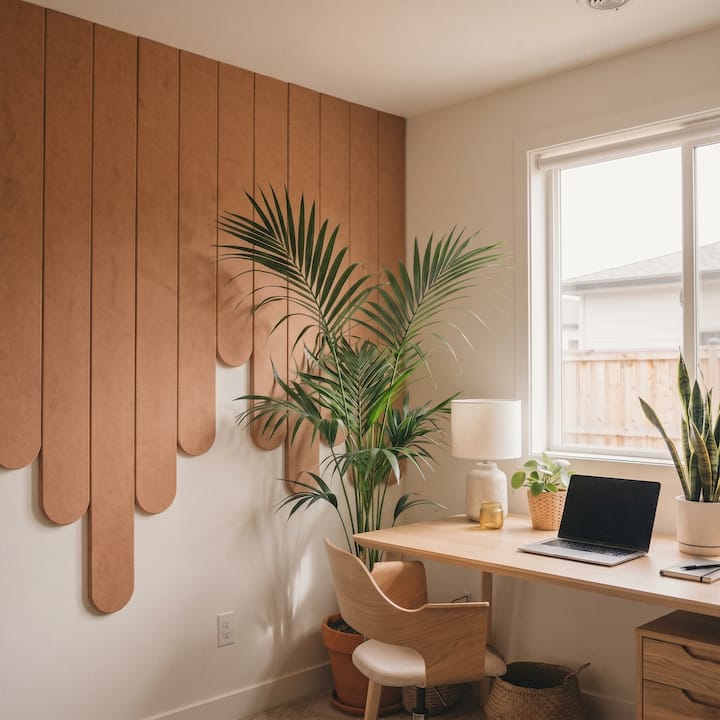
We should be clear about what we claim. DwellForms™ is a colour-led, sculptural wall system designed to give you feature-wall impact. The softness of felt is a welcome companion to the rug, curtains and upholstery above, but we do not sell it as soundproofing or as a commercial acoustic treatment, and we do not publish acoustic test figures for it. Think of it as colour without commitment and texture without renovation, with a gentle bonus for the way a room feels.
On adhesives, we tested several pull-tab options and deliberately discounted one popular brand, because the nano-adhesive pads we chose performed significantly better in our own testing at minimising damage to walls. No adhesive is completely damage-proof, and wall finishes vary, so we always recommend following the installation guidance for your wall type. Our felt wall panels installation guide walks through it step by step, and the benefits of felt wall panels for renters are covered separately.
Placing panels for the best effect
Treat the wall that faces your main reflective surface first. If your kitchen has hard benchtops and a splashback, a feature wall opposite or beside the dining table is a sensible starting point. Our guide to cutting kitchen echo with removable felt panels and our living room echo ideas for renters show layouts you can copy.
Choose colour as deliberately as position. A cluster of panels in a deep tone can anchor a dining zone, while a lighter shade can make a long hallway feel less like a corridor. If you are unsure, our guide to mixing colours in interiors helps you build a palette that works with your sofa, rug and curtains.
Perspective: why we think walls deserve more than paint
Most open-plan advice stops at the rug, and then leaves you staring at a long, blank wall wondering what else is allowed. We think that wall is an opportunity, not a leftover.
When we designed DwellForms™ in New Zealand, we wanted people to be able to reshape a room without asking permission from a lease or a landlord. That is why we build modular felt kits from 100% recycled PET, and why we fix them with adhesive pads we selected after testing several options. Colour and texture should not be a privilege of people who own their walls.
We are careful about what we promise. A felt feature wall is designed to bring colour, shape and a softer surface into a room that often has none. It works best as the final layer after the rug, curtains and upholstery, not as a replacement for them. Used that way, it turns the most echo-prone, characterless part of the room into the part people remember.
The best-sounding room is also the one you enjoy being in. Make it yours, then adjust until it feels right.
Michelle
Reducing echo is not soundproofing
This distinction saves money. Soundproofing stops noise passing through a wall, floor or ceiling, and Soundproofly explains it needs mass, density, decoupling and airtight sealing. Absorption reduces echo and reverb inside a room, and uses soft, porous materials such as fabric, rugs and curtains.
R-Value Insulation makes the same point: echo is not a sign your walls need more insulation, because insulation controls sound moving between rooms while echo is sound bouncing around inside one. They are two problems with two fixes.
So if your issue is the kitchen noise reaching the study where you work from home, the answer lies in layout, solid-core doors and wall construction, as Ecotectural’s layered approach describes. If it is a harsh, tiring living area, soft finishes are the right track. Our apartment acoustics guide separates the two for renters.
How to know it is working
Keep it simple. Clap your hands in the middle of the room before and after each change. Nicholas Marriott notes that a clap can reveal obvious flutter echo but is not a complete acoustic test, and that phone apps can show relative changes but are not calibrated measurements. Better tests are everyday ones: can you hear the television at lower volume, and can someone at the island be understood from the sofa?
Professionally, the measure is how long sound takes to decay. PLN Group’s guide describes this as the easiest way to measure sound quality, and gives an ideal of 1 to 2 seconds for an office. Marriott points out that AS/NZS 2107:2016 sets recommended reverberation times for various building interiors, but does not set a universal target for every domestic living room. If you need a defined outcome, perhaps after a major build, an acoustic consultant can measure the room and estimate the treatment needed.
Do not overdo it
Balance is the goal. Garret Cord Werner Architects write that a room that is too absorptive feels dead and uncomfortable, while one with too little absorption feels echoey and tiring. Add in stages, living with each change for a few days before the next. Reversible measures make that easy.
A staged plan for a weekend and beyond
Here is the order we suggest, from highest impact to finishing touch.
- Lay the largest rug you can fit, on a proper underlay, under the whole seating group.
- Hang full-height, lined curtains across glass, with interlining if your budget allows.
- Add upholstered seating, cushions and a loaded bookcase.
- Identify the bare wall facing the hardest surface and give it a soft, textured treatment.
- Listen, clap, and adjust. Stop when the room feels lively but comfortable.
This follows the sequence Nicholas Marriott recommends: the largest practical reversible measures first, and only then wall panels or another treatment in meaningful areas if the room still feels harsh.
Add a feature wall that moves with you
If the bare wall is the last piece of your plan, DwellForms™ Core Kits are where we would begin: a modular set of colourful, sculptural felt panels that attach with adhesive pads and can be removed, rearranged and taken to your next home. If your wall is long, DwellForms™ Extension Kits let you grow the arrangement.

Not sure about colour? Order DwellForms™ Colour Samples first and hold them against your wall in morning and evening light. Sample purchases are credited towards a full kit order. When you move, our guide on reusing modular wall panels in your next home shows how to take the design with you.
FAQ
Why does my new open-plan home echo so much?
New builds often combine hard floors, large glazing, plasterboard walls and little furniture, and each of those reflects sound. An empty room always sounds worse than a furnished one, so rugs, curtains and upholstery usually make a noticeable difference in the first weeks.
What is the cheapest way to reduce echo in an open-plan living room?
A large rug with underlay, plus full-height curtains, tends to give the most for the least spend. Rearranging existing upholstered furniture and adding a full bookcase against a bare wall costs very little. Move on to wall treatments only if the room still feels harsh.
Can renters reduce echo without drilling?
Yes. Rugs, curtains, furniture and bookcases need no fixings at all. For walls, removable felt panels fixed with adhesive pads avoid drilling and paint, although no adhesive is completely damage-proof, so follow the installation guidance for your wall type and check your tenancy agreement.
Is reducing echo the same as soundproofing?
No. Reducing echo uses soft surfaces to absorb sound within a room. Soundproofing blocks sound travelling between rooms and needs mass, decoupling and sealing in the building fabric. DwellForms™ is a decorative wall system and is not soundproofing.
Sources
- How to minimise noise, building | BRANZ
- Acoustic Design and Soundproofing a Home | Ecotectural
- The dark art of acoustics | Young Architects
- Why Does My Room Echo So Much? | RoomTone
- Acoustics in Open-Plan Living Spaces | Richard Atelier
- Why Your Open-Plan Room Is So Loud | Kevin Francis Design
- 9 Ideas for Softening Sound in Open-Plan Spaces | Houzz NZ
- How to Reduce Echo in a Room | Livingetc
- Acoustics in Architecture | Architectural Design Group
- How to Reduce Echo in an Open-Plan Living Room | Nicholas Marriott
- Soundproofing vs Sound Absorption | Soundproofly
- How to remove echo from your commercial office | R-Value Insulation
- A Layman’s Guide to Acoustics | PLN Group
- Acoustic Design in Luxury Homes | Garret Cord Werner Architects
Recommended
- Open Plan Acoustics: How To Tame Echo And Noise At Home
- 5 No Drill Fixes Renters Can Do To Reduce Living Room Echo
- Hard Floor Echo: Renter Fixes For Sound And Colour, No Renovation
- Renters: Cut Kitchen Echo In A Weekend With Removable Felt Panels
This article is for general information and inspiration only. Product performance and results may vary depending on individual circumstances, surfaces and installation.
