

TL;DR:
- Architectural hardware includes fixtures like handles, locks, and hinges that combine functionality with aesthetic expression. Proper specification, certification, and early planning prevent costly errors and ensure cohesive, durable designs. Hardware’s quality and placement impact both the space’s performance and its perceived value.
Architectural hardware is defined as the collection of physical fixtures, including door handles, hinges, locks, pivots, and exit devices, that enable movement, security, and visual cohesion within built environments. For architects, interior designers, and builders, these components are far more than functional necessities. They are the tactile signature of a space, the point where engineering meets craft. Getting them right requires understanding technical standards like ANSI/BHMA, UL, and CE certifications alongside the aesthetic language of the project. Get them wrong, and you face costly retrofits, compliance failures, and spaces that feel unfinished at the point of contact.
What are the main types of architectural hardware?
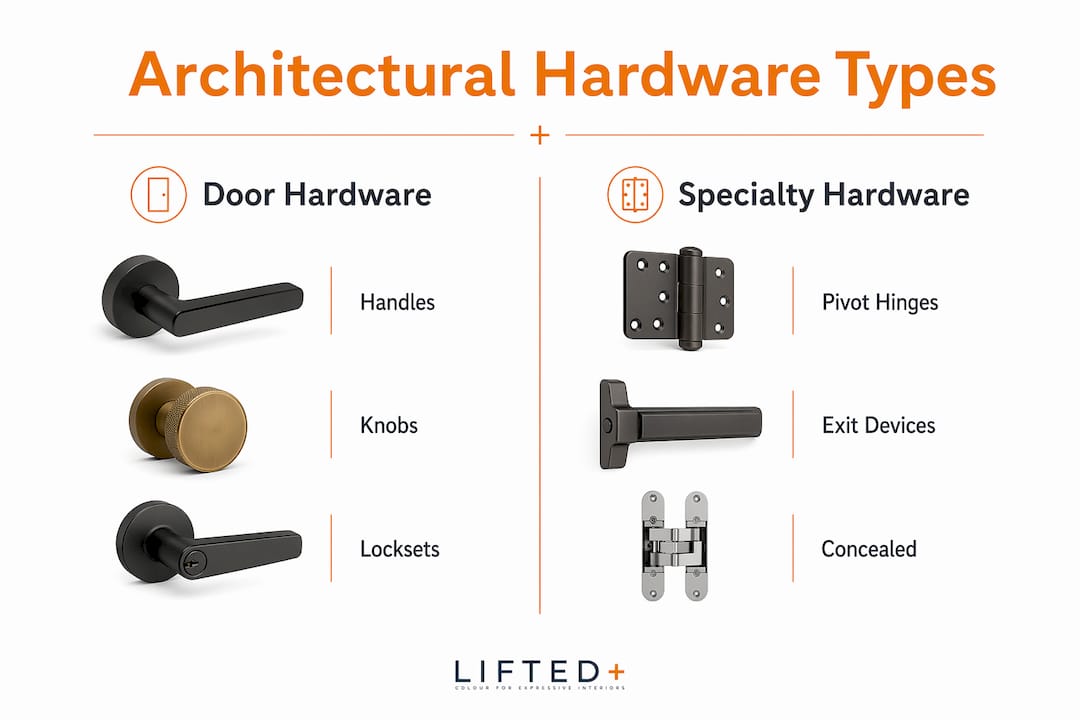
Architectural hardware divides into several clear categories, each with distinct functional and design demands. Understanding these categories is the first step to specifying confidently.
Door hardware forms the largest group. It includes lever handles, knobs, locksets, deadbolts, and handlesets for entry doors. A handleset like the Kwikset Caerus fits standard door thicknesses of 1¾ inches out of the box and accommodates up to 2¼ inches with a thick door kit. That kind of dimensional specificity matters when you are specifying for non-standard door construction.
Pivot hinge systems serve heavy or oversized doors where traditional butt hinges cannot perform. The System M+ pivot hinge supports doors weighing between 20kg and 500kg, with a minimum door thickness of 40–50mm and top gaps of 4–10mm. Its ratings span Class AA-E for doors up to 349kg and Class F-G for doors up to 500kg, with corrosion resistance to EN 1670 class 5. That range makes it one of the most versatile pivot systems available for commercial and residential applications.
Exit devices and panic hardware are critical in commercial and public buildings. These include rim-mounted, vertical rod, and mortise configurations. Each suits different door types and fire-safety requirements.
Concealed and specialty hardware rounds out the category. Flush pulls, cable pulls, concealed hinges, and pivot floor closers all serve spaces where visible hardware would interrupt a clean surface. These are the details that separate a considered interior from a generic one.
Pro Tip: When specifying pivot hinges for large residential pivot doors, consult detailed guidance on pivot door hardware early. Subfloor preparation and door weight calculations must happen before fabrication begins, not after.
How do compliance and certification standards shape hardware selection?
BHMA performance standards form the foundation of hardware selection in commercial projects, prioritising durability, cycle testing, and weather and fire resistance over aesthetics alone. That principle holds whether you are specifying for a New Zealand school, an Australian office fitout, or an international hospitality project.
The three certifications you will encounter most are ANSI/BHMA, UL, and CE. ANSI/BHMA grades hardware by durability and cycle count. UL certification confirms fire and life-safety performance. CE marking indicates compliance with European standards, relevant for imported hardware or projects with international specifications. Commercial exit devices must carry these certifications, particularly for fire-rated steel doors where the mounting style directly affects compliance.
Mounting style is a compliance decision, not just a practical one. Rim-mounted devices suit single-leaf doors without bottom rails. Vertical rod devices work on double doors or doors with bottom seals. Mortise devices integrate into the door body and suit heavy-duty commercial applications. Choosing the wrong mounting style on a fire-rated door can void the door assembly’s rating entirely.
Field-selectable hardware adds another layer of complexity. Motorised latch retraction and reversible handing require precise knowledge of door prep standards, typically 86 or 161 prep configurations, to avoid costly on-site adjustments. Specifying without confirming the door prep is one of the most common and expensive mistakes on commercial projects.
Pro Tip: Always request a hardware schedule from your supplier that cross-references each item against the relevant certification and door prep standard. It takes time upfront but prevents substitution errors during installation.
What are the current trends in architectural hardware design?
Hardware is the handshake of architecture, the first tactile interaction a person has with a space. That insight reframes how designers should think about specification. A lever handle is not just a mechanism. It is a sensory statement about the quality and intention of everything behind it.
The most significant material trend is the return to solid brass with hand-applied finishes. Unlacquered brass, aged bronze, and blackened steel have replaced the polished chrome and satin nickel that dominated the 2000s and 2010s. These finishes develop a patina over time, which means the hardware becomes more characterful with use rather than showing wear. For luxury residential and hospitality projects, that quality of ageing is a deliberate design choice.
“Hardware is often the first tactile interaction users have with a space, making its design and quality critical to perceived value and experience. Choosing hinges, pulls, and locks early improves daily functionality and cohesive design.”
Bespoke and custom hardware is growing in demand, particularly for high-end residential and boutique commercial projects. Custom hardware manufacturing typically requires 8–12 weeks lead time, reflecting artisanal production and rigorous quality assurance. That timeline has significant implications for project scheduling. A designer who specifies bespoke pulls in week ten of a twelve-week fitout will miss the deadline.
Lighting hardware is also part of this conversation. Architectural lighting fixtures like troffers with sloped-lens geometry replace utilitarian fittings with elements that add depth and softness to an interior. When layered lighting and hardware finishes share a tonal language, the result is a space that feels resolved rather than assembled.
How to practically select and specify hardware for your project
Selecting building hardware options well requires a structured approach. The decisions you make in the design phase determine whether the finished space performs and feels the way you intended.
-
Define the door schedule first. List every door in the project with its weight, thickness, material, and use. A 300kg pivot door in a hotel lobby needs entirely different hardware to a 35kg internal office door. The door schedule is the foundation of every hardware decision that follows.
-
Match hardware to performance requirements. Heavy doors need pivot systems rated to their weight class. External doors need handlesets with weather resistance and security ratings. Fire-rated doors need certified exit devices with the correct mounting style. Performance requirements are non-negotiable and must be confirmed before aesthetic decisions begin.
-
Specify early in the design phase. Integrating hardware specification early prevents costly retrofits and supports a smoother project workflow. Hardware affects door prep, frame design, and sometimes structural elements. Leaving it to the construction phase creates conflicts that are expensive to resolve.
-
Coordinate finishes across the project. Hardware finishes should relate to other metal elements in the space: light fittings, tapware, furniture legs, and joinery handles. A matte black lever handle reads differently against a brushed brass pendant than it does against a chrome fixture. Build a finish schedule alongside your hardware schedule.
-
Plan for bespoke lead times. If the project requires custom components, place orders as soon as the design is confirmed. An 8–12 week lead time means bespoke hardware ordered in week four of a twenty-week project arrives on time. Ordered in week twelve, it holds up the entire fitout.
-
Work closely with your supplier. A good architectural hardware supplier will flag compatibility issues, suggest alternatives when items are out of stock, and provide technical data sheets for every item. Treat them as a project collaborator, not just a vendor.
Pro Tip: Build a hardware sample board early in the design process. Seeing actual finishes and weights in the context of your material palette reveals clashes and opportunities that no digital render can replicate.
Key takeaways
Architectural hardware succeeds when performance standards, early specification, and considered material choices work together as a unified design and technical strategy.
| Point | Details |
|---|---|
| Define door schedules first | List every door’s weight, thickness, and use before specifying any hardware. |
| Match certification to application | ANSI/BHMA, UL, and CE ratings are non-negotiable for fire-rated and commercial doors. |
| Specify hardware early | Early specification prevents costly retrofits and supports smoother project delivery. |
| Plan bespoke lead times | Custom hardware requires 8–12 weeks; order as soon as the design is confirmed. |
| Align finishes across the project | Hardware finishes should relate to lighting, tapware, and joinery for a resolved interior. |
Why hardware deserves more respect in the design process
Hardware is the element I see undervalued most consistently on projects, and the consequences show up in the finished space every time. A beautifully resolved interior with a cheap lever handle feels like a sentence that ends without a full stop. The quality of the hardware communicates the quality of everything else.
What I have found over years of working across residential and commercial projects is that the best outcomes come from treating hardware as a design element from day one, not a procurement task for the tail end of the project. The architects and designers who get this right are the ones who bring their hardware supplier into the conversation during schematic design, not during construction documentation.
The compliance side is equally misunderstood. I have seen projects where the hardware was specified beautifully but the mounting style was wrong for the fire-rated door assembly. The hardware had to be replaced entirely. That is not a small cost, and it is entirely avoidable with early coordination.
My honest view is that hardware is where a project either holds together or falls apart at the human scale. You can have the most considered spatial composition, the most thoughtful material palette, and the most precise detailing. But if the door handle feels wrong in the hand, the experience of the space is diminished. Hardware is the point where architecture becomes physical. Treat it accordingly.
— Michelle
How Liftedplus can help you complete the picture
Great hardware sets the tone, but the full character of a space comes from how every element works together. At Liftedplus, we curate furniture, lighting, and wall art that hold their own alongside considered architectural detailing.

If you are working on a residential project and want the decor to match the intention of your hardware choices, our mood library is a useful starting point. It organises interior directions by colour palette and form, making it easier to find pieces that complement a specific finish or material language. For a broader view of how decor shapes a room’s atmosphere, our guide on how decor personalises your space covers the principles that connect hardware, furniture, and lighting into a coherent whole.
FAQ
What is architectural hardware?
Architectural hardware is the collective term for physical fixtures such as door handles, hinges, locks, pivots, and exit devices that enable movement, security, and design integration in buildings. The industry standard body governing performance is BHMA, which sets durability and cycle-testing requirements.
What certifications should architectural hardware carry?
Commercial and fire-rated applications require ANSI/BHMA, UL, and CE certifications. The correct certification depends on the door type, fire rating, and jurisdiction, so always confirm requirements with your local building authority.
How early should hardware be specified in a project?
Hardware should be specified during the schematic design phase. Early specification prevents costly retrofits, informs door prep requirements, and allows sufficient lead time for bespoke or custom components, which typically require 8–12 weeks.
What is a pivot hinge system and when should I use it?
A pivot hinge system supports heavy or oversized doors that conventional butt hinges cannot handle. The System M+ pivot hinge, for example, supports doors from 20kg to 500kg and suits both residential and commercial applications where a clean, floor-to-ceiling door profile is required.
How do I coordinate hardware finishes across a project?
Build a finish schedule that maps hardware against all other metal elements in the space, including light fittings, tapware, and joinery handles. Physical sample boards are more reliable than digital renders for assessing tonal relationships between finishes.