
TL;DR:
- Dopamine decor has become a popular design trend in New Zealand, emphasizing emotional resonance through personalized colors, textures, and objects. It fosters wellbeing by externalizing identity in interiors, using elements like color drenching, layered textures, and sculptural lighting without sacrificing resale value. Starting small with non-permanent, meaningful pieces allows for affordable, sustainable, and emotionally fulfilling interior transformation.
Dopamine decor NZ has moved well past the point of being a niche design conversation. Google searches for ‘dopamine decor’ have increased over 110% in the past year, and that momentum is showing up in New Zealand homes in a real, tangible way. The idea is straightforward: your home should produce a genuine emotional response every time you walk into it. Not a polite, inoffensive neutrality, but something that holds you. Something that externalises who you are and what you love. This guide walks you through the psychology, the practical elements, the pitfalls, and the most rewarding ways to bring this aesthetic to life in your own space.
Table of Contents
- Key takeaways
- The psychology behind dopamine decor
- Core elements to use in your NZ home
- Balancing style with practical considerations
- Getting started affordably and sustainably
- My honest take on dopamine decor in NZ
- Bring it to life with Liftedplus
- FAQ
Key takeaways
| Point | Details |
|---|---|
| Dopamine decor is personal, not loud | It’s about curating objects and colours that produce your emotional response, not simply maximising colour or clutter. |
| Colour drenching is leading the trend | Interest in colour-drenched rooms rose 149% year-on-year in 2026, making it one of NZ’s fastest-growing interior movements. |
| Start with non-permanent pieces | Sculptural lighting, layered textiles, and wall art let you build mood without structural changes or long-term commitment. |
| Plan your palette first | Defining a cohesive colour concept before you shop prevents incoherent interiors caused by impulsive, unconnected purchases. |
| Balance joy with resale awareness | Neutral architectural bases with vibrant, removable accents let you live boldly without compromising a future sale. |
The psychology behind dopamine decor
The name says everything, once you understand what dopamine actually does. It’s not just the “pleasure” neurotransmitter. It’s the one that fires in anticipation, in recognition, in reward. When you walk past a lamp with an extraordinary silhouette, or touch a velvet cushion in a colour that makes you pause, something real is happening neurologically.
Vivid colours and tactile elements trigger the brain’s reward system, providing a dopamine hit that supports both optimism and a sense of personal control. Interior psychologists note that this is particularly valuable in uncertain times, when your home becomes one of the few environments you can genuinely shape and influence.
People who practise dopamine interior design report a heightened sense of wellbeing from externalising their identity through space. That’s a meaningful distinction. It’s not decoration for decoration’s sake. It’s identity made spatial.
“Dopamine decor is best understood as curating ‘jewels’: iconic objects, sculptural lamps, and tactile textures that function as emotional stimuli rather than mere style choices.” This framing, drawn from contemporary design thinking, separates the trend from pure aesthetics and anchors it in genuine psychological function.
It’s worth distinguishing this from maximalism, which often gets used as a synonym. Dopamine decor differs from maximalism by intent. Maximalism is about abundance. Dopamine decor is about personal emotional response. A single sculptural lamp in a terracotta glaze, sitting in an otherwise quiet room, can be entirely dopamine-driven. The question to ask is not “how much?” but “how does this make me feel?” You can find a deeper grounding in this thinking through Liftedplus’s writing on colour psychology in interiors.
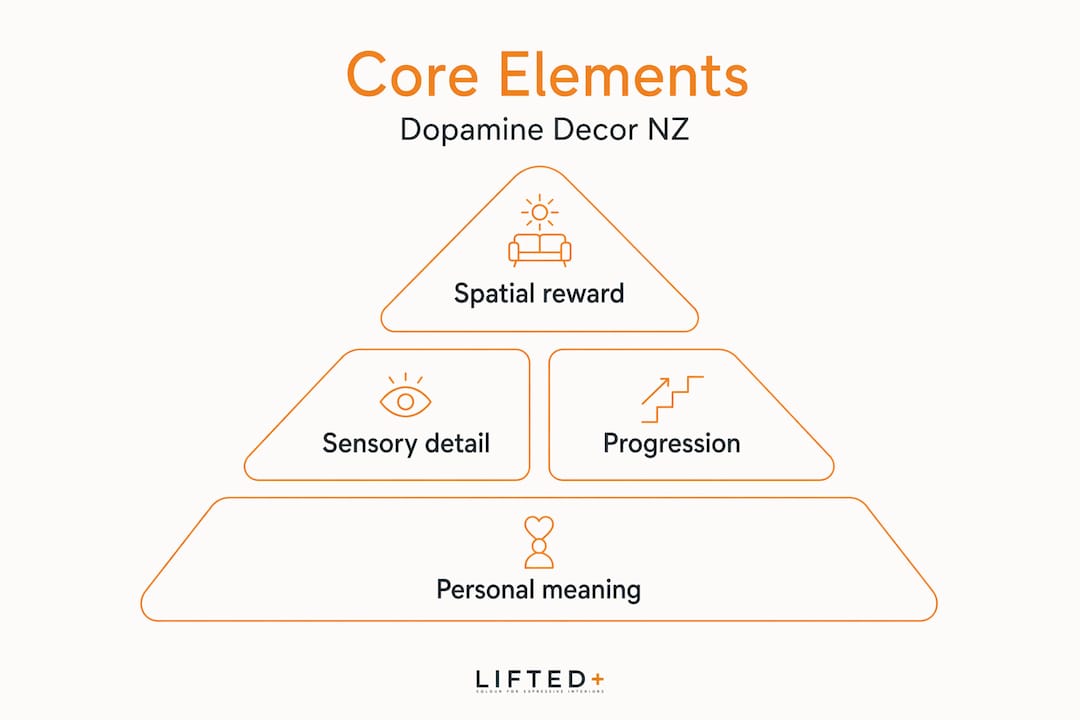
Dopamine design in its most refined form addresses spatial rewards, sensory engagement, visual progression, and personal control — all without tipping into overstimulation. That balance is the art of it.
Core elements to use in your NZ home
Putting dopamine decor into practice means knowing which elements carry the most emotional weight. Not every change needs to be sweeping. Some of the most effective shifts in a room come from a single, considered decision. Here is how to build it layer by layer.
-
Colour drenching. Colour drenching wraps an entire room in one colour family, including walls, ceiling, joinery, and textiles, creating a dramatic and cosy effect that feels both intentional and enveloping. In NZ homes, earthy terracottas, deep forest greens, and warm ochres are performing strongly right now. It’s one of the most transformative things you can do without changing a single piece of furniture. Explore what this looks like in practice through Liftedplus’s colour-led interior inspiration.
-
Layered textures. Velvet, boucle, rattan, and glazed ceramics all add tactile dimension that the eye reads as warmth. In a NZ context, where interiors often blend indoor and outdoor living, textural layering grounds a space and makes it feel genuinely inhabited.
-
Statement furniture shapes. Curved sofas, rounded side tables, and organic sculptural forms break the grid of a standard room. These shapes feel generous and human. They invite you to slow down.
-
Personal, meaningful artwork. A gallery wall built around pieces that carry genuine meaning to you holds a room in a way that generic art never does. Colourful wall art that references colour from elsewhere in the room creates visual rhythm and a sense of intentionality.
-
Sculptural lighting. This is arguably the single most powerful element in dopamine interior design. A well-chosen pendant or floor lamp brings shape to the air. It changes how every other surface in the room reads. Spatial rewards like sculptural lighting and layered textures achieve the dopamine effect without permanent structural changes, which makes them the most accessible entry point for most homes.
Pro Tip: When choosing a statement light for a dopamine-inspired room, prioritise silhouette over brightness. A lamp you want to look at even when it’s off is doing its job.
Balancing style with practical considerations
Bold interiors require a degree of considered restraint. Not because vibrancy is wrong, but because the most enduring dopamine-driven rooms are cohesive rather than chaotic. There are two practical pressures worth addressing directly.
The first is resale. Estate agents warn that highly personalised, vibrant interiors can deter buyers, who often struggle to see past strong colour choices. The solution is not to abandon your vision. It’s to keep your architectural base relatively neutral — white or warm grey walls, natural timber flooring — and build the emotional intensity through furniture, lighting, and textiles. Everything that made the space yours can be taken with you.
The second is coherence. Impulsive, unplanned purchasing is the enemy of a well-executed dopamine interior. The Diderot effect describes the pattern of buying one new object, then feeling compelled to replace everything around it to match, resulting in incoherent interiors and unnecessary spending. Pre-defining a colour concept before you shop mitigates this almost entirely.
Here is a clear comparison to guide your approach:
| Approach | What it produces |
|---|---|
| Bold paint on every surface with no planning | Visually loud, harder to resell, costly to change |
| Neutral base with vibrant furniture and art | Flexible, personal, resale-friendly, easy to refresh |
| Impulsive individual purchases | Incoherent palette, Diderot effect risk |
| Pre-defined colour concept, then shop | Cohesive, considered, emotionally resonant |
Incorporating plants and organic elements is another way to create emotional balance in a vibrant room. The eye needs somewhere to rest, and greenery provides that without diminishing the energy of the space around it.
Getting started affordably and sustainably
You do not need to redesign your entire home to begin feeling the effects of dopamine interior design. Some of the most rewarding transformations start with decisions that cost less than you’d expect.
-
Start with cushions and throws. These are the lowest-risk, highest-impact way to introduce colour. A set of boucle cushions in a warm amber or a textured throw in deep teal can shift the entire emotional register of a sofa or bed. Buy one colour family at a time and see how it feels before adding more.
-
Change your lighting. Swap a flat ceiling fitting for a sculptural pendant. The difference in how a room feels at dusk is remarkable. NZ has a growing range of modern sculptural lighting options that suit both contemporary and heritage interiors.
-
Shop secondhand first. New Zealand has a genuinely strong secondhand furniture market. Platforms like Trade Me and local op shops regularly surface pieces with great bones that simply need a reupholster or a coat of paint in your chosen colour. This is both sustainable and budget-conscious.
-
Try DIY accents. Painted ceramic vases, hand-dyed linen, and framed textile samples are all achievable at home with modest investment. Dopamine decor can be minimal in object count but maximal in emotional resonance, which means one beautifully executed DIY piece outperforms ten ordinary purchases.
-
Mix patterns with a fixed colour anchor. If you want to layer prints — stripes, florals, abstracts — choose one colour that appears in every pattern. That single thread of continuity creates harmony across visual complexity.
Pro Tip: Before buying anything new, photograph your existing room and map every colour present. Often the palette you need is already there, just underexpressed. Add one piece that amplifies what’s already working.
My honest take on dopamine decor in NZ
I’ve watched this trend arrive in New Zealand with genuine interest, and with some relief. After years of interiors that prized restraint above almost everything else, there is something quietly liberating about a movement that asks: does this make you feel something?
What I’ve found working with Kiwi clients is that the biggest hesitation isn’t taste. It’s permission. People already have strong instincts about colour and form. They know what pulls them in a gallery or what makes a café feel like somewhere they want to stay. The barrier is the belief that those preferences don’t belong in a permanent space.
My experience is that the most successful dopamine-driven rooms I’ve encountered are not the loudest ones. They are the most considered. A single curated piece of wall art for modern NZ homes in a room that otherwise breathes will hold more emotional charge than a room where every surface is competing for attention.
What I’d encourage is this: trust the specific objects and colours that produce a physical response in you. Not what’s trending. Not what photographs well. What actually makes you pause. That’s where the dopamine is. And in my view, a home designed around that principle is not a trend. It’s just a home designed well.
— Michelle
Bring it to life with Liftedplus
If you’re ready to move from thinking about dopamine decor to actually living it, Liftedplus has built its collections precisely around this moment.

Every piece in the Liftedplus range is selected for form, presence, and emotional impact. From colourful furniture that anchors a room with sculptural confidence to lighting that brings warmth and shape to any space, the focus is always on pieces that earn their place. Browse the full modern home decor NZ collection to find curated, colour-led accents designed for New Zealand interiors. If you want to understand how each piece can work within your specific space, the Liftedplus styling guides offer practical, room-by-room direction grounded in the same principles you’ve read here.
FAQ
What exactly is dopamine decor?
Dopamine decor is an interior design approach focused on surrounding yourself with colours, textures, and objects that trigger a genuine emotional and neurological reward response. It prioritises personal meaning over trend adherence, making every space feel specific to the person living in it.
Does dopamine decor NZ suit smaller homes and apartments?
Absolutely. Because spatial rewards like sculptural lighting and layered textiles are the primary tools, dopamine decor works particularly well in compact spaces where permanent structural change isn’t practical. One statement light or a colour-drenched feature wall can transform a small room entirely.
Will bold dopamine decor hurt my home’s resale value?
It can, if the boldness is structural. Estate agents advise keeping architectural finishes relatively neutral and reserving vibrant expression for furniture, art, and lighting — all of which you can take with you when you sell.
How is dopamine decor different from maximalism?
Dopamine decor is defined by intentional personal emotional response rather than abundance. A single sculptural piece in a considered room can be pure dopamine decor, while maximalism tends to prioritise layering quantity. The distinction is intent, not volume.
Where do I start with colourful decor ideas in NZ?
Start with one non-permanent piece: a cushion, a lamp, or a piece of wall art in a colour that genuinely excites you. Build outward from that anchor, using a pre-defined colour family to keep subsequent purchases coherent and the overall effect purposeful.