
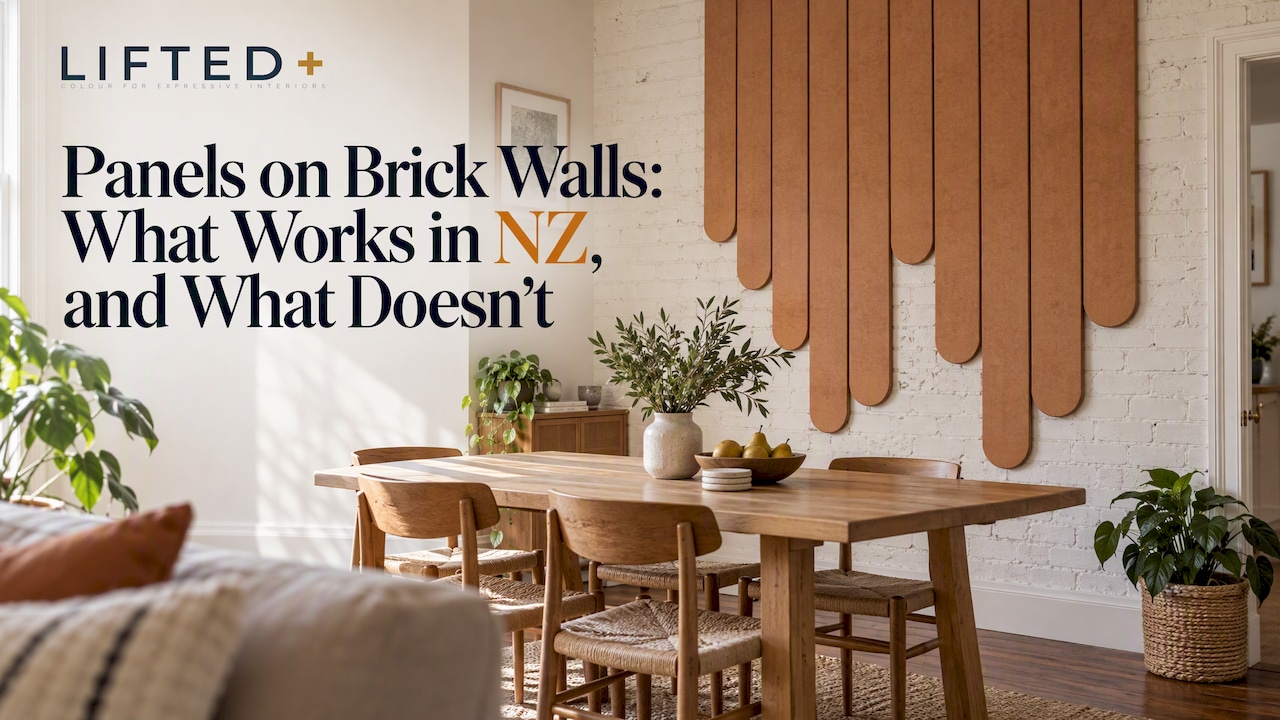
You can put panels on a brick wall, but the brick decides the method. Painted, smooth-faced brick in a rental will usually take a lightweight, adhesive-fixed panel after a proper test patch. Raw, crumbly or damp brick will not, and drilling into masonry is the one route a tenant should not take without the landlord’s written yes. Before you buy anything, work out what kind of brick you have, what condition it is in, and what you are allowed to do to it.
Brick has a reputation as the wall you cannot decorate. It is too hard to drill, too rough to stick to, and too characterful to cover. That reputation is half right. Brick is fussy, but it is not off limits, and a renter-friendly feature wall is still possible if you choose a light panel and a gentle fixing and test before you commit.
Key Takeaways
- Identify your brick first: solid masonry, brick veneer, or a painted brick finish each change what is sensible, and consent rules in NZ treat masonry differently from ordinary internal walls.
- Heavy cladding such as brick-effect boards or stone-look panels usually needs mechanical fixing. Lightweight felt panels fixed with adhesive pads suit renters far better.
- Rough, dusty, unsealed or damp brick is a poor surface for any adhesive. Clean, sealed or painted, smooth-faced brick gives you the best odds, and a test patch is non-negotiable.
- No adhesive is completely damage-proof. Test in a hidden spot, read your tenancy agreement, and ask your landlord if you are unsure.
Table of Contents
- Why brick is the hardest blank wall to decorate
- Check what you have before you fit anything
- What counts as a panel on brick
- The consent question homeowners should know about
- Three renter-friendly ways to dress brick
- How to test brick before you commit
- Our perspective: colour on brick, gently
- Brick wall panels: the trade-offs
- Planning a feature wall on brick
- Where DwellForms™ fits
- When to skip panels altogether
- FAQ
- Sources
Why brick is the hardest blank wall to decorate
A plasterboard wall forgives you. A nail hole can be filled in minutes, and a paint patch is easy to touch up. Brick forgives nothing. Drilling cracks the face of the brick or chews out the mortar, and neither repair is cheap or invisible. Surface texture works against adhesives, because a pad needs flat, clean contact to grip, and brick offers ridges, pores and dust.
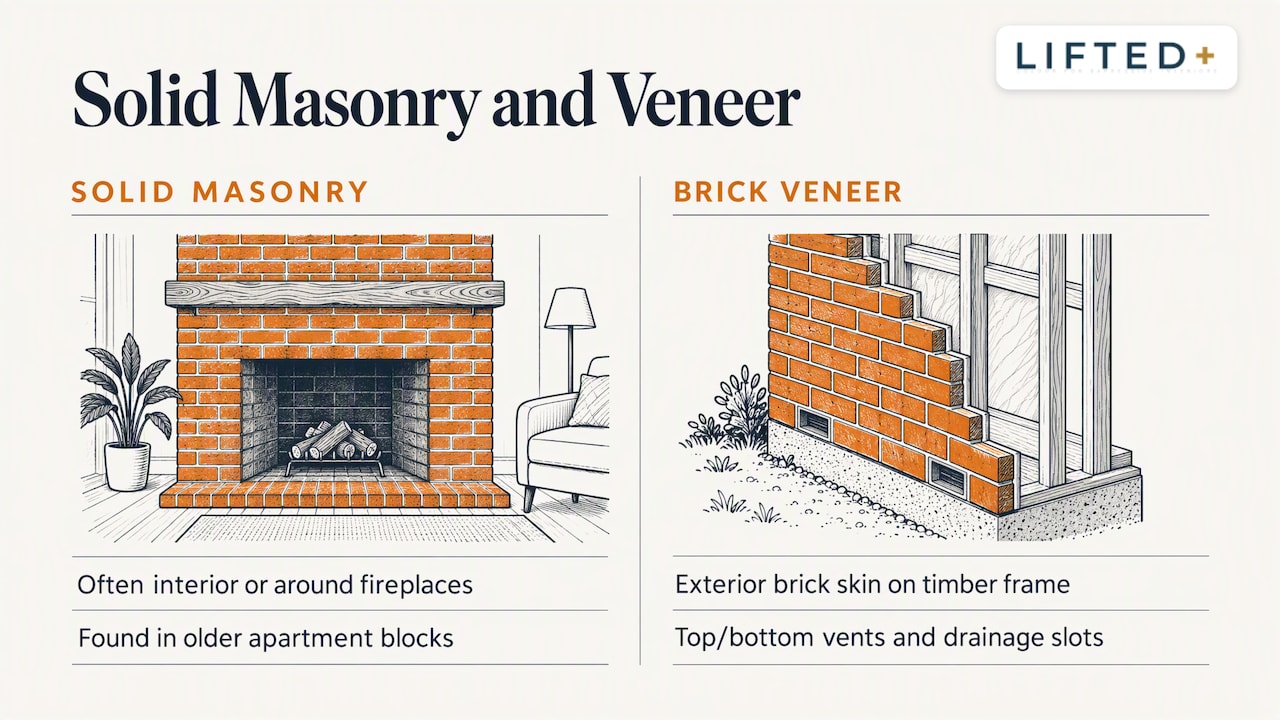
Then there is the question of what you are looking at. In New Zealand, a lot of what people call a brick wall is brick veneer, a single skin of brick fixed to a timber frame, with a cavity behind it. Others are genuinely solid masonry, such as an older internal feature wall, a chimney breast or a fireplace surround. The two behave differently, and so do the rules around them.
The search results for this topic mostly show you the opposite problem: faux brick panels that imitate brick. We are talking about the reverse, putting a decorative layer over real brick you already have.
Check what you have before you fit anything
Three quick checks save you most of the grief.
Is it solid brick or veneer?
Look at the wall from the outside if you can. An exterior brick skin on a timber-framed house is veneer. Inside, a brick wall that sits in the middle of a room, around a fireplace, or in an older apartment block is more likely to be solid masonry or a masonry feature wall. If you rent, your property manager or landlord will know. If you own, your building file or a builder can tell you.
This matters because veneer is designed to shed water. BRANZ explains that veneer needs top vents, bottom vents and drainage slots so the cavity can dry, since the back of the brick can get wet when it rains. That is an exterior detail, so you will not be covering those vents with an interior panel. It does tell you why you should never seal or alter an exterior brick face on a whim.
Is it painted, sealed or raw?
Painted brick is the friendliest surface for renters, particularly if the paint is a smooth, well-adhered finish. Raw brick sheds fine grit, and any adhesive that bonds to that grit will let go with it. A sealed or painted face gives the pad something stable to hold, though the paint itself is a risk: paint that is flaking or recently applied can lift when a pad is removed.
Try this in a hidden corner. Run your palm over the wall. If you collect dust or grit, the surface is not ready. If the paint feels chalky or flakes under a fingernail, stop there.
Is it dry?
Moisture is the quiet saboteur. Brick that feels cold, shows white salty bloom, or smells musty is telling you something. NZ building rules expect interior linings to go on only when the building is weathertight and the structure sufficiently dry, and the building code’s moisture clause (E3) exists to avoid fungal growth and damage from damp. You are not building a house, but the principle holds: do not cover a wall that is still wet. Fix the cause, or tell your landlord, before you decorate.
Good ventilation helps in an occupied home. BRANZ research points to 0.3 to 0.5 air changes per hour as the best way to manage condensation and humidity, which in practice means opening windows, running extraction and not drying washing against the wall.
What counts as a panel on brick
The word covers three very different products.
| Panel type | Typical weight | Usual fixing | Suits a renter? |
|---|---|---|---|
| Brick-effect, stone-look or timber slat cladding | Heavier, rigid boards | Construction adhesive, screws or battens | Rarely |
| Acoustic or MDF slat panels | Moderate to heavy | Battens, screws, strong adhesive | Rarely |
| Lightweight modular PET felt panels | Light | Removable adhesive pads | Often, with a test patch |
Heavy panels need a fixing that you cannot undo. Many claddings are proprietary systems that must be installed to the manufacturer’s requirements, and those requirements typically call for screws, battens or structural adhesive. If you own a solid brick wall and want a permanent look, that route is legitimate, and a builder should do it. If you rent, it is simply a bond claim waiting to happen.
Lightweight panels are the other path. They add colour and shape without asking the wall to carry anything. That is the lane DwellForms™ lives in, and it is the one we will focus on.
The consent question homeowners should know about
If you own the home, a gentle panel is not a building project. But a heavier job is a different story. MBIE says building consent is usually not needed for work on internal walls, except for walls that are load-bearing, bracing, fire separations, part of a specified system, or masonry. Masonry is on that list.
That guidance is about altering or removing walls, not hanging a felt panel with an adhesive pad. Still, it is a useful reminder that a brick wall may be doing structural work, so never cut into it, chase it or alter it without a builder or engineer. Putting a lightweight panel on its surface does none of those things, and if your plan involves anything heavier, check with your local council first.
Three renter-friendly ways to dress brick
Not every solution has to be a panel. Here are the options we would consider, in order of how little they ask of the wall.
Lean it, do not fix it
Large framed art, mirrors and leaning shelves sit on the floor and rest against the brick. They need no fixing at all, they move with you, and they work especially well in front of a chimney breast, where heat and soot make adhesives a poor idea. Our wall art collection and mirrors are made for exactly this kind of layering.
Use a freestanding or furniture-led layer
A tall bookcase, a daybed with a deep headboard or a folding screen gives you height and pattern in front of the brick without touching it. It is the humble answer, but it is surprisingly effective, and we cover the bond-protecting side of it in our guide to protecting walls behind furniture.
Fix lightweight panels with adhesive pads
This is where a modular kit comes in. Felt panels are light, so they ask very little of the fixing. The trick is the surface: smooth, clean, dry and sealed or painted. If your brick is rougher, our guides to fitting panels on textured walls and panels on concrete walls explain how surface texture changes the approach, and the same thinking applies to brick.
How to test brick before you commit
The test patch is the most useful five days you will spend. Here is how we would run it.
- Clean the spot. Pick a hidden area, such as behind a door or in a wardrobe nook. Dust it with a dry soft brush, then wipe with a barely damp cloth and let it dry fully.
- Check the finish. Press a small piece of tape to the wall and peel it. If paint or grit comes with it, the surface is too loose for any pad.
- Fit one pad and one small offcut. Use a single panel offcut or one sample piece, press firmly for the time the instructions state, and leave it for several days.
- Remove it slowly. Follow the removal instructions, working slowly and keeping the pull low and parallel to the wall.
- Inspect. Look in raking light for lifted paint, residue or marks. If you see any, stop and talk to your landlord or consider a lean-and-layer approach.
Our renter’s bond guide walks through the same protection mindset step by step, and our landlord-friendly decor guide helps you frame the conversation with a property manager.
Our perspective: colour on brick, gently
We designed DwellForms™ in New Zealand for people who want colour and sculptural shape on their walls but cannot, or would rather not, paint, drill or renovate. Brick is where that promise meets its toughest test, and we would rather be honest than cheerful about it.
We tested several adhesive systems and pull-tab products before settling on our nano-adhesive pads. We deliberately set one popular brand aside, because in our own testing our selected pads performed significantly better at minimising damage to walls. That is a result from our testing, not a guarantee. No adhesive is completely damage-proof, and no pad suits every wall. Brick, with its texture, grit and unpredictable paint, is one of the places where the test patch matters most.
What we do believe is that a brick wall does not have to stay a mute backdrop. A cluster of felt panels in a bold, confident arrangement can pull a brick wall out of the safe, polite middle, and give a rental the sense that someone actually lives there. If your brick is painted and smooth, there is a good chance we can help. If it is raw, crumbly or damp, we will tell you to start with art, a leaning mirror or a furniture layer instead.
— Michelle
Brick wall panels: the trade-offs
It is worth weighing the case for covering brick against leaving it as it is.
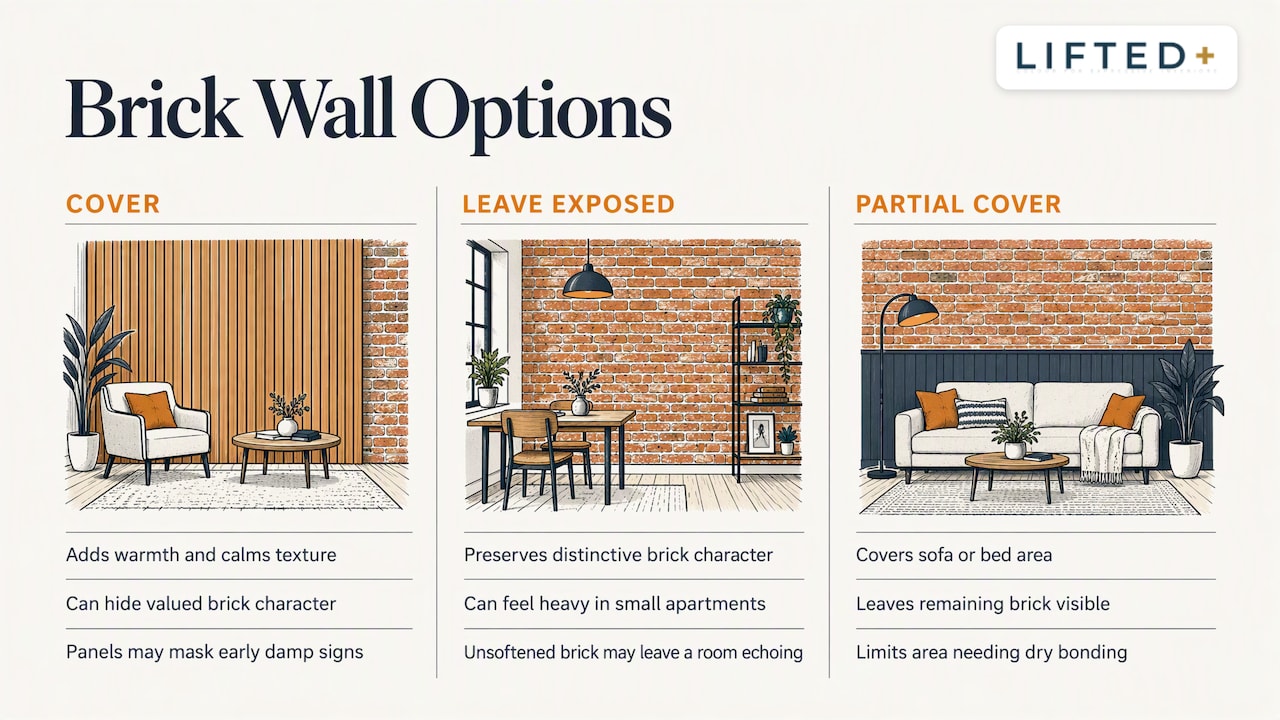
The case for covering it. Brick is dark, cool and busy. In a small apartment, an unpainted brick wall can feel heavy, and the surface does little to soften a room that already echoes. A colourful layer adds warmth, calms the texture and gives you control of the room’s palette. For renters, it is also a way to change a look the landlord will not let you paint.
The case against. Exposed brick has a character you cannot recreate, and covering it can hide a feature that buyers and tenants value. Some brick is also the first place damp shows up, and a panel can mask early warning signs. Our advice is to leave a gap of a few centimetres from the floor and ceiling where you can, check behind the panels every few months, and remove them if you notice any musty smell or marks.
A middle path is partial coverage: a panel arrangement that covers a section of the wall, such as the area behind a sofa or bed, while the rest of the brick stays visible. It is a good-looking compromise, and it limits the area that needs to stay dry and bonded.
Planning a feature wall on brick
A good arrangement does as much as a good fixing. A few principles help.
Choose the wall that earns it. A wall facing the room’s entry or the one you see from the sofa works hardest. Walls with radiators, flues or regularly damp corners should be left alone.
Let colour do the heavy lifting. Brick already carries warm red and brown tones. Cool teals, deep blues and soft greens set against it look intentional, while warm oranges and reds can blend into the brick and disappear. If you are not sure, a colour sample kit lets you hold the felt against your wall in your own light before committing. Our guide to mixing colours in interiors and how to use colour to lift a room will help if you are unsure where to start.
Mind the weight and scale. Keep the arrangement in proportion with the wall. A cluster that stops short of the edges looks designed. One that runs corner to corner on a rough surface asks the adhesive to do more.
Plan to take it down. A removable design works best when you picture the move-out day as you plan it. Keep spare pads, take photographs of the layout, and keep the packaging. Our article on reusable wall panels explains how a kit moves from home to home.
If you want pattern inspiration, our wall panel pattern ideas show layouts you can install in a weekend, and the Skyline kit is a good example of a layout with architectural presence.
Where DwellForms™ fits
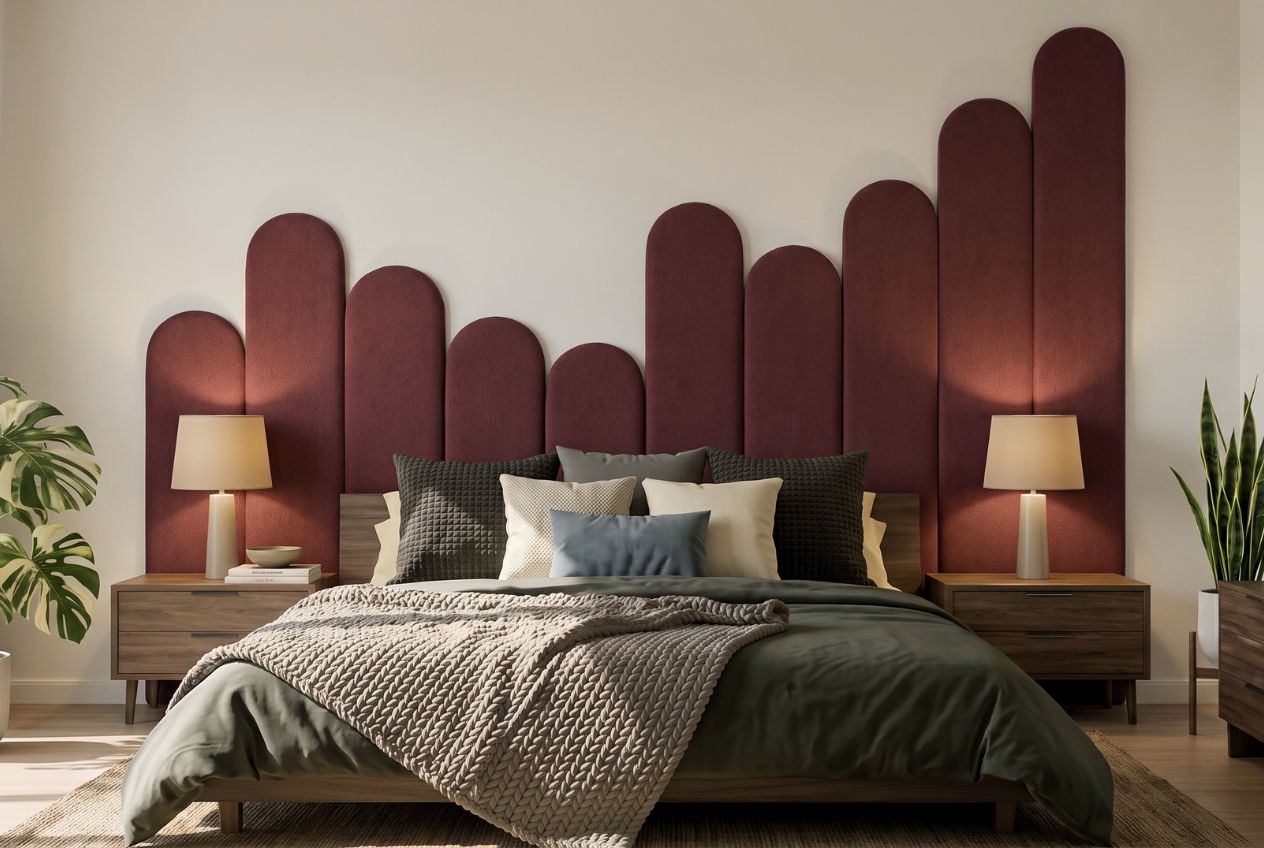
If your brick is painted, smooth and dry, a DwellForms™ kit is a no-drill wall decor option worth a test patch. The panels are precision-cut PET felt made from 100% recycled plastic, they fix with adhesive pads rather than screws or battens, and you can rearrange them or take them to a new home. Start with a core kit, then grow the design later with an extension kit if you want a wider wall.
Not sure which kit suits your room? Our kit chooser for changing spaces and the small-space kit guide narrow the choice quickly. We make no claims about soundproofing or commercial acoustic treatment, and we do not say every wall is suitable. What we offer is colour without commitment, with a clear method for checking your wall first.
When to skip panels altogether
Be honest with yourself about these situations.
- The brick is damp, salty or visibly crumbling.
- The surface sheds grit when you rub it.
- The wall is a chimney breast or sits near a heat source.
- Your tenancy agreement bans any fixing and your landlord says no.
- The wall is a masonry wall you suspect is structural and you were planning to cut into it.
In those cases, the lean-and-layer approach, a large mirror, framed art or a furniture arrangement gives you a lot of the visual lift with none of the risk. There are more ideas in our guides to removable wall panel ideas and renter-friendly home decor.
FAQ
Can you put panels over a brick wall?
Yes, but the method depends on the panel. Heavy cladding needs screws, battens or structural adhesive and suits an owner using a builder. Lightweight felt panels can be fixed with adhesive pads on suitable, clean, dry brick. Always test a hidden patch first.
Can panels be installed on painted brick or brick veneer?
Painted, smooth brick is usually the better surface for adhesive, provided the paint is sound and fully cured. Brick veneer is the exterior skin of a timber-framed house, so interior panels would sit on the interior lining, not the veneer. Never block or alter the veneer’s vents and drainage slots.
Will panels on brick damage the wall?
We cannot promise damage-free removal on any wall, and brick is one of the trickier surfaces. Our pads performed better in our own testing than a popular alternative, but a test patch, a gentle removal and an honest look at your paint are the best protection for your bond.
Do I need consent to cover a brick wall?
For a lightweight panel on the surface, generally no, but check your tenancy agreement or your council if unsure. MBIE lists masonry among the internal walls where consent can apply to alterations, so never cut into or remove brick without proper advice.
How do I tell if I have brick or brick veneer?
Check the exterior and the build. Veneer sits on a timber frame with a cavity, vents and drainage slots near the base and top. If the wall is in the middle of the house or around a fireplace, it may be solid masonry. Your building file or a builder can confirm.
Sources
- Getting behind brick veneer, BRANZ
- Dealing with construction moisture, BRANZ
- Vapour and ventilation bulletin, BRANZ
- Cladding design, BRANZ
- Internal walls and doorways in existing buildings, MBIE
Recommended
- Reusable Wall Panels: Colour Without Commitment In NZ
- Removable Wall Panel Ideas For NZ Renters In 2026
- Panels On Concrete Walls: What Works Without Drilling
- Reuse Wall Panels Without Drilling: NZ Renters Can Take Them Along
This article is for general information and inspiration only. Product performance and results may vary depending on individual circumstances, surfaces and installation.
