

TL;DR:
- PET felt panels are made from 60–100% recycled polyester fibers, offering sound absorption and sustainability benefits. They are versatile in design, easy to install, and suitable for various interior styles and space types. These panels provide effective acoustic performance while combining safety, aesthetics, and eco-friendly credentials.
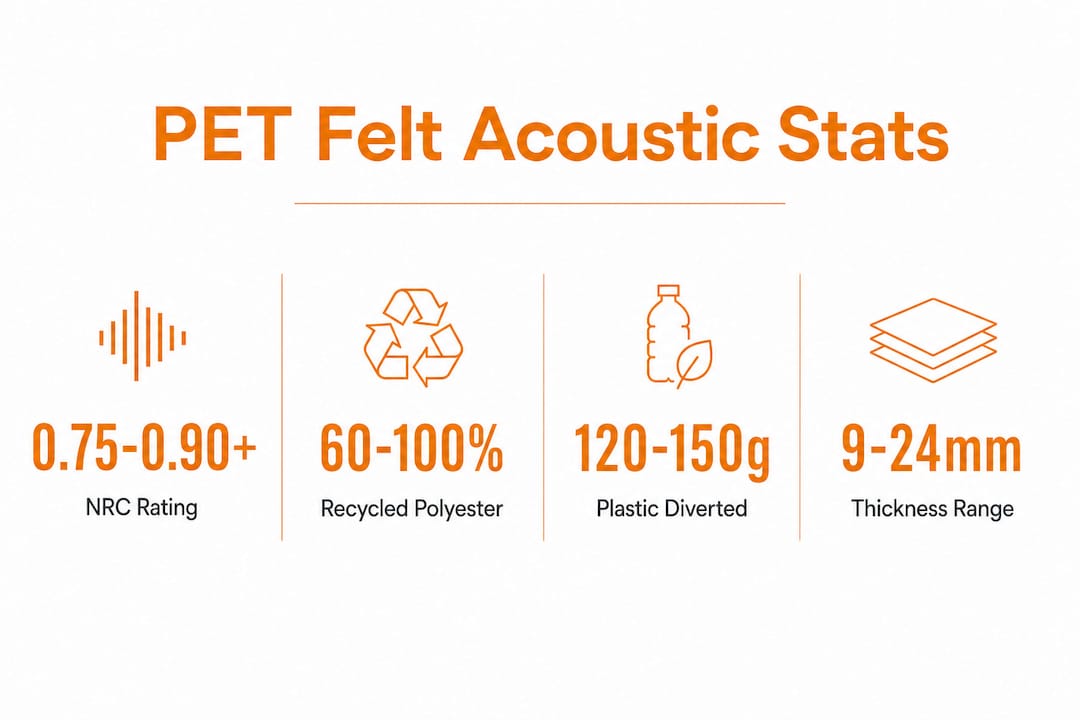
PET felt panels are acoustic wall and ceiling panels made from 60–100% recycled polyester fibres that absorb sound, reduce echo, and add tactile warmth to a room. The industry term is “polyester acoustic panels,” though PET felt has become the widely used shorthand among designers and suppliers. These panels work by converting sound energy into heat through a porous fibre structure, achieving NRC ratings of 0.75–0.90+, which places them close to fibreglass in acoustic effectiveness. What separates them from traditional materials is the combination of safety, sustainability, and genuine design appeal. For interior designers and DIY enthusiasts alike, they represent one of the few acoustic solutions that earns its place on the wall for reasons beyond pure function.
What are the acoustic and environmental properties of PET felt panels?

PET felt soundproofing works through porous absorption. Sound waves enter the panel’s fibre matrix and lose energy as heat rather than bouncing back into the room. This is the same principle used in fibreglass batts, but the material experience is entirely different.
The acoustic performance is measurable and consistent. NRC ratings of 0.75–0.90+ mean these panels absorb between 75% and 90% of incident sound across mid and high frequencies. That performance is competitive with mineral wool and fibreglass without the handling risks those materials carry.
The environmental credentials are equally strong. Each square metre of 12mm panel diverts approximately 120–150 plastic bottles from landfill. That figure reflects the 60–100% recycled polyester content standard across the category. For a project covering 10 square metres, you are diverting the equivalent of 1,200–1,500 bottles.
Health and indoor air quality matter in residential and commercial settings. These panels are formaldehyde-free to E0 grade, low-VOC, and non-irritant. That makes them appropriate for schools, nurseries, home offices, and any space where air quality is a priority.
Standard panel dimensions run 1,220mm x 2,440mm with thicknesses from 9mm to 24mm. Thicker panels generally absorb lower frequencies more effectively, but density matters more than thickness alone. A high-density panel at 2,300 g/sqm often outperforms a thicker panel with lower density. Specify density, not just thickness, when sourcing panels for a serious acoustic brief.
Pro Tip: Ask your supplier for the NRC test data at the specific thickness and density you are ordering. Published NRC figures sometimes reflect ideal lab conditions rather than the panel configuration you will actually receive.
How can you customise PET felt panels for creative wall designs?
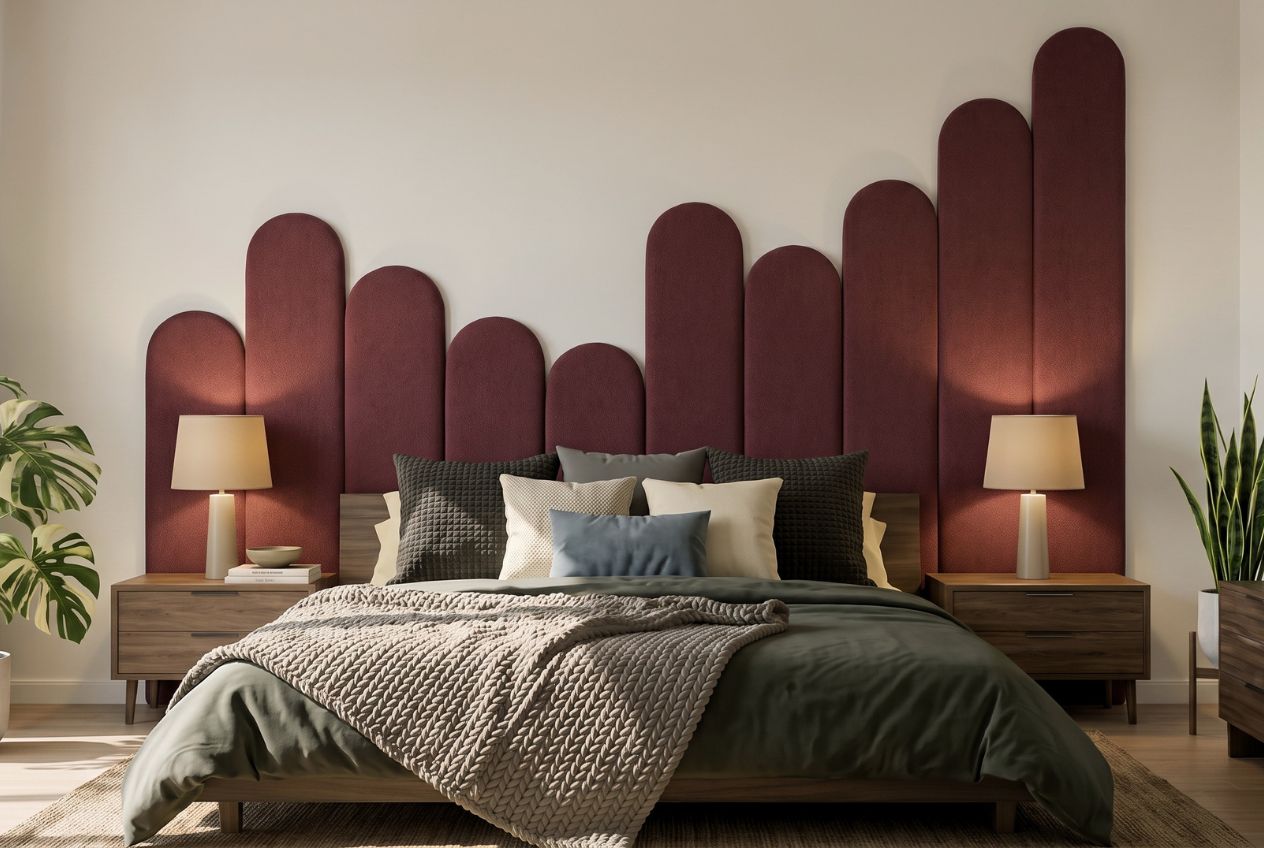
The design range available in this category is genuinely broad. Manufacturers offer over 40 colours, geometric 3D surface textures, printed finishes, and CNC-cut patterns. That variety means acoustic panels no longer need to look like acoustic panels.
The most common creative applications include:
Wall art installations where CNC-cut geometric shapes are arranged in repeating or asymmetric compositions. The panels hold crisp edges well, making them suitable for detailed pattern work.
Acoustic baffles suspended from ceilings in open-plan spaces. These work particularly well in dining rooms and home studios where hard surfaces create persistent echo.
Privacy screens in open offices or studio apartments. A freestanding felt screen absorbs sound on both faces while defining zones without permanent construction.
Decorative feature walls where colour and texture carry the visual weight. A single wall covered in textured felt sheets in a warm terracotta or deep forest green reads as a considered design choice, not an afterthought.
Designers value the ability to print, laminate, or wrap these panels for branded or artistic finishes. A hospitality client might commission panels printed with a custom pattern that ties the acoustic treatment into the broader interior narrative. For DIY projects, the simpler path is selecting from the standard colour range and letting the geometry do the work.
The key design principle is to treat acoustic performance and aesthetic appeal as a single brief, not two separate ones. Panels placed where sound problems are worst will also tend to be the most visually prominent surfaces. That alignment is an opportunity, not a compromise.
Pro Tip: For residential spaces, choose a panel colour that sits one tone darker than your wall colour. The slight contrast reads as intentional layering rather than a patch repair, and the depth it creates gives the room a more considered, tactile design quality that flat paint cannot achieve.
What are the best installation methods for PET felt panels?
Installation is straightforward, but the margin for error is smaller than most DIY guides suggest. The panels are rigid and do not flex to conform to uneven surfaces. A wall with minor undulations will leave air gaps behind the panel, and those gaps reduce both acoustic performance and adhesion strength.
Follow this sequence for reliable results:
-
Prepare the substrate. Fill any holes, sand raised areas flat, and allow plaster or filler to cure fully before proceeding. A flat, clean surface is the single most important factor in a successful installation.
-
Choose the right adhesive. Construction-grade adhesive is the correct choice. Standard household glues fail over time under the panel’s weight. Use a product rated for bonding rigid panels to plasterboard or masonry.
-
Apply adhesive in a grid pattern. Cover the back of the panel with adhesive dots or continuous beads spaced no more than 200mm apart. Full coverage prevents the panel from bowing away from the wall at the edges.
-
Use mechanical fixing for heavy panels or ceiling installations. Adhesive alone is not sufficient for ceiling-mounted panels or panels heavier than approximately 5kg. Use concealed clips or screws with decorative caps to supplement the adhesive bond.
-
Allow full cure time before loading. Do not apply adjacent panels until the first is fully bonded. Rushing this step causes panels to shift before the adhesive sets, creating visible misalignment at joints.
-
Plan CNC-cut panel transport carefully. Geometric cutouts reduce structural integrity. Carry custom-cut panels flat and support the full face during handling. A panel that arrives cracked at a thin bridge between cutouts cannot be repaired cleanly.
Rigid panels require flat, prepared surfaces to avoid gaps that impair both acoustic performance and appearance. That principle applies equally to professional installations and weekend DIY projects. The preparation phase takes longer than the installation itself, and that investment is always worth making.
One handling advantage worth noting: PET felt panels release no airborne fibres, so no protective clothing or respirator is required during cutting or installation. That is a meaningful practical difference from fibreglass and mineral wool, where skin irritation and respiratory precautions are standard.
How do PET felt panels compare with other acoustic options?
PET felt sits in a distinct position within the acoustic panel category. It is not the cheapest option, and it is not the highest-performing material in absolute acoustic terms. What it offers is a combination of properties that no other single material matches.
Fibreglass panels achieve similar or slightly higher NRC ratings at equivalent thickness, but they require protective handling, and their visual finish options are limited. Mineral wool performs well acoustically and offers good fire resistance, but it shares the handling concerns of fibreglass and lacks the design flexibility of felt.
PET felt’s unique combination of sustainability, tactile presence, and easier maintenance sets it apart from both. The fabric-like surface absorbs light rather than reflecting it, which softens a room in a way that rigid foam or wrapped fibreglass panels do not. That quality is particularly valued in high-traffic commercial interiors where durability and warmth need to coexist.
For residential use, PET felt is the strongest choice in most situations. It is safe to handle, visually flexible, and performs well enough for the acoustic demands of living rooms, home offices, and bedrooms. For a recording studio requiring very low noise floors, a specialist acoustic consultant may recommend denser or thicker solutions, and exploring panel alternatives is worthwhile before committing to a specification.
Maintenance is simple. The surface resists dust accumulation better than open-cell foam, and most panels can be vacuumed with a soft brush attachment. Staining is the main risk in high-traffic areas, and lighter colours show marks more readily than mid-tones or deep shades.
For renters and those in temporary spaces, the mechanical fixing options and the panel’s durability make it a practical choice. Panels can be removed and reinstalled in a new location without significant damage to either the panel or the wall, provided the adhesive is applied correctly the first time.
Key takeaways
PET felt panels deliver acoustic performance, sustainable credentials, and design flexibility in a single material, making them the strongest all-round choice for most residential and commercial acoustic briefs.
| Point | Details |
|---|---|
| Acoustic performance | NRC ratings of 0.75–0.90+ place PET felt close to fibreglass without the handling risks. |
| Sustainability | Each square metre of 12mm panel diverts approximately 120–150 plastic bottles from landfill. |
| Density over thickness | Specify panel density (e.g., 2,300 g/sqm) rather than thickness alone for reliable acoustic results. |
| Installation preparation | Flat, clean substrates and construction-grade adhesive are non-negotiable for durable, gap-free mounting. |
| Design range | Over 40 colours, CNC-cut patterns, and printable surfaces allow acoustic treatment to function as wall art. |
Why I think PET felt is the most underrated material in interior design right now
I have watched this material move from niche acoustic specification to genuine design choice over the past few years, and the shift has been faster than most people in the industry expected. What changed is not the material itself. It is the realisation that acoustic comfort and visual quality are not separate problems.
The mistake I see most often in DIY installations is treating substrate preparation as optional. Designers who skip that step end up with panels that bow, gaps that undermine the acoustic seal, and an installation that looks provisional rather than considered. The panels themselves are forgiving. The walls they go onto often are not.
My honest view is that density is the specification most buyers overlook. Thickness is easy to visualise, so it dominates purchasing decisions. But a high-density panel at 9mm will outperform a low-density panel at 24mm in most frequency ranges. If your supplier cannot provide density data, find one who can.
The design potential here is also still largely untapped. Most installations I see use a single colour across a full wall. The more interesting work layers two or three tones in geometric arrangements, letting the panel geometry create shadow and depth that changes with the light across the day. That is where this material stops being acoustic treatment and starts being wall art with a purpose.
— Michelle
How Liftedplus approaches colour, texture, and wall presence
Acoustic panels solve a real problem, and the best ones do it without asking you to compromise on how your space looks and feels. At Liftedplus, the approach to wall presence starts with the same question: does this piece hold the room, or does it disappear into it?
The Liftedplus collection of wall art and decorative pieces is built around colour, form, and the kind of tactile weight that makes a room feel finished. Whether you are working alongside acoustic panels or looking for statement pieces that carry the visual energy of a space on their own, the mood library is a useful starting point for pairing colours and forms. For renters and those working in temporary spaces, the renter-friendly decor ideas guide covers practical approaches that work without permanent fixtures.
FAQ
What are PET felt panels made from?
PET felt panels are made from 60–100% recycled polyester fibre, typically sourced from post-consumer plastic bottles. Each square metre of 12mm panel diverts approximately 120–150 bottles from landfill.
How well do PET felt panels absorb sound?
PET felt panels achieve NRC ratings of 0.75–0.90+, meaning they absorb 75–90% of incident sound. That performance is comparable to fibreglass at equivalent thickness.
Are PET felt panels safe to install without protective gear?
Yes. Unlike fibreglass and mineral wool, PET felt panels release no airborne fibres during cutting or installation, so no respirator or protective clothing is required.
Can PET felt panels be used in rental properties?
PET felt panels can be installed and later removed without significant wall damage when mounted with construction-grade adhesive on a properly prepared surface. Mechanical fixing options also allow clean removal.
What sizes do PET felt panels come in?
Standard panels measure 1,220mm x 2,440mm with thicknesses ranging from 9mm to 24mm. Custom CNC-cut shapes and sizes are available from most manufacturers for bespoke design applications.