
No adhesive is renter safe in every situation. Some are far kinder to a wall than a nail, but how kind depends on your paint, your preparation and, above all, how you take the product off again. This guide explains what New Zealand tenancy rules expect of you, where common removable adhesives succeed and fail, and how to put colour on a rental wall with the least risk to your bond.
Key takeaways
- Under New Zealand tenancy rules you need your landlord’s consent for changes, and you remain responsible for damage beyond fair wear and tear. ‘Removable’ is a feature of the product, never a legal defence.
- Wall finish and preparation matter as much as the brand: clean, cured, smooth paint is the friendliest surface, while wallpaper, flaking paint and fresh paint are the riskiest.
- Removal is where most bond disputes begin. Slow, correct release technique protects paint far better than a stronger stick.
- Spreading weight across many light points, as a modular panel kit does, is gentler than hanging one heavy object from a single strip.
- Ask in writing first. A short, specific email turns a grey area into a record you can point to at your final inspection.
Table of Contents
- What ‘renter safe’ means under New Zealand tenancy rules
- The main adhesive types, and where each one falls short
- Know your wall before you choose your adhesive
- Putting it on: the preparation that makes the difference
- Taking it off: where bonds are won or lost
- Our point of view: renter safe is a system, not a sticker
- Colour and texture without drilling: how DwellForms™ fits
- A short test for any adhesive product you are considering
- FAQ
- Sources
What ‘renter safe’ means under New Zealand tenancy rules
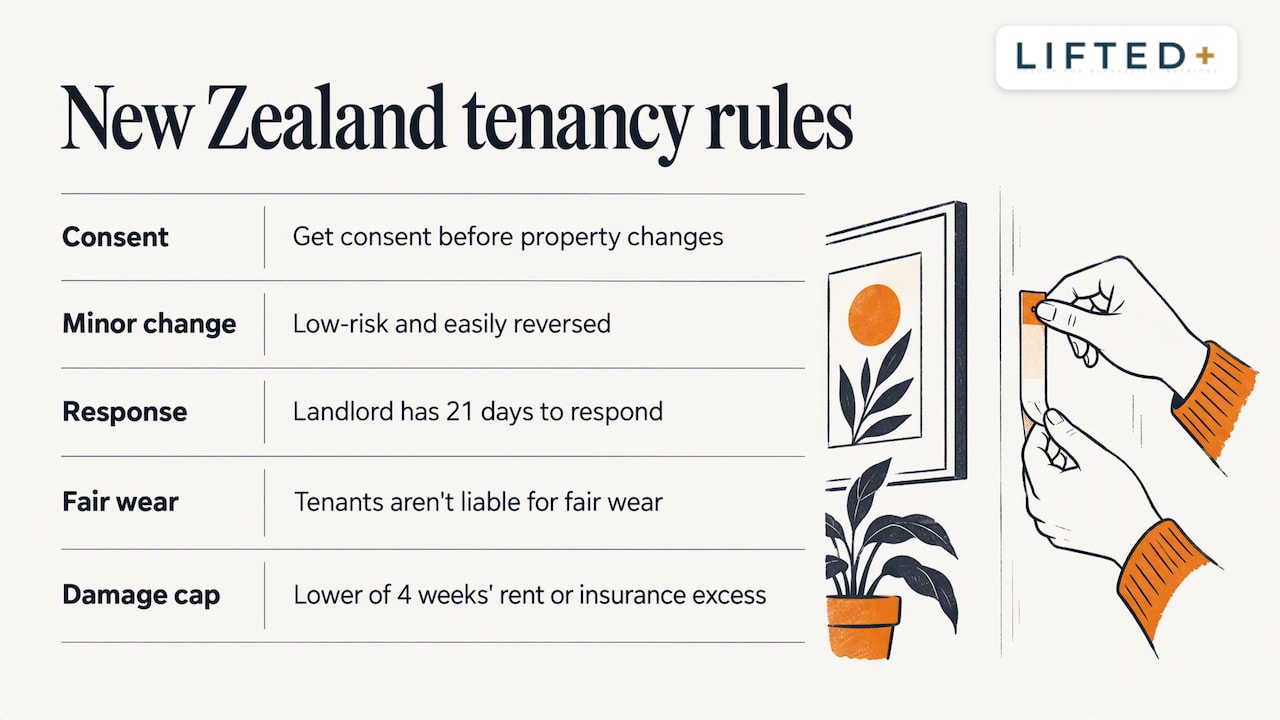
The phrase sounds like a guarantee. It is closer to a hope. Tenancy Services states that tenants must get consent before making changes to the property, and that landlords cannot unreasonably refuse a minor change. A minor change is one that is low risk and easily reversed, and the landlord has 21 days to respond to your request.
That gives you a useful frame. An adhesive-mounted wall feature is a good candidate for a minor change precisely because it can come off again. But the same page makes the other half clear: you are expected to return the property in substantially the same condition, and removal and repair costs generally fall to you unless you agree otherwise.
What happens if a mark does appear? Tenancy Services explains that tenants are not responsible for fair wear and tear, but are liable for careless or intentional damage, with liability capped at the lower of four weeks’ market rent or the landlord’s insurance excess. Because adhesive damage can often be avoided by following instructions, it is easily argued to be careless rather than ordinary wear. You keep the right to challenge a claim at the Tenancy Tribunal, but you would rather never get there.
It pays to read how these disputes play out. A Tenancy Tribunal decision summarised on Tenancy.co.nz shows that a well-known picture strip brand can still tear paint, and that the tenant paid. One property manager’s public warning about hanging strips in rentals tells a similar story: an otherwise excellent tenant damaged a wall while trying to remove one at the end of the tenancy.
The honest conclusion is this: a product’s marketing promise does not move the legal burden. Your preparation, your consent and your removal technique do.
The main adhesive types, and where each one falls short
Most renter-friendly adhesives fall into a handful of families. Each suits a particular job, and each has a failure mode worth knowing before you commit a wall to it.
Pull-tab picture strips and hooks
These are the best known. Pairs of interlocking strips press together, stick to the wall and release when you stretch the tab slowly. The maker’s own instructions say to clean the wall with rubbing alcohol, not household cleaners, and rate each pair of medium strips at 1.35 kg. That is plenty for a lightweight frame and nowhere near enough for a heavy mirror.
Their weakness is the removal. If the tab is pulled towards you rather than stretched slowly and straight down, paint can lift with it. They also depend heavily on the wall: textured, dusty or poorly bonded paint gives them very little to hold.
Removable glue and hook systems
Hardware-store systems that pair a twist-off hook with a removable glue are designed for smooth, finished indoor surfaces such as painted walls, wood, metal and tiles. The manufacturer’s guidance is to clean the surface, give the glue time to set before loading it, and avoid weak or damaged surfaces. The practical limit is that they are made for hooks and light prints, not for covering a wall.
Putty and tack
Reusable putty is cheap and tempting for posters. It can leave an oily ring on paint, soften over time in warm rooms and lift small flakes of paint on removal. We cover this in detail in our guide on how Blu Tack can cost NZ renters their bond, and it is a good example of a product that feels harmless right up to the final inspection.
Double-sided tape
Carpet tape and general double-sided tape are built to bond permanently. On painted plasterboard they often take the paper face with them. Unless a product is explicitly designed to release cleanly, treat tape as a last resort.
Peel-and-stick vinyl and wallpaper
These are popular for colour, but they rely on a larger adhesive surface across the whole wall. That makes the margin for error on removal much smaller, particularly on older or matt paint. If you want a wider view of the trade-offs, our piece on 11 adhesive myths NZ renters believe walks through the most common misunderstandings.
Nano-adhesive pads
Reusable pads with a micro-structured surface hold by surface grip rather than by a conventional glue layer. They can be lifted, rinsed and reused, and suit lightweight modular items. Quality varies widely between products, which is why testing matters, and we say more on that below.
Know your wall before you choose your adhesive
The adhesive is half of the equation. The wall is the other half, and it is the half renters usually cannot change.
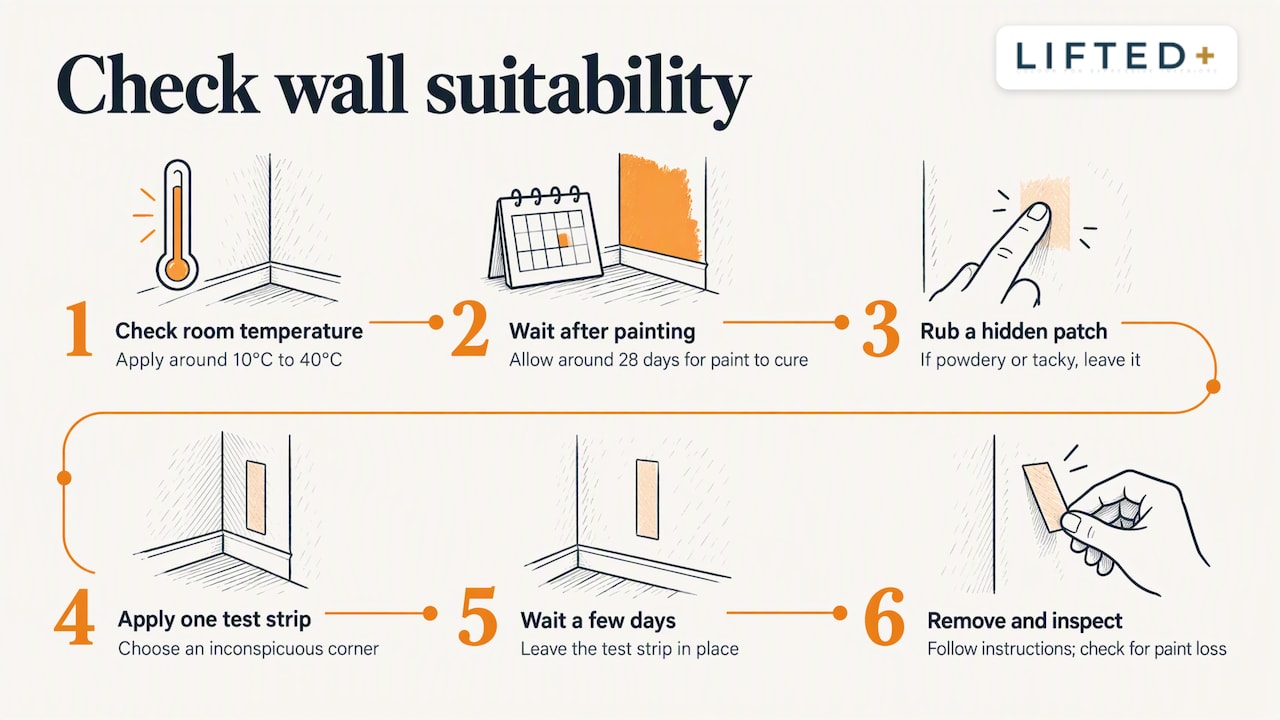
Smooth, cured, good-quality paint is the friendliest surface. Walls that were painted recently need time: the research behind this article points to waiting around 28 days after painting before applying removable products, because the paint is still curing and will not yet grip the plasterboard firmly.
Now the surfaces to approach with caution, or avoid altogether:
Wallpaper and vinyl-finish walls can tear on removal. Flaking, chalky or damaged paint will release with the adhesive. Heavily textured walls reduce contact area. Bathroom and kitchen walls, where steam and grease interfere with grip, are poor candidates. Brick, concrete and rough plaster behave differently again, and are better discussed with your landlord than guessed at.
A simple test helps. Run a clean finger over an inconspicuous patch: if paint rubs off as powder, or the surface feels tacky, leave it. Then stick one test pad or strip in a hidden corner, leave it for a few days and remove it exactly as instructed. If paint comes away there, you have learned something cheaply.
The temperature of the room matters too. Manufacturer guidance for removable adhesives generally points to application in moderate conditions, roughly 10°C to 40°C. A cold winter room is not the moment to press products onto a wall.
Putting it on: the preparation that makes the difference
Most adhesive failures trace back to ten minutes of skipped preparation. The sequence is short.
- Ask your landlord in writing, describe the product and say how it will come off. Landlords have 21 days to answer a minor change request.
- Photograph the wall in good light before you start, with a date on the image or in the file name.
- Clean the contact area with isopropyl alcohol on a lint-free cloth, then let it dry fully. Household sprays leave residue that weakens the hold.
- Press firmly for the time the instructions state, then wait before adding load. Some hooks need up to a day before they carry weight.
- Keep your layout light. Many small lightweight points are kinder to paint than a few heavy ones.
If you want a fuller walk-through of the paperwork and photographs, our six steps for protecting your bond lay it out in order, and the 21 day rule explained for colour-minded renters covers the consent timeline.
The checklist mindset is useful beyond the wall itself. Even a landlord turnover checklist from a US cleaning service shows how closely walls are inspected when a unit changes hands, and that is a good reminder to document your own condition at move-in and again at move-out. Local rules differ, so rely on Tenancy Services for New Zealand obligations.
Taking it off: where bonds are won or lost
Most of the marks in tenancy disputes appear at removal, not during the stay. Three habits make a real difference.
Go slowly. For pull-tab strips, the maker’s instruction is to stretch the tab slowly and straight down, never towards you. Fast, angled pulling is the textbook way to peel paint.
Warm gently. A hairdryer on a low setting softens adhesive on a stubborn pad and reduces tension on the paint beneath it. Keep it moving and never overheat.
Stop when it resists. If paint begins to lift, pause, warm the area and ease the product off in smaller increments. Residue can be treated afterwards; torn paint cannot be untorn.
For panels and larger items, work from a corner and release one pad at a time. Our guide to removing adhesive wall panels without wrecking the wall goes through the process step by step.
Our point of view: renter safe is a system, not a sticker
We design DwellForms™ for people who rent, so we think about the final inspection from the first sketch. Our view is that the word ‘safe’ belongs to a combination: a considered adhesive, a sensible wall, a light layout and a patient removal. Remove any one and the promise weakens.
That is why we do not describe anything as guaranteed damage-free, ours included. Walls vary, paint ages and people pull at different speeds. What we can do is reduce the risk by design and tell you honestly where it remains.
We tested several adhesive options for our panels, including a popular pull-tab system from a well-known brand. We deliberately discounted that brand because the nano-adhesive pads we selected performed significantly better in our own testing at minimising damage to walls. That is a result from our testing, not a claim that any adhesive, ours included, is completely damage-proof. Spreading a design across many small, light panels also means no single point carries a heavy load.
There is a creative side to this, too. Renters are often told to choose neutral because it is safe, and the result is a home that feels borrowed. Colour without commitment is possible, and a wall that has shape, texture and a clear point of view pulls a room out of the safe, polite middle. Doing it responsibly simply means asking first, preparing properly and removing carefully.
— Michelle
Colour and texture without drilling: how DwellForms™ fits
If you are after a renter-friendly feature wall rather than a single hook, our DwellForms™ Core Kits are modular panel kits cut from felt made of 100% recycled PET. They go up with our tested nano-adhesive pads, with no drilling, paint or wallpaper, and they can be rearranged or taken to your next home. Our Extension Kits let you grow a layout later.
Not sure which colour will suit your light? Order a colour sample kit first. Sample kit purchases are credited towards a full kit order. For layout ideas, see our best renter feature walls and our guide to testing wall panel colours for three days.
Remember: we do not promise suitability for every wall, and our panels are decorative. They are not a soundproofing or acoustic treatment.
A short test for any adhesive product you are considering
Before you buy, ask five questions. Does the maker say which surfaces it is meant for, and does your wall match? Does it state a weight limit that you can respect with margin to spare? Does it explain removal clearly? Can you test it somewhere hidden? And will your landlord agree to it in writing?
If the answer to any of those is no, choose a different product or a different wall. For more options that never touch the wall at all, our ideas for wall decor for renters without damage and protecting walls behind furniture are a good place to continue.
FAQ
What is the most renter safe adhesive in New Zealand?
No adhesive is safe on every wall, so the best choice is the one matched to your surface, weight and removal method. Smooth, cured paint with a lightweight item and slow, careful removal gives you the lowest risk. Your landlord’s written consent protects you whichever product you use.
Do I need my landlord’s permission to use removable adhesive?
Yes, in principle. Tenancy Services says tenants must get consent for changes, and landlords cannot unreasonably refuse minor, easily reversible ones. Asking in writing creates a record, and the landlord has 21 days to respond.
Who pays if an adhesive pulls paint off the wall?
If the damage goes beyond fair wear and tear, you may be liable for repairs, capped at the lower of four weeks’ market rent or the landlord’s insurance excess. You can challenge a claim at the Tenancy Tribunal. Photographs from move-in and move-out strengthen your position.
Can I use adhesive on wallpaper or freshly painted walls?
We would avoid both. Wallpaper can tear on removal, and fresh paint has not fully cured, so it may lift with the adhesive. Allow the paint time to cure and test a hidden spot first.
Are DwellForms™ panels guaranteed not to damage walls?
No. We do not claim any adhesive is completely damage-proof. Our nano-adhesive pads performed significantly better than the popular pull-tab system we tested, but results still depend on your wall, preparation and removal technique.
Sources
- Tenants making changes to the property, Tenancy Services
- Damage and repairs, Tenancy Services
- Liability for damaged walls from picture strips, Tenancy.co.nz
- Medium picture hanging strips instruction sheet, 3M
- Command hook application instructions, 3M
- Undo Hooks and Glue, Selleys New Zealand
Recommended
- Protect Your Bond: 6 Steps For NZ Renters To Use No Drill Panels
- 11 Adhesive Myths NZ Renters Believe That Risk Your Bond
- 21 Day Tenancy Rule: How Blu Tack Can Cost NZ Renters Their Bond
- Save Your Bond: NZ Renters Protect Walls Behind Furniture, No Drill
This article is for general information and inspiration only. Product performance and results may vary depending on individual circumstances, surfaces and installation.
