

Last Updated: November 2, 2026
Quick Summary
To add texture to blank walls without damaging a rental, use removable options like modular felt panels, peel-and-stick fabric wallpaper, tension-rod curtains and adhesive strips rated for the weight. Textiles, layered rugs, fabric-shaded lamps and large plants add tactile depth with no fixings at all.
- Cheap double-sided tape is the most common cause of paint lifting on removal.
- Mount curtain rods 10-15cm below the ceiling and 15-20cm beyond the window frame each side.
- Warm bulbs around 2700K flatter natural fibres better than 4000K cool white.
- Layer light at three heights: floor lamp at 150-170cm, table lamp at 50-60cm.
- One plant at 1.5m or taller reads as a statement; five small pots read as clutter.
Table of Contents
- Renter-Friendly Wall Decor That Adds Real Texture
- How to Decorate Apartment Walls Without Drilling
- Textural Wall Treatments That Come Straight Off
- Soft Furnishings and Textiles for Instant Warmth
- Layering Floor Rugs, Cushions and Linens
- Temporary Rental Wall Updates With Decorative Lighting and Ambiance
- Statement Furniture, Window Treatments and Botanical Elements
- Budget-Tier vs Investment-Tier Texture Upgrades
- Frequently Asked Questions
Renter-Friendly Wall Decor That Adds Real Texture
Texture is what turns a flat rental into a room with a point of view. Paint and colour alone can leave a wall looking unfinished, while surface depth changes how a room feels the moment you walk in. Below, we break down the renter friendly ways to add texture that survive a lease inspection, from removable wall treatments to textiles and lighting.
Why Texture Beats Colour Alone
Colour changes a wall’s mood. Texture changes its character.
A painted accent wall reads as a decision someone made once. A wall with depth, whether that’s felt panels, a woven hanging or a slatted screen, catches light differently through the day and gives the eye something to travel across.
The catch is that texture usually means commitment. Paint, render, timber battens and wallpaper all leave a mark. That’s the tension this guide resolves: how to add real, tactile depth without giving a landlord a reason to withhold a bond.
The Damage-Free Rule Book
Damage-free decorating rests on three rules: nothing goes into the wall, nothing bonds so hard it lifts paint, and nothing stays fixed long enough to leave a shadow.
In practice, that means:
- No nails, screws or wall plugs unless your lease explicitly allows them
- Removable adhesive strips rated for the weight you’re hanging, applied to clean, cured paint
- Tension rods for curtains, no brackets required
- Freestanding and leaning pieces that never touch the wall at all
Watch out: cheap double-sided tape is the single most common cause of paint lifting on removal. If a product doesn’t state that it’s removable, assume it isn’t.
How to Decorate Apartment Walls Without Drilling
Decorating apartment walls without drilling comes down to choosing the right fixing for the surface and the weight. Adhesive hooks and strips handle light pieces, tension rods carry curtains, and freestanding screens or leaning panels do the rest. Match the method to the load and the wall, and almost any wall can be dressed.
Adhesive Hooks, Tension Rods and Removable Strips
Adhesive hooks work well for lightweight frames, small mirrors and string lights.
Tension rods are the quiet hero of rental window treatments. They hold sheer curtains and light drapery in a doorway or recess without a single screw.
Removable strips bridge the gap between the two. They suit medium-weight pieces and come off cleanly when pulled straight down, slowly, along the wall.
Working With Textured and Awkward Walls
Textured, rendered and slightly uneven walls are where most adhesive products fail. The contact area drops, and the fixing peels.
For these surfaces, lean on methods that don’t rely on a flat plane: freestanding screens, tension rods in recesses, leaning panels, and floor-standing decor. If you want a deeper walkthrough, our guide on installing felt wall panels on textured walls covers the specific approach for awkward surfaces.
Textural Wall Treatments That Come Straight Off
The best textural wall treatments for renters are the ones designed to be removed. Modular felt panels, peel-and-stick fabric wallpaper, removable wall decals and fabric hangings all add depth and come away without tools.
Modular felt panels are our pick for a blank wall that needs real architectural shape.
If you’re starting from scratch, our broader guide on how to add texture to a rental home walks through the full set of reversible techniques.
Soft Furnishings and Textiles for Instant Warmth
Textiles are the fastest texture upgrade in any rental, and the least risky.
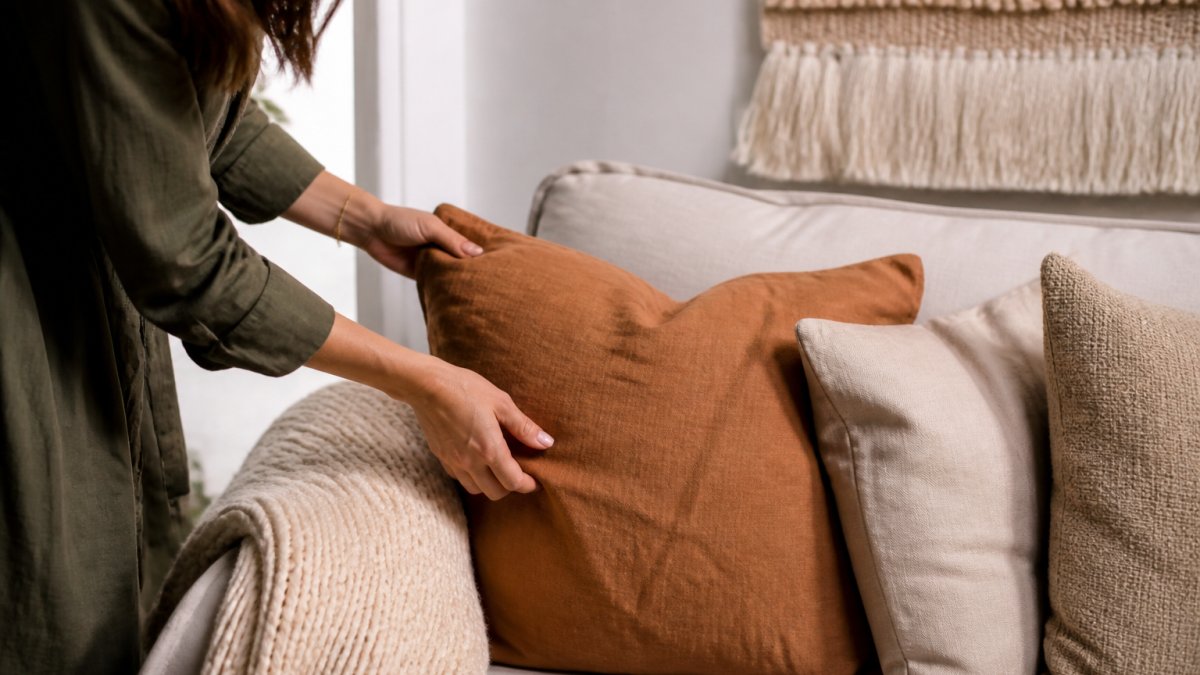
Start with what you touch. A chunky knit throw, velvet or boucle cushions, and a linen slipcover over a plain sofa add tactile depth in an afternoon.
Watch out: an all-synthetic fabric mix can read flat under downlights. Mixing in at least one natural fibre, even a small linen cushion, changes how the whole arrangement catches light.
Layering Floor Rugs, Cushions and Linens
Layering is where a rental starts to feel designed. A dense rug over hard flooring adds warmth underfoot and softens the room’s acoustics, while a second smaller rug or a throw over an armchair builds visual depth without a single fixing.
A common mistake is buying one rug that’s too small. If echo is the real problem, our guide to fixing hard floor echo in rentals covers dense rugs, thick pads and the acoustic side of soft furnishings.
Temporary Rental Wall Updates With Decorative Lighting and Ambiance
Lighting is texture you can switch on. A floor lamp with a fabric or woven shade throws a soft, grainy light across a wall that a ceiling fixture never will, and it adds height and depth to a corner without touching the wall. But the texture effect depends on three variables most renters never adjust: shade material, bulb temperature and placement height.
Shade material changes the grain of the light
A linen or cotton shade diffuses light into a soft, slightly directional wash that reveals wall texture, felt panels, woven hangings, even the tooth of a painted wall, because the light rakes across the surface rather than hitting it flat.
Watch out: a glossy or metal shade directs light in a hard cone, which flattens texture and highlights every imperfection in the wall. If the wall is uneven, choose a fabric shade.
Bulb temperature and beam angle
Warm bulbs around 2700K keep the room feeling soft rather than clinical, and they flatter natural fibres, jute, linen, wool, far better than 4000K cool white, which makes them look grey. A narrow beam (around 36 degrees) placed close to a textured wall creates a grazing effect that exaggerates depth; a wide flood washes the wall evenly and minimises it.
Placement: the three-height rule
Layer three sources at different heights: a floor lamp at 150-170cm, a table lamp at 50-60cm, and a small accent light low or high. This creates overlapping pools of light that give a room visual depth without a single fixing. Place a floor lamp behind a sofa or beside a reading chair and let the shade do the work, the wall behind it becomes a textured backdrop rather than a blank plane.
What to buy vs what to build
A fabric-shaded floor lamp is an investment-tier piece: it moves with you, works in any room, and the shade can be swapped for a different texture later. Our curated collection of floor lamps blends sculptural form with warm LED output, which is exactly the combination a rental living room needs.
For ambiance, avoid relying on a single overhead fixture. A ceiling light alone flattens every texture in the room. Add at least one low source and one grazing source, and the room will read as designed even before you hang anything on the wall.
Statement Furniture, Window Treatments and Botanical Elements
Statement furniture, full-length curtains and a few large plants do more for a rental’s texture than a wall of small decorations. Each adds a different kind of depth: furniture gives mass, drapery gives vertical softness, and plants give organic shape. But the texture payoff depends on material choice and scale, not just presence.
Furniture: mass and tactile contrast
A single oversized piece, a bouclé armchair, a jute-wrapped side table, a leather ottoman, beats five small ones every time because it gives the eye one strong textural anchor. The material matters more than the shape: bouclé and shearling read as soft and dense, jute and rattan read as dry and woven, leather reads as smooth and reflective. Mixing one soft, one dry and one smooth material in the same room creates tactile contrast that photographs as depth.
Watch out: an all-synthetic furniture mix, polyester velvet, acrylic throws, polypropylene rug, can read flat under downlights because the fibres reflect light uniformly. Introducing one natural-fibre piece, even a small linen cushion, changes how the whole arrangement catches light.
Window treatments: vertical texture and acoustic value
Hang curtains high and wide on a tension rod to make a window feel larger, mount the rod 10-15cm below the ceiling and 15-20cm beyond the window frame on each side.
For a renter-specific hardware hack, tension rods with rubber end caps protect the paint and require no brackets. If the recess is too wide for a tension rod, a spring-loaded shower rod in a doorway or alcove can carry a light curtain without a single screw.
Plants: organic shape and living texture
A tall fiddle-leaf fig or a trailing pothos on a shelf adds a living layer that photographs beautifully and needs no fixing. Scale matters: one plant at 1.5m or taller reads as a statement; five small pots read as clutter. Choose a pot with a textured surface, terracotta, woven seagrass, ribbed ceramic, so the container adds texture even when the plant is sparse.
The tactile-sensory angle competitors miss
Most renter guides treat texture as purely visual. The stronger approach is to design for touch as well as sight: a room where the sofa, rug, throw and curtain each offer a different hand-feel, smooth, nubby, cool, warm, feels more layered than one where every surface is the same synthetic softness.
For a compact feature wall you can take with you, the DwellForms™ Linear Accent Kit includes Mini Layout Pieces so you can test your layout before committing to the wall.
Budget-Tier vs Investment-Tier Texture Upgrades
Texture upgrades split cleanly into two tiers, and the right choice depends on how long you’re staying and how much you want to carry to the next place.
| Tier | What it includes | Best for | Comes with you? |
|---|---|---|---|
| Budget | Cushions, throws, tension-rod curtains, adhesive hooks, small plants | Short leases, first rentals | Mostly yes |
| Investment | Modular felt panels, floor lamps, dense rugs, statement furniture | Longer stays, frequent movers who want reusable pieces | Yes, with reconfiguration |
Budget pieces refresh a room quickly and cheaply, but they wear and date. Investment pieces cost more upfront and reward you across several moves.
For a compact feature wall you can take with you, the DwellForms™ Linear Accent Kit includes Mini Layout Pieces so you can test your layout before committing to the wall.
Frequently Asked Questions
How can I add texture to a rental without damaging the walls?
Stick to methods that lift off cleanly. Removable adhesive strips, tension rods, freestanding screens and modular felt panels all add texture without a drill. Layer soft furnishings like cushions, throws and floor rugs for warmth, and swap in ambient lighting for depth. Before anything goes up, test a small patch of any adhesive on an inconspicuous spot and check your tenancy agreement, since some leases restrict wall fixings entirely.
How can I decorate apartment walls without drilling?
Use removable hooks and strips rated for the weight you need, tension rods between two walls for lightweight drapery, and leaning shelves or ladders for display. For larger walls, modular panels that mount without hardware give you architectural shape and texture in one step. Keep heavy items low and freestanding, and choose products explicitly labelled damage-free so removal is straightforward when you move out.
Can removable wall panels be moved and reused?
Yes, if you choose modular kits designed for it. Lifted Plus DwellForms™ panels are made to be taken down and reconfigured in a new room or a differently shaped space, so a layout that worked in one apartment can be reshaped for the next.
What can I use to cover textured walls in a rental?
Textured and uneven walls defeat most adhesives, so favour methods that do not rely on a flat surface. Freestanding room dividers, leaning art ledges, tension rods and floor-standing screens all work. Fabric hung from a ceiling-mounted track or a tension rod adds softness without contact adhesive.
Blank walls are the default in a rental, and they don’t have to stay that way. The trick is choosing texture that fixes without force and moves without a trace. Lifted Plus builds DwellForms™ kits from 100% recycled PET felt, with no-drill installation, no paint and no renovation, designed to be pulled down and reconfigured in your next place. Explore DwellForms™ and turn a blank wall into an interior that feels like yours.

