

Last Updated: November 13, 2026
Quick Summary
The best acoustic panels for rental apartments are no-drill modular wall kits, such as recycled PET felt panels, that tame echo without marking walls you do not own. Choose lightweight panels with removable fixings or freestanding stands, and check your wall type before buying. Confirm current pricing before committing, as it depends on quantity, dates, and delivery.
- Acoustic panels absorb sound inside a room; soundproofing blocks noise between rooms.
- Modular recycled PET felt kits cost $40-$120 per panel, or $300-$900 for a small wall kit.
- Freestanding panels carry no removal risk because they never touch the wall.
- Place panels at first reflection points at ear height before covering other walls.
- Keep a gap of at least 300 mm from the ceiling and floor in bedrooms.
Table of Contents
- What Renters Actually Need From Acoustic Panels
- Quick Comparison: Acoustic Panel Options for Rental Apartments
- Acoustic Panels vs Soundproofing: What Each One Really Does
- Damage-Free Acoustic Panel Mounting for Every Wall Surface
- Recycled PET Felt Acoustic Panels: The Renter-Friendly Material
- Wood Slat, Foam and Fabric-Wrapped Panels: What Else Works
- How to Arrange Acoustic Panels in a Small Apartment
- Budgeting Your Setup and Planning for Your Next Move
- Frequently Asked Questions
What Renters Actually Need From Acoustic Panels
The best acoustic panels for rental apartments solve two problems at once: they tame echo and noise without leaving a mark on walls you do not own. No-drill modular wall kits suit exactly this situation, and the points below cover what matters. Most renters do not want a studio-grade sound booth.
That reframes the whole purchase. Instead of chasing the highest sound-absorption number, you are balancing three things: how well the panel softens sound, how it attaches to the wall, and whether you can take it with you when the lease ends.
Sound Absorption Versus Blocking Noise From Neighbours
Sound absorption and sound blocking are different jobs, and confusing them wastes money. Absorption panels soak up sound inside your room, cutting echo and reverberation so voices and TV audio stop bouncing off hard walls. Blocking noise from neighbours is soundproofing, and that mostly depends on mass, airtight seals and the wall structure itself.
A panel on your wall will not stop a bass line coming through the shared wall. If neighbour noise is your main complaint, start with gaps and seals, which our guide to renter-friendly apartment acoustics covers in detail, then add panels for the room’s internal sound.
Quick Comparison: Acoustic Panel Options for Rental Apartments
No single option wins for every renter, so here is how the main choices stack up on the factors that decide a rental purchase. The table below sets out the main options on the factors that decide a rental purchase.
| Option | Typical size and thickness | Typical weight per panel | Mounting method | Removal risk | Budget band (NZD) | Best for |
|---|---|---|---|---|---|---|
| Modular recycled PET felt kits | 600 x 600 mm to 900 x 600 mm, 9-12 mm | 1-2 kg | No-drill clips, adhesive strips or tension rails | Low if strips are used correctly | $40-$120 per panel; $300-$900 for a small wall kit | Design-led walls, easy moves |
| Wood slat panels | 600 x 2400 mm, 20-25 mm | 8-15 kg | Screwed or glued to battens | High, fixings and adhesive residue | $150-$400 per panel plus battens | Feature walls in owned homes |
| Acoustic foam tiles | 300 x 300 mm, 25-50 mm | 0.2-0.5 kg | Adhesive or impaling clips | Medium, adhesive residue common | $15-$40 per tile | Budget home studios |
| Fabric-wrapped DIY frames | 600 x 900 mm, 50-75 mm | 3-6 kg | Hooks, French cleats or leaned | Low if lightweight and hook-mounted | $60-$150 per frame in materials | Custom looks on a budget |
| Freestanding panels | 600 x 1200 mm, 50 mm | 5-10 kg | Floor stands, no wall contact | None | $200-$500 per panel including stand | Temporary setups, corners |
Typical weight per panel
The pattern is clear. Anything that touches the wall with adhesive or fixings carries a risk at move-out. Anything freestanding or modular avoids that risk entirely. Weight matters when choosing a removable fixing, because lighter panels put less strain on the fixing.
Confirm current pricing on the product page or request a quote before committing, as pricing depends on quantity, dates, and delivery.
What the specifications mean in practice
Thickness and density drive performance more than panel count. Thin felt panels generally absorb mid and high frequencies more than low ones, so they tame echo and harshness more than bass. Foam tiles of 25-50 mm behave similarly. Fabric-wrapped frames with dense insulation inside can reach lower frequencies if you build them deep enough, but depth adds weight and cost.
For a rental, lighter options with removable fixings suit most leases, while heavier or adhesive-backed options carry more risk at move-out.
Acoustic Panels vs Soundproofing: What Each One Really Does
Acoustic panels treat sound inside a room. Soundproofing stops sound moving between rooms. That is the short version, and it is the distinction most buying guides skip.
Sound treatment means controlling how sound behaves in your space. Panels absorb reflections, reduce echo, and make a room sound tighter and quieter to the ear. Sound insulation, or soundproofing, means adding mass and sealing gaps so less noise passes through walls, floors and doors.
For a rental, treatment is usually the realistic move. You can hang or lean panels without permission and without structural changes. Full soundproofing typically means building work, which most leases will not allow.
Damage-Free Acoustic Panel Mounting for Every Wall Surface
Damage-free mounting is the make-or-break detail for renters, and the right method depends on your wall. A fixing that works on painted plasterboard can fail on textured plaster or wallpaper. Check your wall type before you buy anything. Choosing removable fixings that suit the surface also helps keep paint intact, so SpaceKits can offer ideas for decorating around the panels without changing the walls.
- Painted plasterboard: removable adhesive strips work if the paint is sound and clean. Test one strip in a hidden spot first.
- Textured or wallpaper walls: adhesive struggles to grip. Lean or freestanding setups are safer.
- Brick or concrete: adhesive rarely holds. Use freestanding panels or a floor-leaning arrangement.
- Previously patched walls: adhesive can lift loose paint. Avoid it.
Adhesive Strips, Hooks and Freestanding Frames Compared
Adhesive strips are quick and invisible but depend entirely on paint quality, and cheap strips fail. Hooks need a fixing point, which usually means a small hole. Freestanding frames and stands avoid the wall completely, which makes them the safest choice for a strict lease. We put common adhesives through their paces on our own walls, and the results are worth reading before you trust a strip with a heavy panel: see our adhesive wall test diary.
Recycled PET Felt Acoustic Panels: The Renter-Friendly Material
Recycled PET felt acoustic panels are lightweight, soft-edged boards made from recycled plastic bottles, and they hit the rental sweet spot: light enough for removable mounting, soft enough to absorb mid and high frequencies, and durable enough to move with you.
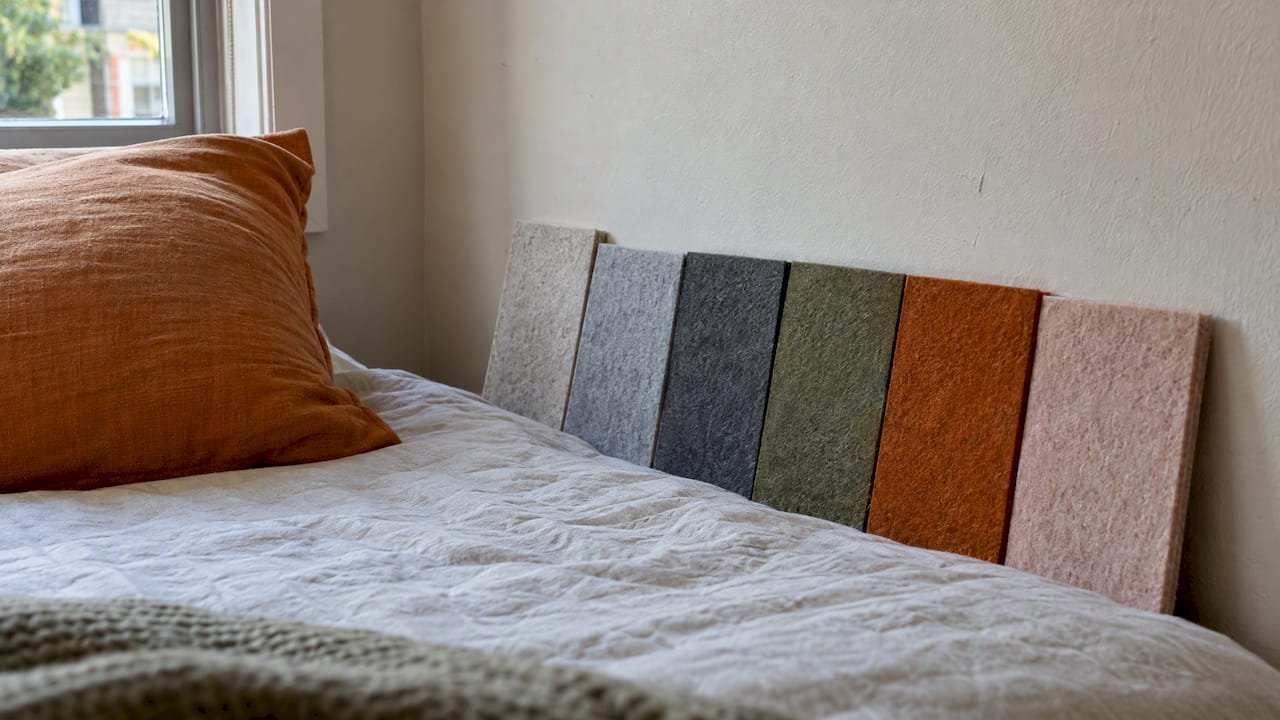
DwellForms™ kits are made from this material. If you want to know how the felt holds up over time, read what decides if recycled felt panels last.
Wood Slat, Foam and Fabric-Wrapped Panels: What Else Works
Wood slat panels are often designed to be screwed or glued to battens, which may not suit renters without landlord approval.
The trade-off across all three is the same: performance and looks improve as installation gets more permanent. For a rental, favour the lightest option that still does the job, and keep the fixing removable.
How to Arrange Acoustic Panels in a Small Apartment
Placement matters more than panel count in a small room. Start where sound reflects most: the wall opposite your seating or bed, and the corners where echo builds. A common mistake is covering one wall completely and ignoring the rest of the room. The room-specific plans below show how to prioritise reflection points without covering every wall.
Bedroom: calm the echo around the bed
In a bedroom, the priorities are the wall behind the headboard and the wall opposite the bed. Sound bounces between these two surfaces, so treating one or both reduces the flutter echo that makes a room feel harsh at night.
- Put two to four panels at ear height on the wall opposite the bed, centred on the pillow line.
- Add one or two panels behind the headboard if the wall is bare; this also softens sound reflecting back at you.
- Treat one corner near the window or wardrobe where bass tends to collect.
- Keep a gap of at least 300 mm from the ceiling and floor so the room does not feel closed in.
Watch out: do not stack panels directly above the headboard if you use adhesive strips on painted plasterboard; the combination of warmth, weight and paint condition is where strips most often fail.
Living room: target the first reflection points
In a living room, the first reflection points are the walls beside and opposite the main seating position. These are where sound from the TV or speakers hits a hard surface and arrives at your ear slightly late, blurring dialogue.
- Sit in your usual spot and have someone hold a mirror flat against the wall; wherever you can see the speaker or TV in the mirror is a first reflection point.
- Place one panel at ear height at each first reflection point, typically one on each side wall and one on the wall opposite the seating.
- Add a panel or two in the corners behind the speakers to break up bass build-up.
- Use a mix of shapes and colours to make it a feature, not a patch.
Home studio or desk corner: prioritise the desk wall
For a desk-based setup, the wall in front of you and the side walls at desk height matter most. Treat the wall behind the monitor first, then the side reflection points, then the corner behind you.
- Two panels behind the monitor at seated ear height.
- One panel on each side wall at the same height, if space allows.
- A corner panel or freestanding panel behind the listening position.
A simple priority order for any room
If budget or wall space is limited, work through this order: first reflection points at ear height, then the wall opposite the main seating or bed, then corners, then secondary walls. Sketch your wall first and move pieces around before committing.
Budgeting Your Setup and Planning for Your Next Move
Budget depends on how much wall you want to cover and the material you choose.
Portability is the quiet advantage of modular panels. If you are ready to plan a feature wall, explore the DwellForms™ Linear Feature Wall Panels Kit to see how a no-drill kit comes together.
Renting should not mean living with echo and blank walls. Lifted Plus makes modular, 100% recycled PET felt wall kits that add colour and shape without paint or drilling, and they are built to move with you.
Frequently Asked Questions
Do acoustic panels reduce noise from neighbours?
Only partly. Acoustic panels absorb sound inside your room, which cuts echo and reverberation, but they do not block sound travelling through shared walls. If neighbour noise is the main problem, panels will soften the sound bouncing around your space rather than stop it entering. Pairing absorption with soundproof curtains and sealing gaps around doors gives a more noticeable improvement. Treat panels as one layer of a wider plan, not a complete barrier.
How can I hang acoustic panels without damaging rental walls?
Damage-free acoustic panel mounting comes down to matching the method to the wall. Smooth painted walls usually hold removable adhesive strips well, while textured or freshly painted surfaces are better served by freestanding frames or panel stands. Always clean the wall first, press adhesive strips firmly for the full recommended time, and test with one panel before committing to a layout. Avoid hanging anything heavy above a bed or doorway.
Are felt acoustic panels better than foam panels?
For renters, recycled PET felt acoustic panels are designed to be moved and reconfigured, which suits frequent moves. If you move often or want a design-led finish, felt is a practical choice.
How many acoustic panels do I need for a small room?
Start with coverage on the wall behind your desk, sofa or bed, plus one adjacent wall if echo persists. For a small bedroom or home office, a cluster covering roughly one to two square metres is a sensible first step. You can add panels gradually and judge the difference by ear. Covering every wall is rarely necessary and can make a small room feel flat and over-damped.
Can acoustic panels be removed and reused when I move?
Modular felt panels and freestanding frames are designed for exactly that. Remove them carefully and keep the mounting hardware. The panels can be rearranged into a new layout for a smaller or differently shaped room.

