
You can make an apartment noticeably calmer, though not silent, with a sequence of renter-friendly steps. The single highest-return move is sealing the gaps around doors, windows and service penetrations before you spend on anything else. World Health Organization guidance and building code testing both exist for a reason: noise control is measurable, and so are your results.
TL;DR:
- Sealing gaps around doors, windows, and service conduits is the most effective and low-cost first step, especially for airborne noise reduction.
- Impact noise from above is best addressed through structural decoupling, which generally requires landlord approval for modifications.
- Flanking sound paths through shared edges and conduits often bypass surface treatments, making sealing these points crucial before adding absorption or mass.
- A typical renter’s fixes can reduce noise by 5 to 15 decibels, but impact noise remains the hardest to eliminate from inside the apartment.
- Field-tested measures like FSTC and FIIC are more reliable indicators of real-world soundproofing than lab ratings, with a 3 decibel change being perceptible to residents.
Table of Contents
- Airborne noise versus impact noise: why one fix does not suit both
- Flanking paths: how sound sneaks around your best efforts
- A sequenced plan: cheap fixes first, structural changes last
- When you need landlord sign-off, and how to ask for it
- Understanding STC, IIC and what a 3 dB change actually means
- Matching your fix to your problem: a short decision guide
- Where colour-led wall panels fit into room acoustics
- The honest trade-off between fixing noise and feeling at home
- A calmer wall is also a better looking one
- FAQ
- Sources
Airborne noise versus impact noise: why one fix does not suit both
Apartment noise falls into two broad camps, and confusing them is why so many DIY fixes fall flat. Airborne noise travels through the air itself: voices, televisions, traffic, a neighbour’s music. It responds well to mass and sealing, because you are blocking a path the sound takes through gaps and thin materials. Impact noise is different. It is the thud of footsteps, dropped objects or furniture dragging across a floor above you, and it moves through the building’s structure rather than the air. Decoupling, not just adding mass, is what actually interrupts it.
That distinction shapes what you should expect from any given fix.
- Airborne noise (conversations, traffic, TV) responds to sealing gaps, heavier curtains and dense soft furnishings.
- Impact noise (footsteps, dragged furniture, dropped items) needs structural decoupling and responds poorly to surface treatments alone.
- Mixed noise from shared walls or floors often needs a combination of both approaches, applied in sequence.
If your main complaint is footsteps from upstairs, a few cushions and a rug will take the edge off, but they won’t solve it.
Flanking paths: how sound sneaks around your best efforts
Sound rarely travels in a straight line through a wall. It flanks, meaning it finds an indirect route through gaps, shared service conduits, window frames, door undercuts and even slab edges that connect one unit to the next. According to Studio Matrx, flanking paths are the most overlooked reason DIY soundproofing fails: a renter adds one absorption panel to a wall, hears no real difference, and concludes acoustic treatment doesn’t work, when the sound was never travelling through that wall to begin with.
Common leak points worth checking first:
- Gaps under and around entry and internal doors
- Window seals and frames, especially older aluminium joinery
- Power points, vents and service conduits shared between units
- Skirting boards and slab edges where walls meet floors
Pro tip: Slide a sheet of paper under your door. If it moves freely or light shows through, that gap is likely leaking more sound than any decorative panel could absorb.
Sealing these entry points before adding an isolated panel means every later fix works harder, rather than fighting a problem that’s bypassing it entirely.
A sequenced plan: cheap fixes first, structural changes last
The order you apply fixes matters as much as the fixes themselves. Starting with absorption and skipping sealing is the most common reason renters feel like they’ve spent money for nothing.
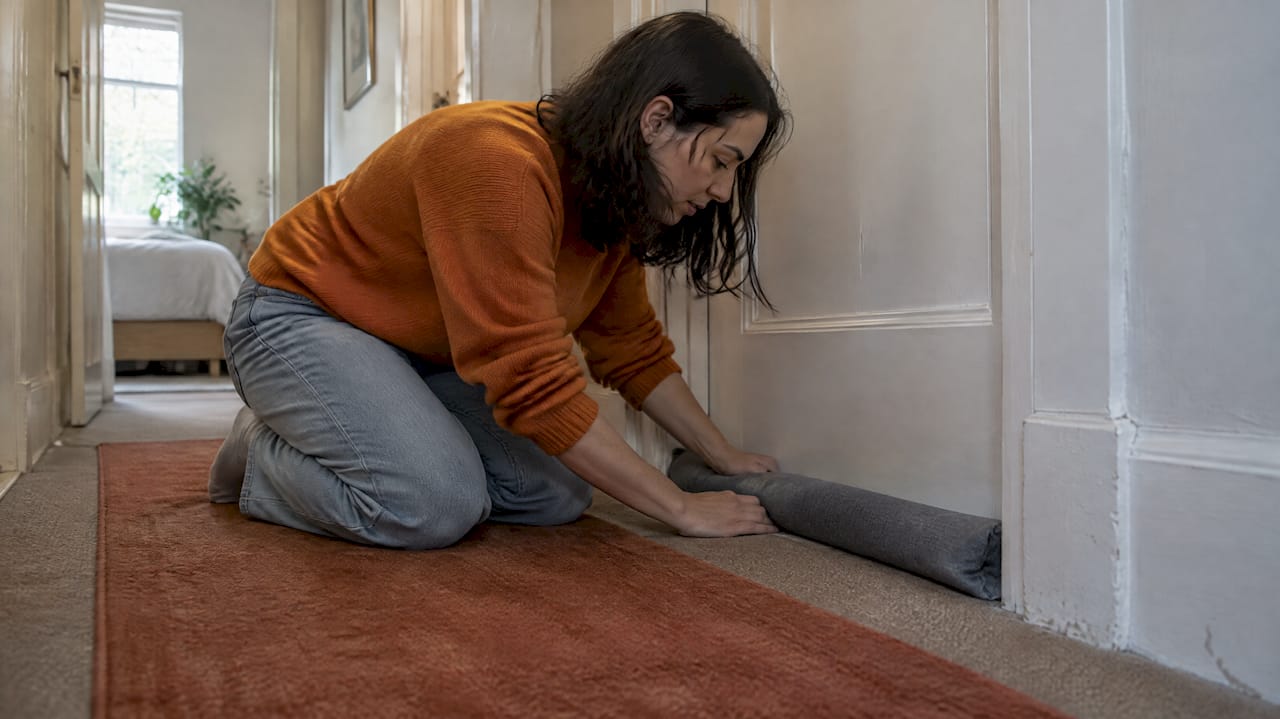
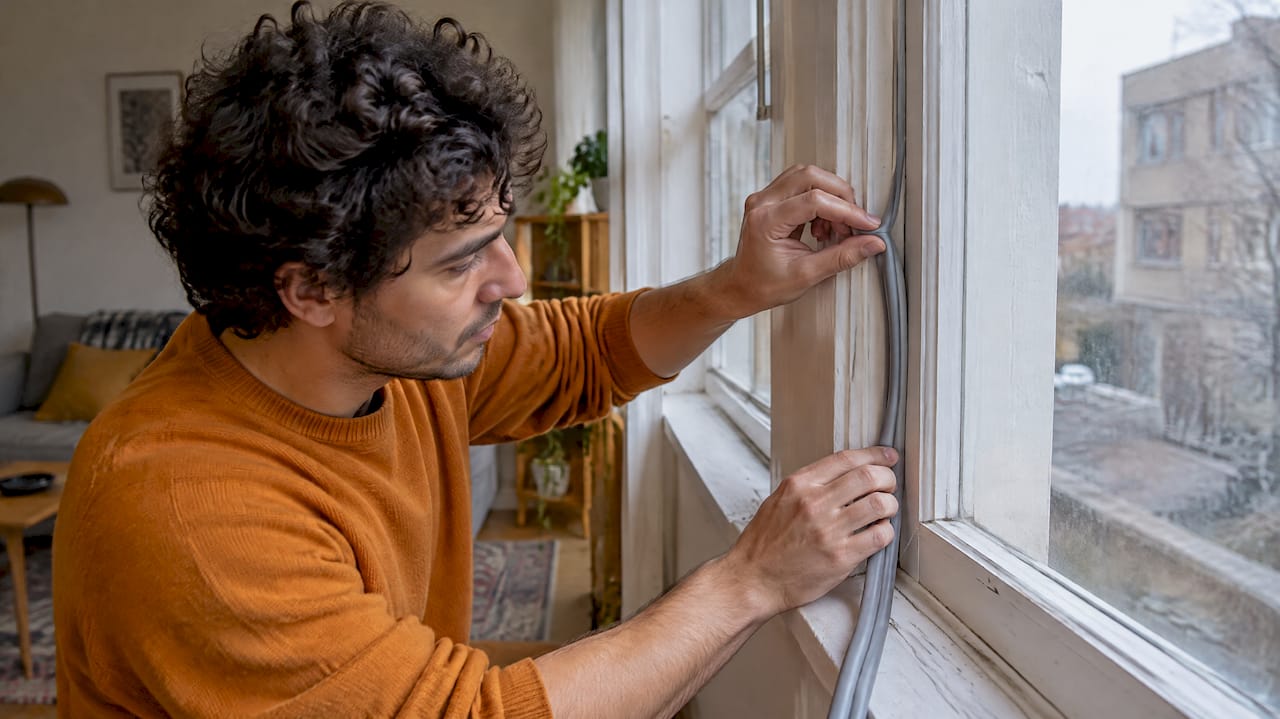
- Seal first. Fit weatherstripping and door sweeps to close the gaps you found in your flanking check.
- Add floor mass. A rug with a dense underlay cuts footstep noise transmitted into the room below and softens reflected sound in your own space.
- Layer soft furnishings. Heavy curtains, and secondary glazing where your lease allows it, reduce airborne noise from windows.
- Add absorption. Bookshelves, soft furniture and adhesive-mounted panels, such as PET felt wall panels, reduce echo and some airborne noise without a single drill hole.
- Consider heavier mass or structural work only once the cheaper layers are in place and you still need more, and only with permission.
Apartment Therapy notes that sealing air gaps is consistently the highest-impact, lowest-cost intervention available to renters, ahead of anything decorative.
Realistic expectations matter here. Non-structural fixes commonly deliver somewhere in the range of 5 to 15 decibels of reduction, and impact noise from the apartment above you is the hardest problem to solve from inside your own four walls, because the energy is travelling through the slab itself.
- Door sweeps and weatherstripping: quick, cheap, immediate airborne noise reduction
- Rugs with dense underlay: softens footsteps for those below you, modest benefit for noise coming from above
- Heavy curtains or secondary glazing: meaningful reduction for street and window noise
- Adhesive-mounted absorption panels: reduces echo and some airborne noise, no structural change required
Impact noise from upstairs neighbours is the hardest category to treat from your side of the ceiling, and internal treatments alone rarely resolve it fully.
When you need landlord sign-off, and how to ask for it
Some interventions go beyond what a renter can reasonably do without approval. Secondary glazing, false ceilings and independent stud walls all usually require landlord or body corporate consent, partly because they alter the building fabric and partly because uniformity rules in some buildings restrict visible changes to windows and facades.
If you want to pursue one of these:
- Ask in writing, and be specific about what you want to install and why.
- Offer to share an acoustic report or FSTC/FIIC test results if the building has them on file.
- Propose a reversible version of the change first, such as a free-standing secondary glazing unit rather than a fixed one.
- If permission is denied, fall back to the renter-friendly layer: sealing, soft furnishings and absorption panels will still improve things.
Understanding STC, IIC and what a 3 dB change actually means
Two acronyms do most of the work in acoustic testing. STC, or Sound Transmission Class, measures how well a wall or floor blocks airborne noise. IIC, or Impact Insulation Class, measures how well a floor blocks impact noise. The field-tested versions, FSTC and FIIC, matter more than lab figures because they reflect how a wall actually performs once flanking paths are accounted for, rather than how it performs in a controlled lab setting.
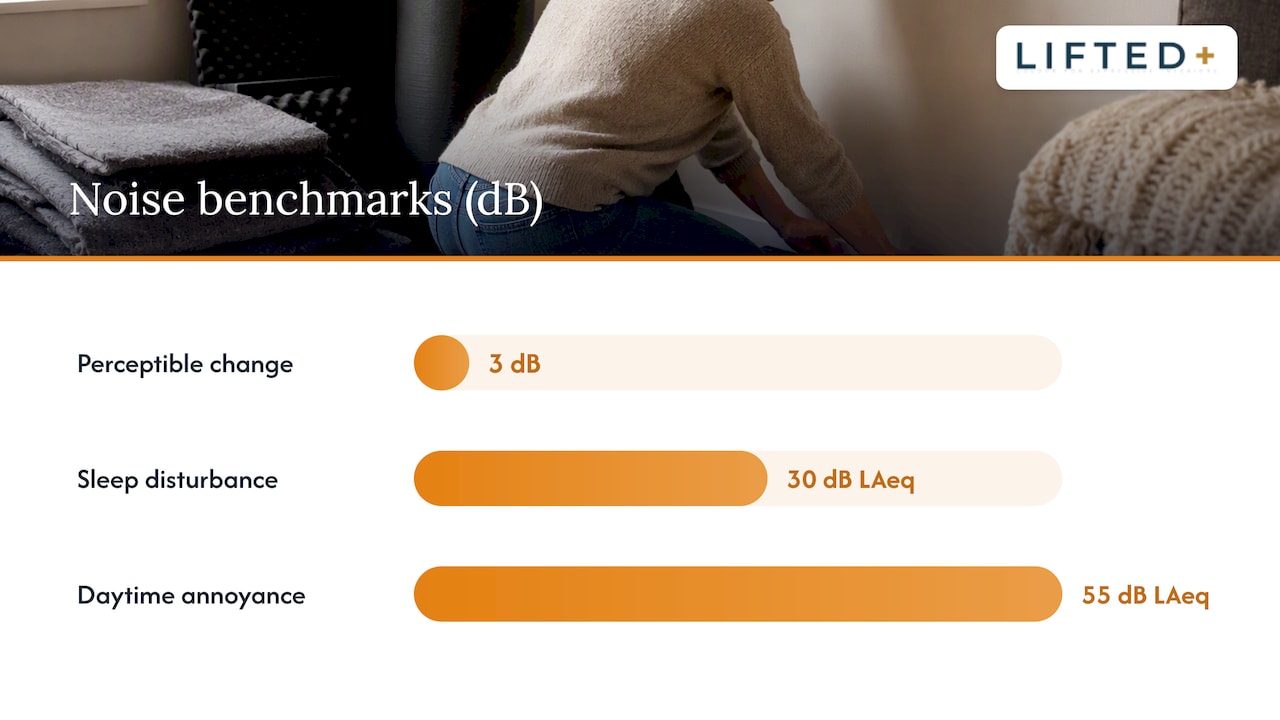
New Zealand’s Determination 2019/010 illustrates how these field tests are used to verify building code compliance, and shows that even a 3 decibel change is perceptible to the people living with it, despite sounding small on paper.
On the health side, the World Health Organization indicates that sleep disturbance effects can begin around 30 dB LAeq, with annoyance rising once daytime noise climbs above roughly 55 dB LAeq. That’s a useful benchmark for deciding whether your noise problem is a genuine health issue or simply an annoyance worth managing.
- STC and IIC describe lab performance; FSTC and FIIC describe real-world, in-building performance.
- A 3 dB change is small numerically but noticeable in daily life.
- WHO thresholds give you a rough sense of when noise moves from irritating to genuinely disruptive.
Matching your fix to your problem: a short decision guide
Treat this as a quick diagnostic rather than a shopping list.
- Identify your dominant noise type. Footsteps point to impact noise; voices and traffic point to airborne noise.
- Map your leak points. Run the paper test on doors and check window seals before buying anything.
- Check what you’re allowed to change. Confirm with your landlord before anything semi-permanent.
- Set a budget band and match it to realistic outcomes.
As a rough guide: a cheap band (sealing, rugs, curtains) delivers modest but real airborne noise reduction; a medium band (adding absorption panels and heavier textiles) improves both echo and some airborne transmission; a structural band (secondary glazing, independent walls) is the only category that meaningfully touches impact noise, and it needs permission.
Pro tip: Fix the cheap band completely before judging whether you need to go further. Most renters stop a layer too early and blame the wrong fix.
Where colour-led wall panels fit into room acoustics
Once the sealing and soft-furnishing layers are in place, a feature wall can do real, measurable work on room acoustics while also transforming how a space feels.
- Panels attach with tested adhesive pads, with no drilling, screws or wall damage.
- They’re modular, so you can rearrange or take them with you to your next place.
- Placing them on a wall that reflects sound most, often the one opposite a window or hard flooring, adds genuine absorption alongside colour and texture.
They reduce echo and soften a room’s reflected sound. They are not a substitute for sealing gaps or treating impact noise from above.
The honest trade-off between fixing noise and feeling at home
Persistent noise wears people down in ways that are easy to underestimate, and a staged approach that delivers a visible win early, a sealed door, a softened room, keeps momentum going. The most liveable fix pairs the technical sequence with a space you actually want to be in.
— Michelle
A calmer wall is also a better looking one
We think the best acoustic plan is one you’d choose even if the noise problem vanished tomorrow. Our DwellForms™ Core Kits give you a starting feature wall that adds absorption and colour in one move, with no drilling and no landlord drama, while our Extension Kits let you scale coverage as you work through a room.

If you’re not sure which colour suits your space yet, order a few Colour Samples before committing to a full wall. For placement advice and bond-friendly installation guidance, our bond protection guide and bedroom acoustics ideas walk through exactly where panels do the most good. Browse our DwellForms™ Core Kits to start your wall today.
FAQ
How much noise is too much noise in an apartment?
The World Health Organization notes that sleep disturbance effects can start around 30 dB LAeq, with daytime annoyance rising once noise passes roughly 55 dB LAeq. If your apartment regularly exceeds those levels, it’s worth pursuing both sealing fixes and a conversation with your landlord or body corporate.
Does sound travel up or down in flats?
Impact noise, such as footsteps, travels through the building structure and is typically most noticeable to the unit directly below the source. Airborne noise, like voices or music, can travel in any direction through shared walls, gaps and flanking paths rather than following a single route.
How do I soundproof my apartment so I don’t hear my neighbours?
Start by sealing gaps around doors and windows, since flanking paths are the most common reason DIY fixes underperform according to Studio Matrx. Follow with rugs, heavy curtains and absorption panels, and treat impact noise from above as the hardest category to resolve without the neighbour’s cooperation.
How can I tell if my apartment has good soundproofing?
Run a basic leak check: a sheet of paper under the door, a listen at windows and vents, and attention to whether conversations carry clearly through shared walls. Field test results like FSTC and FIIC, referenced in building determinations such as New Zealand’s Determination 2019/010, give a more formal answer if your building has that data on file.
Can decorative wall panels replace proper soundproofing?
Decorative, adhesive-mounted panels like DwellForms™ improve room acoustics by reducing echo and softening reflected sound, but they aren’t a structural soundproofing solution. For genuine noise blocking between units, sealing, mass and, where needed, structural changes remain necessary alongside any decorative absorption.
Sources
- Studio Matrx — Noise reduction strategies for apartments
- Determination 2019/010 — building code sound transmission determination
- Apartment Therapy — 9 easy tricks to soundproof an apartment