

TL;DR:
- Layered lighting with ambient, task, and accent sources enhances room ambiance and versatility.
- Proper scale, placement, and style of fixtures ensure visual harmony and functionality.
- Using energy-efficient LEDs and thoughtful statement fixtures transforms home design with practicality and style.
You spend months choosing the right sofa, the perfect rug, the artwork that speaks to you, and then you switch on a single overhead bulb and the whole room falls flat. It is one of the most common frustrations in home design, and it is entirely avoidable. Lighting is not an afterthought. It is the element that gives every other decision its power, its warmth, its sense of intention. This guide walks you through the foundations of good lighting, the art of choosing statement pieces, and the practical considerations that make a real difference in modern New Zealand homes.
Table of Contents
- Understand the foundations of good lighting
- Match lighting to your space: scale, placement, and style
- Select statement lighting that holds a room
- Consider efficiency and innovation for modern homes
- Checklist and common mistakes to avoid
- Why lighting beyond the basics truly transforms a Kiwi home
- Find the perfect lighting and decor for your New Zealand home
- Frequently asked questions
Key Takeaways
| Point | Details |
|---|---|
| Layer lighting | Combining ambient, task, and accent lights creates both function and visual depth. |
| Right size, right place | Scale fixtures to fit your rooms and surfaces for maximum style and balance. |
| Choose statement pieces wisely | Let a standout fixture anchor the room—without overpowering the space. |
| Prioritise efficiency | LEDs and smart options save energy and money without skimping on style. |
Understand the foundations of good lighting
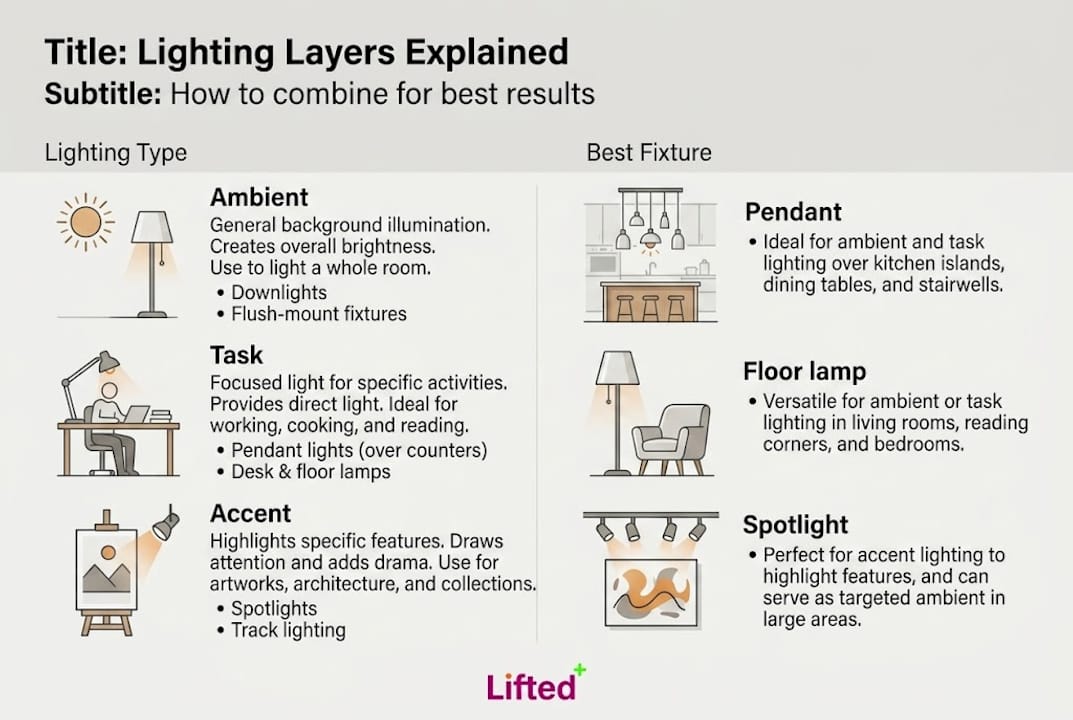
Good lighting begins with understanding that no single source can do everything. Most rooms rely on three distinct types, each serving a different purpose and contributing a different quality of light to the space.
Ambient lighting provides the overall illumination that allows you to move through a room safely and comfortably. Think ceiling fixtures, recessed downlights, or a central pendant that fills the space with a diffuse glow. Task lighting is focused and purposeful, directed at a specific activity: a reading lamp beside an armchair, under-cabinet lights in a kitchen, or a desk lamp in a study. Accent lighting is where personality enters. Wall sconces that wash light across a textured surface, a picture light above a favourite artwork, or a small spotlight trained on a sculptural object all fall into this category.
The real power comes from combining all three. As layered lighting tips demonstrate, a room with only one source reads as flat and uninviting, regardless of how beautiful the fixture itself might be. The right lighting approach recommends using ambient for overall illumination, task for specific activities, and accent for highlights and statements. The same source notes that 3+ sources per room are recommended for versatility in a living space, avoiding the flatness that a single overhead light creates.
| Lighting type | Primary purpose | Common fixtures |
|---|---|---|
| Ambient | General illumination | Pendants, downlights, ceiling mounts |
| Task | Focused activity support | Desk lamps, under-cabinet strips, reading lamps |
| Accent | Highlight and drama | Sconces, picture lights, spotlights |
For modern New Zealand homes, where open-plan layouts are common and natural light varies significantly by season, layering becomes especially important. A well-lit room in winter should feel just as considered as it does on a bright summer afternoon. Dimmer switches on ambient sources and independently controlled accent lights give you that flexibility without requiring a full redesign.
Pro Tip: When planning a new room’s lighting, sketch out the three layers before you purchase a single fixture. Knowing what each light needs to do makes every subsequent decision far easier and more intentional.
Explore how to layer lighting at home to see how these principles translate into real interiors with genuine visual impact.
Match lighting to your space: scale, placement, and style
With a grasp of lighting foundations, it is time to connect those options with your home’s unique layout and character. Scale is everything. A pendant that looks striking in a showroom can feel lost in a double-height dining room, or oppressive in a compact kitchen. Getting the proportions right is not guesswork; there are reliable guidelines to follow.
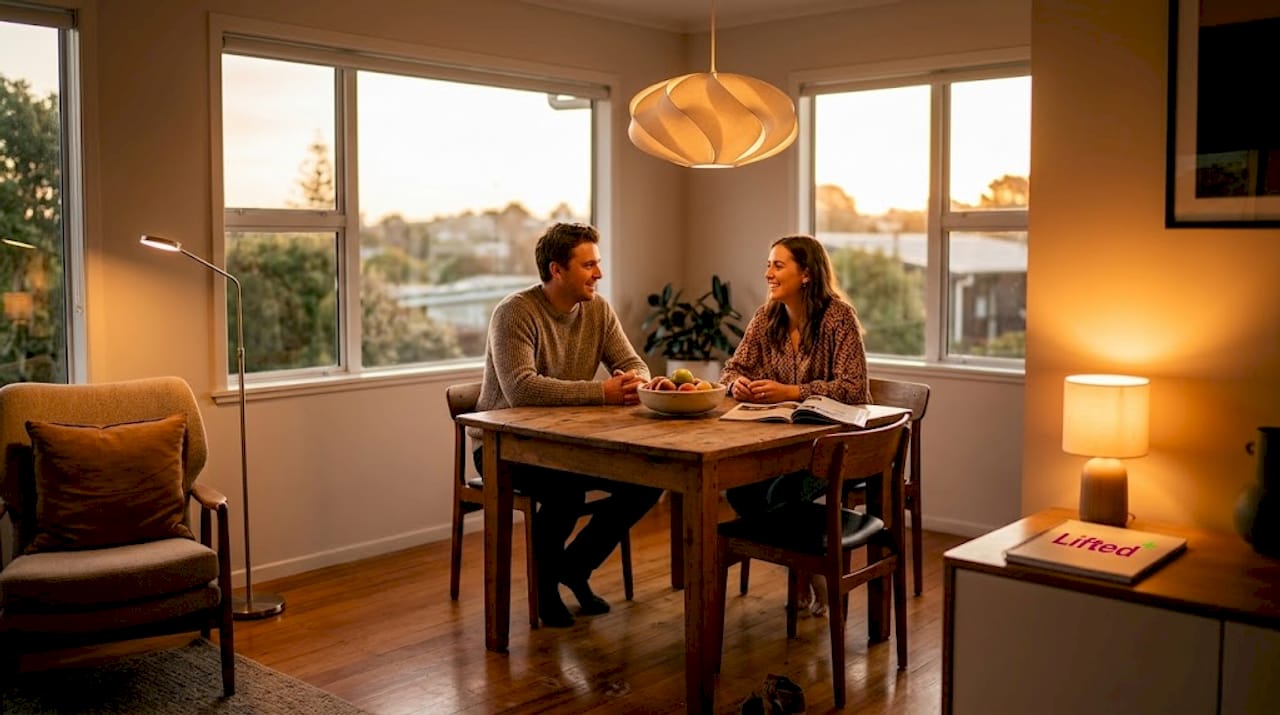
For pendants above a dining table, the right pendant diameter should fall between one-third and two-thirds the width of the table. A 1,800mm table, for example, suits a pendant between 600mm and 1,200mm in diameter. For table lamps, the shade height should be roughly 1.5 times the height of the table it sits on. These proportions create visual harmony rather than imbalance.
Ceiling height shapes your fixture choices just as much as floor area. The right fixture for your ceiling means flush mounts or semi-flush fittings for low ceilings, and pendants or chandeliers for rooms with generous height. In New Zealand homes, where older villas often have high stud heights and newer builds tend toward lower ceilings, this distinction matters enormously.
How to approach scale and placement in four steps:
- Measure your ceiling height and note the room’s footprint before looking at any fixtures.
- Identify the primary focal point, whether that is a dining table, a kitchen island, or a reading nook, and plan your statement piece around it.
- Use the proportion guidelines above to narrow your shortlist to fixtures within the right size range.
- Consider IP ratings for any fixture near moisture, including bathrooms, outdoor-adjacent areas, or covered decks common in New Zealand homes.
Style is the final layer of this decision. A sculptural rattan pendant suits a relaxed coastal aesthetic; a geometric brass chandelier belongs in a more formal, contemporary interior. The fixture’s finish, material, and silhouette should feel like a natural extension of the room’s existing palette rather than a jarring addition.
Statement lighting for open spaces requires particular care with scale, since open-plan rooms can absorb fixtures that would overwhelm a smaller room. When choosing statement lamps, consider how the lamp’s form reads from multiple angles, since a lamp in an open-plan space is often visible from several rooms at once.
Pro Tip: Hang pendants so the base of the shade sits approximately 750mm to 850mm above a dining table. This keeps the light functional without blocking sightlines across the table.
Select statement lighting that holds a room
Once general lighting is sorted, it is time to amplify style and drama with carefully chosen statement pieces. A statement fixture is not simply an expensive light. It is a piece that brings shape to the air around it, that pulls the eye and holds it, that gives the room a reason to exist beyond mere function.
What separates a statement fixture from a standard one? Form, finish, and presence. A statement piece has a silhouette that reads clearly from across the room. It has a material or colour that adds tension against the surrounding palette. It occupies space with intention, the way a sculpture does, rather than simply hanging there to provide light.
“Statement pieces like pendants make focal points but must proportion correctly to avoid overwhelming spaces.” This is the nuance that separates a well-designed room from one that simply has an interesting fixture in it.
When selecting a statement piece, consider these qualities:
A strong silhouette that reads clearly from a distance. A finish or material that contrasts or complements the room’s existing tones without competing with them. A scale that commands attention without consuming the space. A light quality, whether warm, diffuse, or directed, that suits the room’s mood. A form that feels considered rather than decorative for its own sake.
The statement lighting essentials that truly work in New Zealand interiors tend to share one quality: they feel inevitable in the space, as though the room was always waiting for them. That sense of rightness comes from careful selection, not impulse. Autumnal tones, earthy finishes, and organic forms are particularly well-suited to the warm, grounded palettes that characterise contemporary Kiwi interiors.
Explore sculptural lighting ideas to see how form-led fixtures can become the defining element of a room without overpowering it.
Consider efficiency and innovation for modern homes
After aesthetics, practicality and responsibility make a real impact on your living and running costs. The shift to LED lighting is one of the most straightforward improvements any New Zealand homeowner can make, and the numbers are compelling.
LEDs save 75 to 85% energy compared to traditional incandescent and halogen bulbs, and the average New Zealand home can save $150 to $300 per year by making a full switch. Over the lifespan of an LED bulb, which can reach 25,000 hours compared to roughly 1,000 hours for a standard incandescent, the savings compound significantly.
| Bulb type | Average lifespan | Energy use (relative) | Annual cost estimate |
|---|---|---|---|
| Incandescent | 1,000 hours | High | $$$ |
| Halogen | 2,000 hours | High | $$$ |
| CFL | 8,000 hours | Medium | $$ |
| LED | 25,000 hours | Low | $ |
Beyond cost, LED technology has evolved to offer a full spectrum of colour temperatures, from the warm amber tones that suit living rooms and bedrooms to the cooler, crisper light that works well in kitchens and bathrooms. This versatility means you no longer need to sacrifice ambience for efficiency.
Smart lighting systems add another dimension. Dimmable LEDs, colour-adjustable globes, and app-controlled circuits allow you to shift a room’s mood without changing a single fixture. For open-plan homes, the ability to lower ambient light in the dining zone while keeping the kitchen bright is genuinely useful, not just a novelty.
Key considerations when selecting efficient lighting:
Choose LEDs with a colour rendering index (CRI) of 90 or above for the most accurate, flattering light quality. Match colour temperature to the room’s function: 2,700K to 3,000K for living areas, 4,000K for kitchens and workspaces. Look for fixtures compatible with dimmer switches, since not all LEDs dim smoothly on older circuits. Consider smart globes in key rooms for maximum flexibility.
Find energy-smart lighting inspiration that proves efficiency and beauty are not mutually exclusive choices.
Checklist and common mistakes to avoid
Before you start transforming your rooms, check for practical oversights and learn from common slip-ups. Even experienced decorators make avoidable errors when it comes to lighting, and a simple checklist can save both money and disappointment.
Pre-selection checklist:
- Have you measured the room and noted ceiling height, floor area, and the location of power points?
- Have you identified the three lighting layers you need: ambient, task, and accent?
- Have you confirmed the fixture’s scale suits the room using proportion guidelines?
- Have you checked the IP rating for any fixture near moisture or outdoor exposure?
- Have you considered the globe type, colour temperature, and whether the fitting is dimmable?
- Have you thought about how the fixture looks when it is switched off, since a statement piece should be beautiful in daylight too?
Common mistakes to avoid:
Relying on a single overhead source. As noted by lighting experts, flat lighting from one source is one of the most common and easily corrected errors in residential interiors. Choosing a fixture that is too small. A pendant that is undersized for its space reads as timid rather than considered. Ignoring the switched-off appearance. A fixture that looks industrial and beautiful when lit but dull and forgettable by day is only doing half its job. Matching everything too precisely. A room where every finish and material is identical can feel sterile. Thoughtful contrast creates life. Overlooking the quality of light itself. A beautiful fixture fitted with the wrong globe, too cool, too harsh, or too dim, will undermine the entire effect.
Explore the types of designer lighting that work across different room styles, and discover how lifting any space with the right combination of sources can be simpler than you expect.
Pro Tip: Before committing to a fixture, hold a paint swatch or fabric sample from your room beside it in the showroom. Seeing how the materials interact in person is far more reliable than relying on screen images alone.
Why lighting beyond the basics truly transforms a Kiwi home
Most lighting advice stops at the functional. Layer your sources, get the scale right, switch to LEDs. All of that matters. But the homes that genuinely move people, that feel memorable and expressive the moment you walk in, are the ones where lighting has been treated as a design medium rather than a utility.
We believe this is the piece most guides miss. Lighting is not just the last decision you make in a room. It is the decision that determines whether every other choice lands. The right fixture does not simply illuminate a space; it gives the room its emotional register. It signals intention. It tells anyone who enters that this home was put together with care.
Many New Zealand homes settle for lighting that is adequate. The result is spaces that are comfortable but forgettable, rooms that never quite reach their potential despite beautiful furniture and considered colour choices. The payoff of going further is a home that feels uniquely yours, one where the lighting’s role in ambience is felt before it is consciously noticed. That is the standard worth aiming for.
Find the perfect lighting and decor for your New Zealand home
Ready to elevate your home’s ambience with inspired lighting selections?
At Lifted+, we curate statement lighting and home decor designed specifically for modern New Zealand interiors. Our curated lighting collection brings together sculptural forms, grounded colour palettes, and considered finishes that hold a room with presence and purpose. Whether you are starting from scratch or refining a space that is almost there, our range offers the pieces that pull everything together. Browse statement lighting inspiration to find your focal point, or explore our lighting decor advice to understand how form-led fixtures transform ordinary rooms into spaces worth remembering.
Frequently asked questions
What type of lighting is best for open-plan living?
Layered lighting combining ambient, task, and accent sources offers the most flexibility for open-plan spaces, allowing you to shift the mood and function of different zones independently. Experts recommend using ambient for overall illumination, task for specific activities, and accent for highlights and statements.
How do I calculate the right size for a statement pendant over a dining table?
Choose a pendant with a diameter between one-third and two-thirds the width of your dining table to achieve balance and visual impact. The right pendant proportions also suggest table lamps should be 1.5 times the height of the surface they sit on.
Are LED lights worth the switch in New Zealand homes?
Yes. LEDs save up to 85% energy compared to traditional bulbs and can reduce annual power bills by $150 to $300 in the average New Zealand home, making the switch both financially and environmentally sound.
What are common mistakes to avoid when selecting lighting?
The most frequent errors include relying on a single overhead source, choosing fixtures that are out of scale, and overlooking energy efficiency. Lighting specialists note that three or more sources per living room are recommended to avoid flat, uninspiring results.