
TL;DR:
- Oversized wall art exceeds 36–40 inches and acts as a focal point that defines a room. Proper size, placement, and mounting are essential for creating a balanced and impactful display.
Oversized wall art is defined as any piece exceeding 36–40 inches in width or height that acts as a striking focal point in a room. Where smaller works get lost, a large-scale piece commands the wall, anchors furniture, and sets the mood for the entire space. The right piece does not beg for attention. It simply holds the room. Whether you are a homeowner planning a full redesign or a renter working with what you have, understanding size, proportion, and placement is what separates a statement wall from a cluttered one.
1. What size should oversized wall art be?
Oversized wall art should cover 60%–75% of the width of the furniture beneath it. That means a two-metre sofa calls for art that spans roughly 120–150 centimetres across. Getting this ratio right is the single most important decision you will make.
Eye-level placement sits at 57–60 inches from the floor, which is where the centre of the artwork should rest. Allow 6–10 inches of clearance above furniture and at least 12 inches below the ceiling. These numbers are not arbitrary. They reflect how the human eye reads a wall and how the brain registers comfort or tension in a space.
For walls without furniture, art on unoccupied walls should cover 50%–60% of the available wall space. Less than that and the piece floats without purpose. More and the room starts to feel compressed.
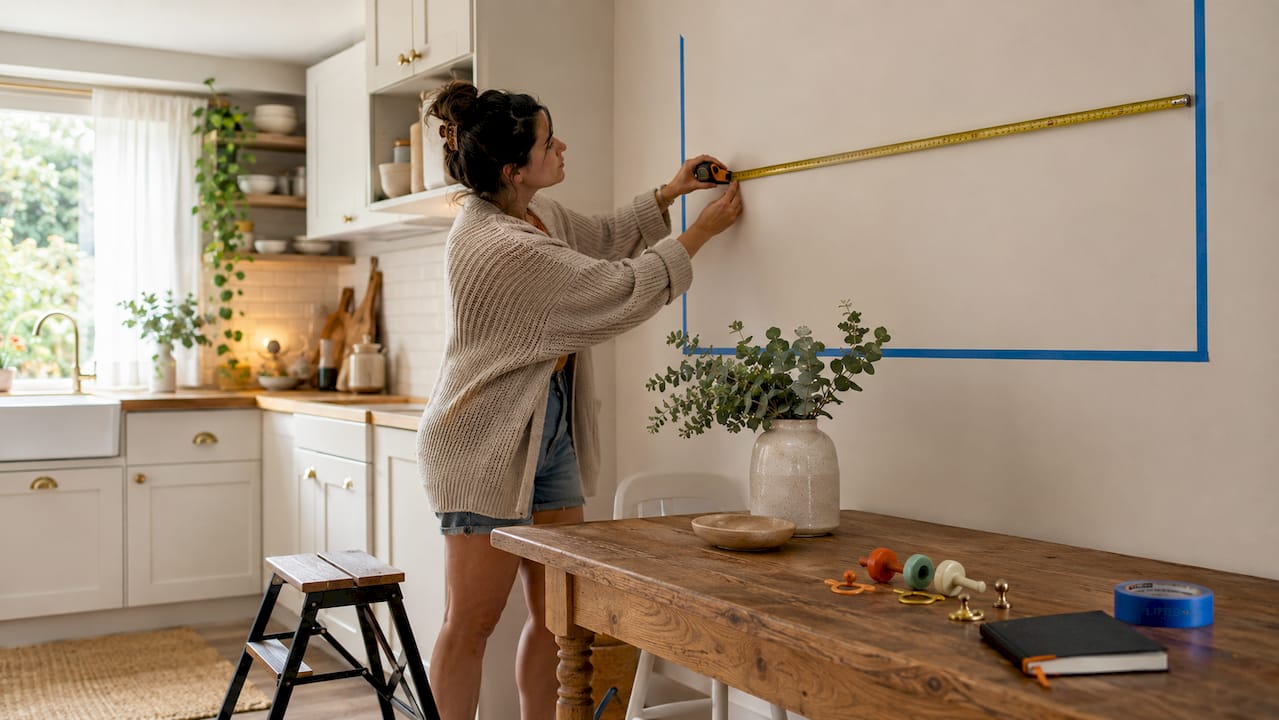
Pro Tip: Before you buy, cut sheets of newspaper or use painter’s tape to map out the exact dimensions on your wall. Living with the outline for a day tells you more than any ruler will.
2. Canvas prints
Canvas prints are the most popular format for large wall decor, and for good reason. The textured surface gives depth that a flat poster cannot replicate. Stretched canvas also eliminates the need for glass, which keeps the piece lighter and easier to hang. For rooms with natural light, the matte finish reduces glare significantly. Canvas suits almost every interior style, from coastal to contemporary, making it the most versatile starting point for statement wall art.
3. Framed oversized prints
A frame changes the entire character of a print. It adds visual weight, signals intention, and creates a finished edge that reads as considered rather than casual. Thin black frames suit modern and minimalist rooms. Wide timber frames work in warmer, more traditional spaces. The frame is not decoration around the art. It is part of the composition.
Framed pieces also protect the print from humidity and dust, which matters in New Zealand’s coastal climates. Retailers like Bed Bath & Beyond offer framed pieces under $200, making this format accessible without sacrificing presence.
4. Acrylic and metal art
Acrylic and metal prints deliver a high-definition finish that no canvas can match. Colour saturation is intense, edges are sharp, and the surface has a luminous quality that catches light differently throughout the day. Metal art in particular suits industrial and contemporary interiors where hard lines and reflective surfaces already exist. Acrylic works well in spaces with strong architectural features, such as exposed concrete or floor-to-ceiling glass. Both formats are heavier than canvas, so mounting method matters more here.
5. Wall tapestries
Tapestries are the largest-scale option available without a frame or rigid backing. They drape softly, absorb sound, and bring textile warmth to rooms that feel cold or sparse. Bed Bath & Beyond stocks tapestries up to 88 by 104 inches, which is large enough to cover an entire feature wall. For renters, tapestries are ideal because they hang from a rod or clips and leave no permanent marks. The soft edge also contrasts beautifully with hard furniture lines.
6. Statement mirrors as oversized art
A large mirror functions as both art and architecture. It reflects light, expands the perceived size of a room, and creates a focal point without adding colour or pattern to the mix. In narrow hallways or compact living rooms, an oversized mirror pulls the space open in a way no painting can. Choose a frame that matches your existing hardware and furniture finishes for a cohesive result. Round mirrors in particular have become a defining feature of contemporary New Zealand interiors.
7. Textile art and macramé
Macramé and woven textile art add tactile dimension that flat prints cannot offer. The knotted or woven surface catches shadow and creates depth that shifts as light moves through the day. These pieces suit bohemian, Scandinavian, and natural material-led interiors. They are also lightweight, which makes them renter-friendly and easy to reposition. Pair a large macramé piece with timber furniture and linen textiles for a grounded, organic aesthetic.
8. Wall sculptures in wood, metal, or ceramic
Three-dimensional wall art brings shape to the air in a way that flat works simply cannot. A large timber relief, a cluster of ceramic forms, or a welded metal composition creates shadow play and physical presence that changes with the time of day. These pieces work especially well in rooms where the furniture is low-profile and the walls carry the visual weight. They are also conversation pieces in a way that prints rarely are. The trade-off is that installation requires more care, as weight distribution across multiple fixing points is critical.
9. Limited edition and bespoke pieces
A limited edition piece carries a different kind of presence. Knowing that fewer than fifty of something exist in the world changes how you see it on your wall. Bespoke commissions go further still, allowing you to specify dimensions, palette, and subject matter to fit your exact space. Liftedplus curates limited edition wall art in extra-large formats specifically for this reason. The investment is higher, but the result is a piece that no neighbour, hotel lobby, or Pinterest board will replicate.
10. Photographic oversized prints
A large-scale photograph commands a room through narrative. A single image of a coastline, a forest canopy, or an abstract close-up of texture can anchor a space as effectively as any painted canvas. The key is choosing an image with strong tonal contrast and a clear focal point. A busy or low-contrast photograph at large scale reads as visual noise rather than art. Black and white photography is particularly effective because monochrome art complements almost any colour palette without competing with existing furnishings.
11. Abstract and contemporary art
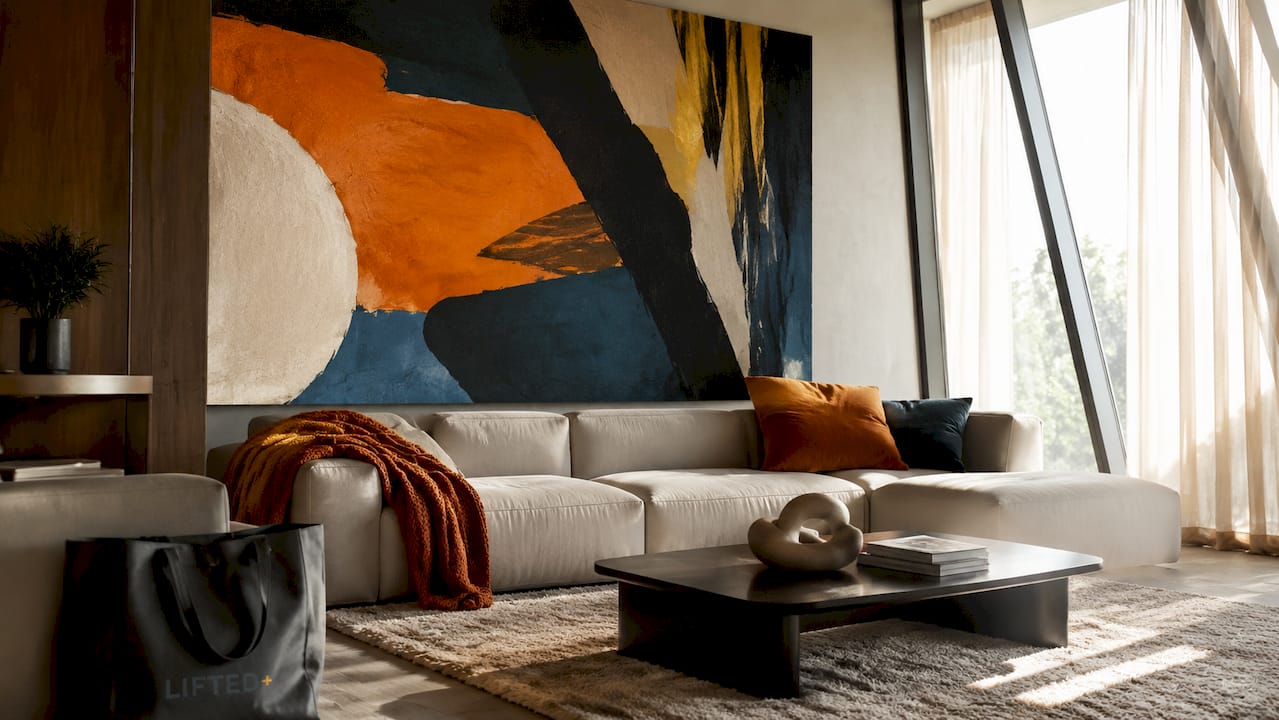
Abstract art is the most forgiving format for large wall decor because it does not demand a literal reading. A large abstract canvas in warm ochre, terracotta, or deep green anchors the room’s colour story and gives the eye somewhere to rest without prescribing a mood. Designer Lynne Alberding advises choosing one bold piece for a single wall rather than distributing smaller works across multiple surfaces. That restraint is what gives the piece its power. One strong abstract work does more for a room than six smaller ones ever will.
12. How to mount oversized art safely
Mounting is where most homeowners make costly mistakes. Heavy or wide pieces require more than a picture hook and a prayer. The French cleat system is the most reliable method for large works because it distributes weight evenly across a horizontal bracket rather than concentrating it at two points. This keeps the piece flush against the wall and dramatically reduces the risk of it shifting or falling.
Always fix into wall studs where possible. Wall anchors work in plasterboard but have weight limits that large art pieces frequently exceed. D-rings and wire are adequate for pieces under 10 kilograms, but anything heavier deserves a more considered solution. Poor mounting is both a safety hazard and a visual one. A piece that tilts or sits proud of the wall loses its authority immediately.
Pro Tip: For pieces valued over $500 or weighing more than 15 kilograms, hire a professional art installer. The cost is minor relative to the risk of damage to the artwork or the wall.
13. How to integrate large wall decor with your existing style
Oversized art works best as a single statement on one wall rather than as part of a crowded arrangement. Dedicate one surface to the piece and keep surrounding walls clear. This is not minimalism for its own sake. It is the act of giving the work room to breathe and the viewer room to see it properly.
Match the frame material and finish to what already exists in the room. A room with warm timber floors and linen upholstery calls for a natural wood frame. A space with black steel shelving and concrete tones suits a thin black or raw metal frame. The art should feel chosen for the room, not dropped into it. For guidance on decorating with oversized art across different interior styles, the principles of proportion and restraint apply regardless of whether your home is modern, traditional, or somewhere between.
14. Where to buy oversized wall art in Australia and New Zealand
Freedom and Temple & Webster both offer custom sizes up to 2.5 metres wide, which covers most residential wall situations. Urban Road specialises in large-format canvas and framed prints with a strong Australian aesthetic. Bed Bath & Beyond carries over 42,000 oversized print options, with prices starting from $60 for unframed prints. Framed pieces generally begin around $200 and scale upward with size and material.
Online purchasing works well when you have done the measuring and know your dimensions precisely. Brick-and-mortar stores allow you to assess colour accuracy and surface texture in person, which matters for large pieces where a slight colour shift becomes very visible at scale. Whichever route you take, use painter’s tape on your wall first. Buying a piece you cannot return is a significant risk when the dimensions are this large.
| Retailer | Format options | Price range |
|---|---|---|
| Bed Bath & Beyond | Prints, tapestries, framed | From $60 |
| Freedom | Canvas, framed, custom | From $150 |
| Temple & Webster | Canvas, framed, custom | From $120 |
| Urban Road | Canvas, framed | From $180 |
| Liftedplus | Limited edition, framed | From $200 |
Key takeaways
Oversized wall art succeeds when size, mounting, and style work together as a single considered decision rather than three separate ones.
| Point | Details |
|---|---|
| Size to furniture ratio | Art should span 60%–75% of the furniture width below it for visual balance. |
| Eye-level placement | Centre the piece at 57–60 inches from the floor for comfortable viewing. |
| Mount for the weight | Use a French cleat system for heavy or wide pieces rather than D-rings or wire. |
| One wall, one piece | A single oversized work on one wall has more impact than multiple smaller pieces combined. |
| Match frame to room | Choose frame material and finish that already exists in your space for a cohesive result. |
Why oversized art is both an art and an engineering problem
The pieces I see fail most often in real homes are not the wrong style. They are the wrong scale, hung at the wrong height, on a wall that was never meant to carry that much visual weight. People fall in love with a piece online, buy it without measuring, and then spend months wondering why the room still feels off.
What I have come to believe is that oversized art is genuinely two problems in one. The first is aesthetic: does this piece have the right colour, form, and character for this space? The second is structural: can this wall hold it, and will it stay level and flush for years? Most buyers solve the first problem and ignore the second entirely.
The other mistake I see constantly is overcrowding. A large piece surrounded by smaller works loses its authority. It becomes part of a conversation when it should be the only voice in the room. Restraint is not a compromise. It is the whole point. When you give a single strong piece the wall to itself, something shifts. The room stops being a collection of objects and starts being a considered space.
My honest advice is to spend as much time choosing your mounting method as you spend choosing the artwork itself. And if you are drawn to three-dimensional wall sculpture or very heavy framed pieces, treat installation as a non-negotiable professional job. The art is worth it. The wall is worth it. Your peace of mind is worth it.
— Michelle
Liftedplus: curated large wall art for New Zealand homes
Liftedplus brings together a considered selection of statement wall art in large and extra-large formats, including limited edition framed works and pieces designed specifically for the scale of modern New Zealand interiors. The collection prioritises colour, form, and presence over trend-chasing, which means each piece is chosen to hold a room rather than simply fill it.
Whether you are a homeowner building a long-term collection or a renter looking for renter-friendly decor ideas that make a genuine impact, Liftedplus has options that work with your wall and your life. Browse the full collection or read the styling guides to find the piece that belongs in your space.
FAQ
What counts as oversized wall art?
Oversized wall art is any piece exceeding 36–40 inches in width or height. At this scale, a single work functions as the primary focal point of a wall rather than as one element among many.
How do I know what size art to buy for my wall?
Art above furniture should cover 60%–75% of the furniture’s width. For bare walls, aim for a piece that fills 50%–60% of the total wall space to remain present without overwhelming the room.
What is the safest way to hang heavy wall art?
A French cleat system is the most reliable method for heavy or wide pieces because it distributes weight evenly and keeps the artwork flush against the wall. Always fix into wall studs where possible rather than relying on plasterboard anchors alone.
Can renters hang oversized wall art?
Yes. Tapestries and textile works hang from rods or clips without permanent fixings. Lighter canvas prints can be hung with removable adhesive strips rated for the appropriate weight, though very heavy pieces require landlord approval for stud fixing.
Does oversized art work in small rooms?
A single well-proportioned oversized piece can make a small room feel larger by drawing the eye upward and outward. The key is choosing one piece for one wall and keeping the surrounding surfaces clear so the work has room to do its job.
Recommended
- How To Choose Art For Double Height Walls – Lifted+ | More Colour. More Mood. More Life.
- How To Decorate With Oversized Art – Lifted+ | More Colour. More Mood. More Life.
- How Big Should Wall Art Be? Get It Right – Lifted+ | More Colour. More Mood. More Life.
- Oversized Art Or Gallery Wall? – Lifted+ | More Colour. More Mood. More Life.