
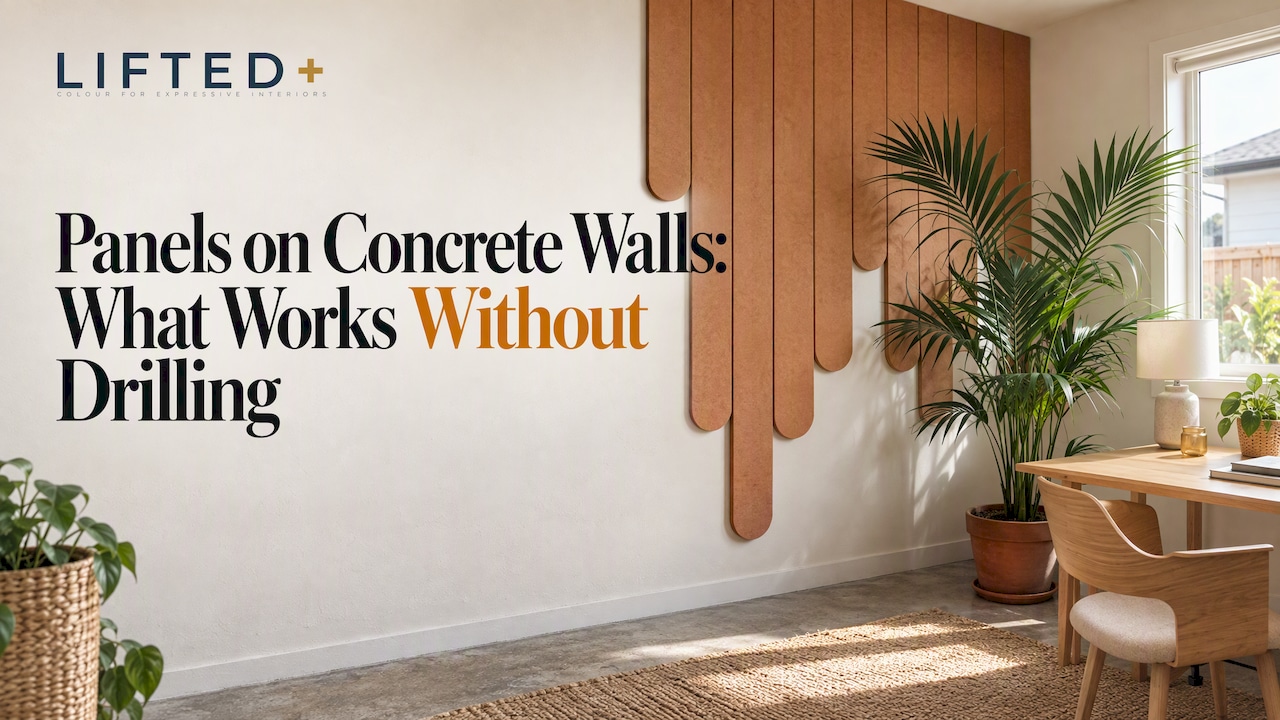
You can put panels on a concrete wall, but how you do it depends on whether the wall is yours to alter. Permanent panels need a sound, dry, clean surface and a fixing method suited to masonry. A removable, renter-friendly feature wall needs something gentler: a lightweight panel, a well-chosen adhesive and a patch test before you commit.
This guide covers both routes, so you can decide which one fits your home, your lease and your sense of colour.
Key takeaways
- Concrete is hard, but it is not automatically easy to stick to. Dust, moisture and a porous or textured surface are what decide whether anything holds.
- Permanent panels (rigid sheets, faux-concrete cladding, timber-look boards) call for surface preparation and masonry fixings. That is a decision for owners, not tenants.
- For a removable feature wall, lightweight PET felt panels with adhesive pads avoid drilling entirely, but they suit smooth, sealed, painted surfaces best and should always be tested first.
- No adhesive is completely damage-proof. Test a small area, document the wall’s condition and follow the removal steps.
- Order a colour sample kit before a full kit. It lets you judge colour and patch-test the wall at the same time.
Table of Contents
- Why concrete walls behave differently
- Permanent panels on concrete: the owner’s route
- What if you rent, or simply do not want to commit?
- Can adhesive hold on concrete?
- Lightweight felt panels as a no-drill alternative
- How to test your concrete wall before you commit
- Choosing colour for a concrete room
- Our perspective on concrete walls
- Start with colour samples
- Panels on concrete walls: your questions answered
- Sources
Why concrete walls behave differently
Plasterboard is forgiving. Concrete is not. It is dense and cold, and it is often more porous than it looks. Many New Zealand apartments, townhouses and basement rooms have concrete or concrete masonry walls, sometimes left raw and sometimes painted. Each finish asks something different of a panel.
There are three things to understand before you choose anything.
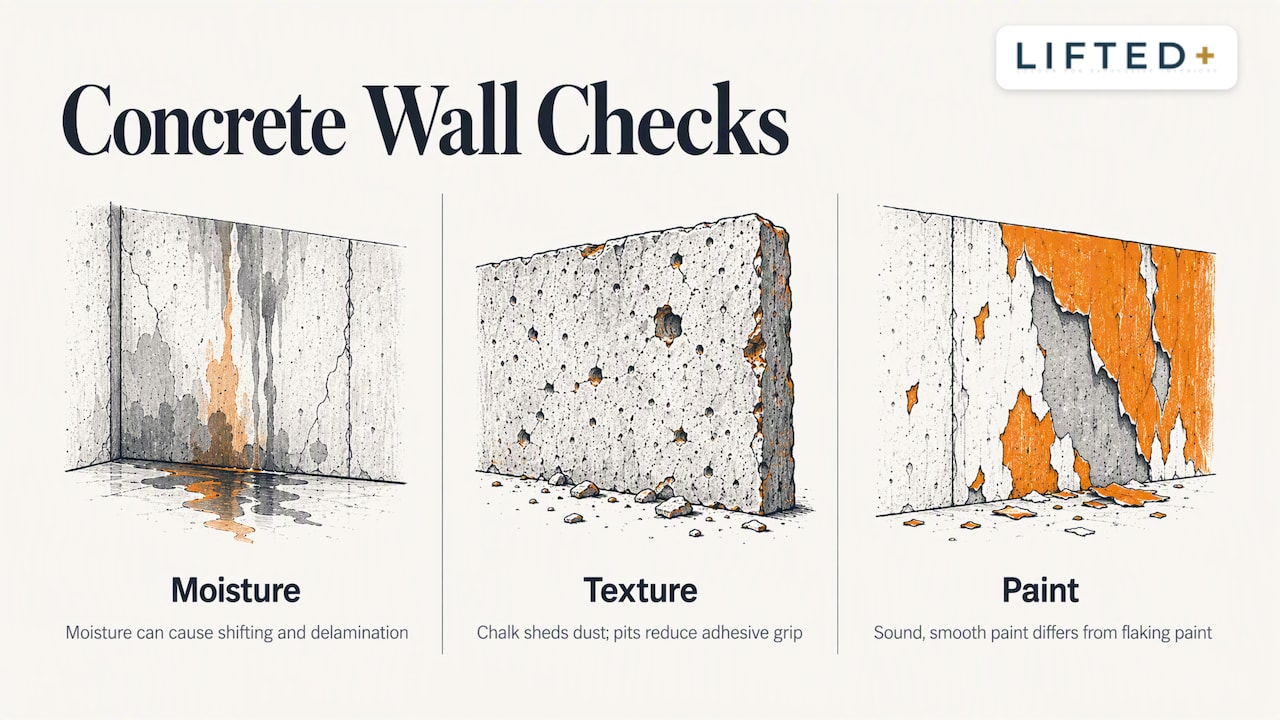
Moisture. Concrete holds and transmits moisture, and a wall that feels dry in summer can behave differently in winter. Installation guidance for one concrete-effect panel system requires concrete to be free of dust, efflorescence and moisture for the panels to bond properly, and it names shifting and delamination as the usual consequences when it is not.
Surface texture. Raw concrete can be rough, chalky or pitted. A chalky surface sheds dust under adhesive, and a pitted one gives an adhesive pad very little flat area to grip.
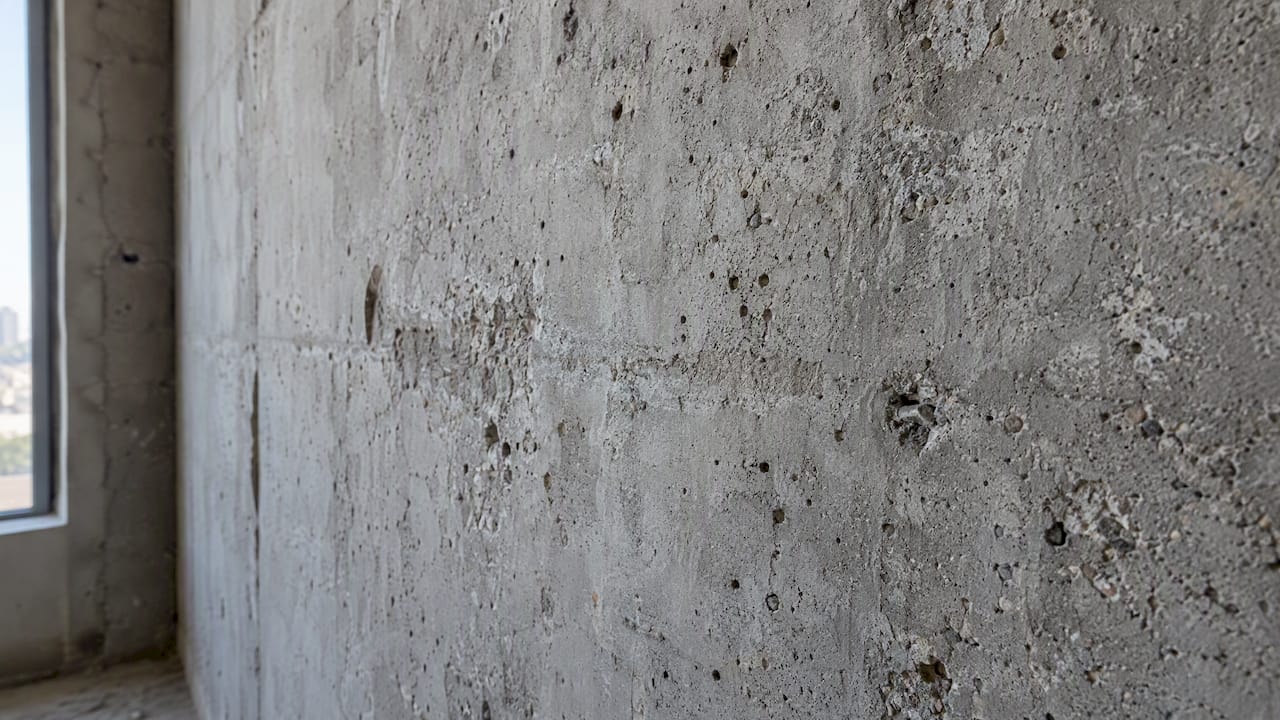
Paint. Many interior concrete walls carry a coat of paint. Paint that is sound and smooth behaves very differently from paint that is flaking, powdery or very old.
None of this rules panels out. It simply means the wall comes first and the panel second.
Permanent panels on concrete: the owner’s route
If you own the home and want a lasting finish, the search results are full of options: wave-profile concrete sheets, faux shuttered concrete, roughcast-look cladding and wood-composite boards. They are a different category from a removable feature wall, and they come with a different set of obligations.
Preparing the substrate
Manufacturers of permanent systems are consistent on this: the wall must be sound, dry and clean. Some ask for a moisture test or an approved sealer so the surface is not porous enough to defeat the adhesive. The installation guide quoted above also stresses acclimatising panels before fixing, which matters because a panel that moves after it is fixed will pull at its bond.
Fixing methods
Rigid panels on concrete are typically fixed with masonry anchors, battens or a manufacturer-approved adhesive. These are permanent decisions. They leave holes, residue or a new framing layer, and they are hard to reverse.
Moisture and building rules
New Zealand’s building code treats moisture seriously. If your concrete wall is external, below ground or part of a bathroom or laundry, check the relevant guidance before adding any lining. The Building CodeHub lining guide notes that specifying and fixing internal linings takes real skill if the result is to perform in its environment. For wet areas, Clause E3 on internal moisture requires wall surfaces next to sanitary fixtures to be impervious and easily cleaned. A porous felt or fabric panel is not the answer there.
If your project involves structural work, a damp problem or a lining that must meet code, speak to a licensed builder or your local council before you buy anything.
What if you rent, or simply do not want to commit?
Most tenants cannot drill into concrete, and many owners would rather not. A tenancy agreement usually limits fixings, and the type of wall can shape what is allowed or practical, along with repair responsibility. Always check your agreement and ask your landlord in writing before you change anything.
The first question is what you are trying to achieve. Often it is not a concrete look at all. It is colour, texture and a sense that the room belongs to you. That is where a removable wall design comes in: colour without commitment, texture without renovation.
Tenants in particular tend to fall back on neutral walls out of caution rather than preference. Property managers say the fear of the end-of-tenancy inspection is usually what holds people back, and that following manufacturer removal instructions and photographing the wall before and after puts you in a much stronger position.
Can adhesive hold on concrete?
Sometimes, and only under the right conditions. Adhesive hanging products tend to perform best on smooth, painted plasterboard and are less reliable on textured paint, brick or panelling. Concrete sits closer to the difficult end of that range, which is why it needs more care.
Here is how common concrete finishes tend to compare for a lightweight, removable panel.
| Wall finish | How adhesive pads are likely to behave | What to do |
|---|---|---|
| Smooth, sealed, painted concrete in good condition | Best case for a removable system | Clean, dry, patch test |
| Painted concrete block with visible joints | Pads may bridge joints and lose grip | Position pads on flat faces; test thoroughly |
| Raw, unpainted concrete | Porous and often dusty; weak bond | Seek landlord or owner approval to seal, or choose a freestanding option |
| Chalky, flaking or damp wall | Poor grip and higher risk to the surface | Do not use adhesives; fix the underlying issue first |
| Textured or bagged finish | Uneven contact area | Test small; expect mixed results |
The honest summary: we do not claim our panels suit every wall, and concrete is a surface where testing matters more than usual.
Lightweight felt panels as a no-drill alternative
DwellForms™ by Lifted+ is a New Zealand-designed modular wall system made from precision-cut PET felt, which is produced from 100% recycled plastic. The panels are light, they are installed with adhesive pads rather than screws, and they can be removed, rearranged and taken to your next home. There is no paint, wallpaper or drilling involved.
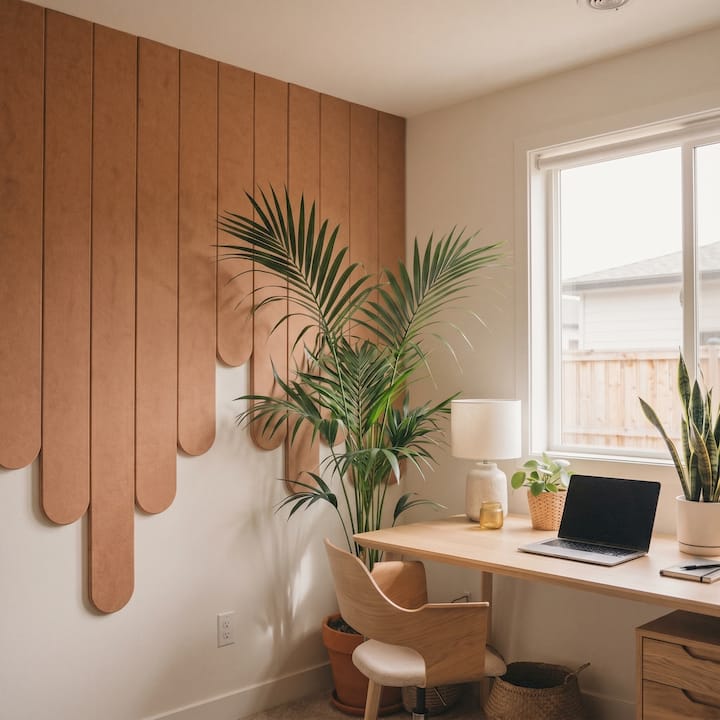
That lightness is the point on concrete. A heavy rigid panel needs structural fixings. A light felt module needs only a small, well-placed contact area, which is why a modular layout can work where a full-coverage sheet cannot. Building guidance reflects the same idea: designers are advised to allow for variation in wall size and moisture rather than rely on a single full-coverage treatment, which can be hard to maintain or move.
A note on our adhesive
We tested several adhesive options before settling on the nano-adhesive pads that come with our kits. We deliberately discounted one popular pull-tab brand, because in our own testing the pads we chose performed significantly better at minimising damage to walls. “Minimising” is the honest word. No adhesive is completely damage-proof, and it can react badly with older paint finishes or brittle plaster, so we never promise a guaranteed result.
What a felt panel is not
It is not a soundproofing product, and it is not a commercial acoustic treatment. We do not sell it as either. Some felt products elsewhere are specified for acoustic work or direct-glue applications, but that is a different category with different installation methods. DwellForms™ is a colour-led feature wall designed for homes.
How to test your concrete wall before you commit
A short test saves a lot of regret. Work through these steps in order.
- Look at the wall in daylight. Check for chalky dust, flaking paint, white salt deposits or damp patches. If you see any, stop and deal with that first.
- Run your hand across it. If your palm comes away powdery, the surface will not hold an adhesive.
- Wipe a small patch. Use a lightly damp cloth, let it dry fully, and check that the paint does not lift.
- Photograph everything. Take dated photos of the wall before you start, including corners and any existing marks. Repeat after removal.
- Order colour samples. A sample piece lets you press a pad against the wall, leave it for a few days, then remove it and see what happens.
- Plan the layout on the floor. Arrange panels on the floor first, then decide where each pad will land so they sit on flat faces, not on joints or pits.
- Install, then check again. After a week, check that no corner is lifting before you add more panels.
If you want a closer look at the removal side, our guide on removing adhesive wall panels without wrecking the wall walks through it. For broader reassurance, see our damage-free wall panels guide for renters.
Choosing colour for a concrete room
Concrete is cool, grey and quiet. That is a gift if you know how to use it, because colour reads strongly against it.
Warm tones such as terracotta, ochre and soft coral lift a cool room and make a concrete wall feel inhabited. Deep blues and greens deepen the mood and suit a bedroom or reading nook. A tonal palette of one hue in several depths reads as architectural rather than decorative. Our guide to mixing colours in interiors shows how to pair shades with confidence, and how to use colour to lift a room covers the principles behind it.
There is also a small, practical advantage in a modular layout. Because each module is separate, you can build the composition outward, add to it later with an extension kit and avoid committing an entire wall on day one. Our explainer on extending wall panels without drilling covers how that works.
For ideas on what to put around the wall, browse no-drill decor ideas for small spaces, which shows how much character you can add to a rental without a single hole.
Our perspective on concrete walls
We get asked about concrete often, usually by someone standing in an apartment with a blank grey wall and a lease that says no holes. The question underneath is rarely technical. It is: can I make this feel like mine?
Our answer is yes, with honesty about the limits. Concrete is not our easiest surface, and we would rather you know that before you buy than discover it on a Sunday afternoon with a panel sliding down the wall. Painted, smooth, sound concrete is a good candidate. Raw, chalky or damp concrete is not, and we will say so.
What we believe in is the principle behind the product: a rented home should be allowed to have colour. Neutral, temporary-feeling rooms are too often the result of caution rather than taste. A considered cluster of sculptural panels pulls a space out of the safe, polite middle without asking anything permanent of the building.
So test first, photograph the wall, start with samples and build outward. A wall that holds the room is worth a little patience.
— Michelle
Start with colour samples
If you are unsure how your concrete wall will respond, begin small. Our DwellForms™ Colour Samples let you see the felt in your own light and patch-test the wall, and sample purchases are credited towards a full kit order. When you are ready, the DwellForms™ Core Kits are the place to start, and you can add to them later with the Extension Kits.
Panels on concrete walls: your questions answered
Can you put panelling directly on concrete walls?
Yes, but the method depends on the panel. Rigid panels are usually fixed with masonry anchors, battens or a manufacturer-approved adhesive, and the wall must first be clean, dry and sound. Lightweight removable panels can go on with adhesive pads, provided the surface is smooth, sealed and tested first.
What is the cheapest way to cover a concrete wall?
Paint is usually the lowest-cost permanent change, but a tenant generally cannot paint without permission. For a renter, the cheapest route to a finished look is often a small modular layout that you can expand over time, rather than a full-wall treatment.
What kind of panelling can I use on cement walls?
Permanent options include wave-profile concrete sheets, faux-concrete cladding and wood-composite boards, all of which suit owners who can drill or glue. For a removable wall design, light PET felt modules with adhesive pads avoid drilling altogether, though they work best on smooth, sealed surfaces.
How much does concrete wall panelling cost?
Prices vary widely by material, wall area and whether you pay for installation, so get quotes from local suppliers and installers. Our own kits are priced on the product pages, and a modular layout lets you spread the cost by starting with a core kit and extending later.
Will adhesive panels damage my concrete wall?
We cannot promise they will not, and no adhesive is completely damage-proof. Risk rises on raw, chalky or old painted surfaces. A patch test, before and after photos and careful removal give you the best chance of leaving the wall as you found it.
Sources
- Concreate installation guidelines (ArchiPro NZ)
- Good Practice Guide: Internal lining, 2nd edition (Building CodeHub)
- Acceptable Solutions and Verification Methods for Clause E3 Internal Moisture (MBIE)
- How to Personalise a Rental NZ: Tenant Guide and Legal Rights (Property Plus)
- Can You Hang Nails In Your Apartment? (Nailicy)
- No Drill Mirror Mounting NZ: Options for Rental Properties (CF Creation)
Recommended
- No Drill: 3 Ways To Fit Panels On Textured Walls For Renters
- Getting Panels On Curved Walls Right Without A Single Drill Hole
- Extend Wall Panels Without Drilling: Renter Safe DwellForms™ Kits
- No Drill Wall Panel Corners For Renters: 1–2mm Gap, 20mm V Groove
This article is for general information and inspiration only. Product performance and results may vary depending on individual circumstances, surfaces and installation.
