
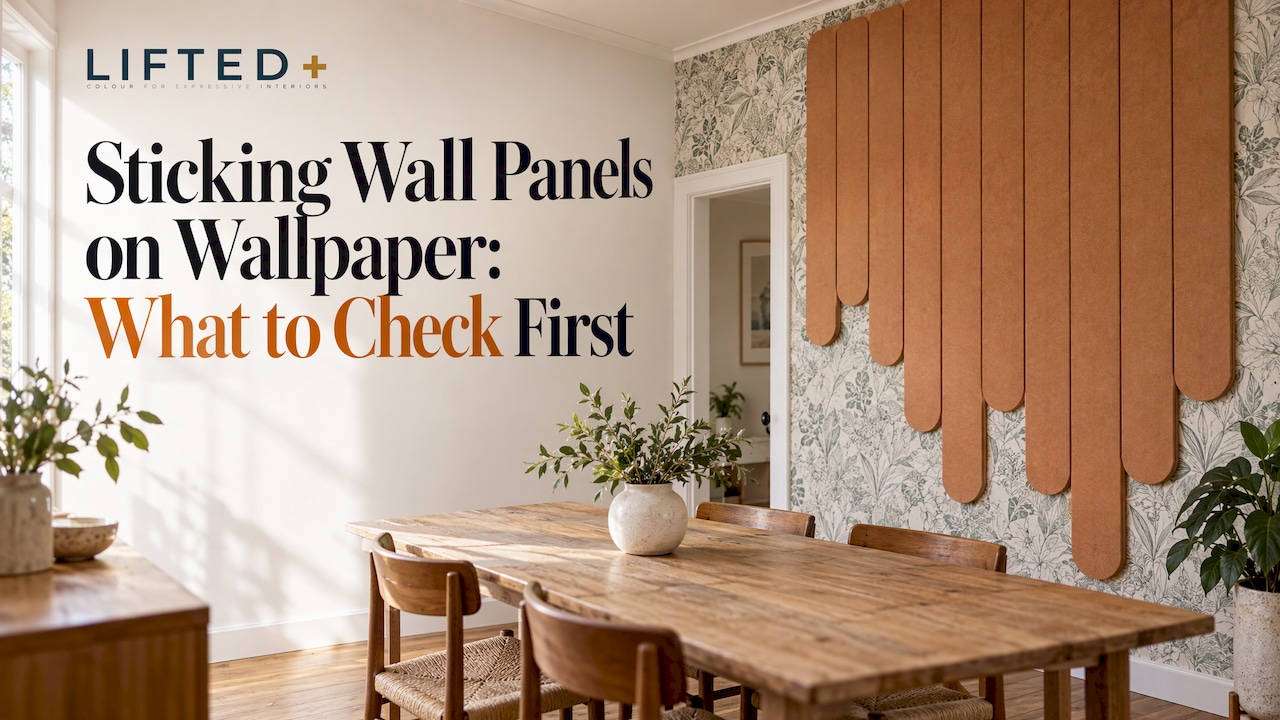
You have a wall with wallpaper you did not choose, a lease or a budget that rules out stripping it, and a strong urge to put something colourful in its place. The good news is that you can often stick lightweight decorative panels over wallpaper. The catch is that the wallpaper, not the wall, becomes the surface your adhesive holds onto, so the condition of that paper decides how well the panels hold and how cleanly they come off later.
This guide walks through what to check, how to test, how to fit panels without bubbles or lifting, and what to do when the wallpaper is simply not a good candidate. We have written it for renters, owners, apartment dwellers and anyone working from a spare room with a very beige view.
Key Takeaways
- Panels can work over wallpaper that is smooth, firmly stuck down, clean and dry. Loose seams, bubbles, flocking, heavy embossing and damp are the common reasons they do not.
- Adhesive grips the wallpaper, so the wallpaper is the thing at risk on removal. A small test patch in a hidden spot tells you far more than any guess.
- Our DwellForms™ kits use nano-adhesive pads that we selected after testing several options. No adhesive is completely damage-proof, so patience and preparation matter.
- Humidity, cold external walls and fresh, strong initial tack all change how adhesive behaves. Fit in dry, mild conditions and leave panels alone once they are up.
- If the wallpaper fails the checks, you still have good no-drill options, from sealing and lining the surface to leaning art or mirrors.
Table of Contents
- Why wallpaper changes the question
- Check the wallpaper before you touch a panel
- The ten-minute test patch
- Why timing and conditions matter
- How to fit panels over wallpaper without bubbles or lifting
- Taking panels down from wallpaper
- Our perspective
- When wallpaper is not a good surface
- Different homes, different answers
- Choosing colour against patterned paper
- Ready to try it on your wall?
- FAQ
- Sources
Why wallpaper changes the question
A plain painted wall is a relatively predictable surface. Wallpaper is a sandwich: paste, paper (or vinyl, or a paper-backed textile), sometimes a printed or coated top layer, then the wall. When you press an adhesive pad onto it, you are asking the top layers to carry the load and to stay put when you pull the panel away.
That is why the same panel can behave very differently on two walls that look similar. A well-bonded vinyl wallpaper hung properly a few years ago may be a perfectly sound surface. A paper that is lifting at the seams, or was hung over unprimed plaster, may come away with the pad in a sheet.
So the honest answer to “can I stick panels on wallpaper?” is: sometimes, and you can find out which case you are in within about ten minutes.
Check the wallpaper before you touch a panel
Start with the paper itself. Walk the wall in good side light, with a window or a torch held at a low angle, because shadows reveal what flat daylight hides.
Is it firmly stuck down?
Press your palm across the surface, then run a fingertip along every seam and along the top edge near the ceiling and the skirting. You are looking for bubbles, hollow patches, curling corners and seams you can slip a fingernail under. Any of those means the paper is not bonded to the wall, and an adhesive pad will simply be bonded to something that is itself unattached.
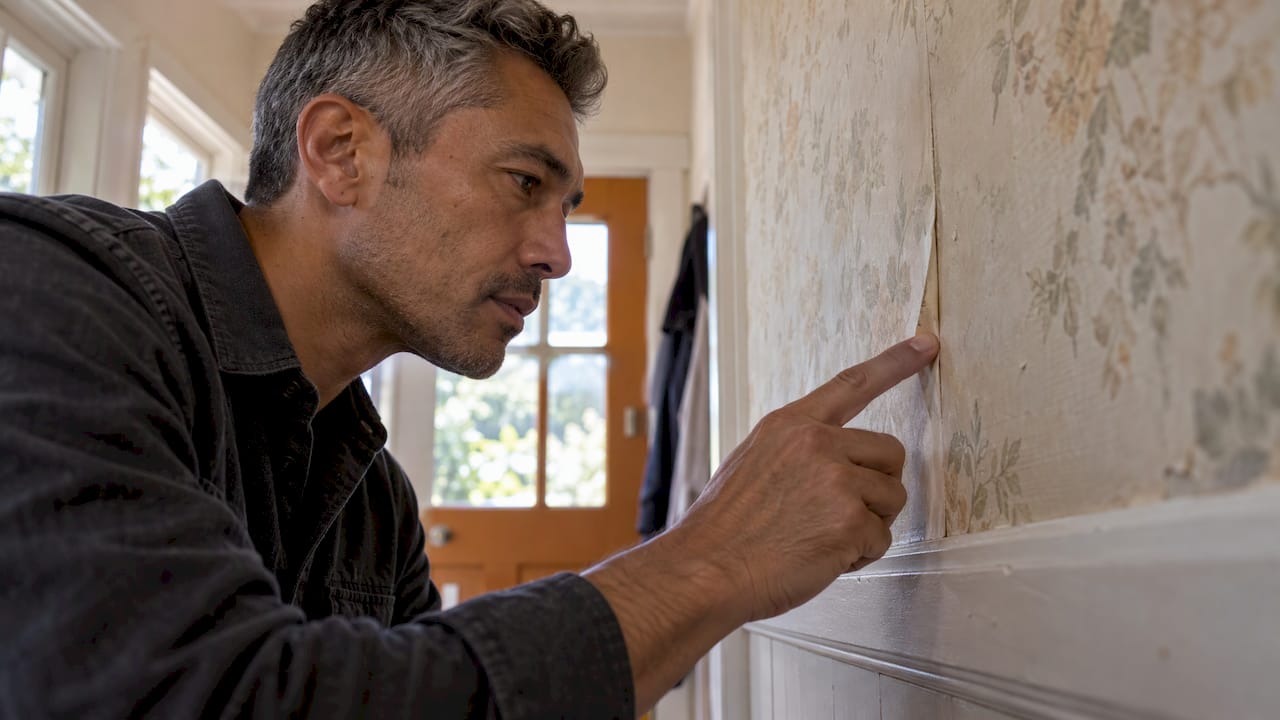
A hollow sound when you gently knock with a knuckle is another clue. A solid, dull sound suggests the paper is well attached.
What is the surface like?
Smooth, matte or satin vinyl and tightly woven papers are the friendliest. Flocked papers, deeply embossed patterns, foils, grasscloth and anything with a dusty, powdery feel are harder. Pads need enough flat contact area to grip, and texture reduces that area. If your paper has a pronounced relief, our guide to fitting panels on textured walls without drilling covers how to think about contact area, and the notes on installing felt wall panels on texture go further.
Is there any sign of damp?
Brown tide marks, a musty smell, peeling near windows or in a bathroom corner, and wallpaper that feels cool and slightly clammy are all warnings. Adhesive and moisture are not friends, and a damp wall is a maintenance problem to fix first, not a decorating problem. If you rent, tell your landlord or property manager about it in writing.
Is it clean?
Kitchens and hallways collect a fine film of grease and dust. Wipe the area where pads will sit with a barely damp, lint-free cloth and let it dry completely. Do not soak wallpaper: water can lift seams and stain paper.
For a practical, trade-side view of judging wallpaper condition and wall flatness before you decorate, these painting and decorating checks are worth a skim.
The ten-minute test patch
No checklist replaces a test. It is the single most useful step, and it costs you almost nothing.
- Pick a spot that will be hidden once the panels are up, such as behind where a panel will sit, near a corner, or behind a piece of furniture.
- Clean the spot and let it dry.
- Press a single pad (or a small offcut of panel with a pad) firmly for the time the product instructions give.
- Leave it for at least 24 to 48 hours in the room’s normal conditions.
- Peel it away slowly, at a low angle, folding the panel back on itself rather than pulling straight out.
- Look at the paper: any lifting, whitening, torn surface or glossy residue tells you what to expect.
If the test patch comes away clean, that is encouraging, not a guarantee. If the paper lifts even slightly, treat that as your answer and move to one of the alternatives further down.
Our colour samples are handy here for a second reason: you can check how a colour looks against your wallpaper’s tones in your own light while you test the surface. Sample purchases are credited towards a full kit order.
Why timing and conditions matter
The riskiest moment for any peel-and-stick product is often right after it goes on. In a test of 12 peel-and-stick wallpaper brands on smooth walls, Wildfire Interiors found that about half pulled off paint or some drywall when removed after one week, while after three months 11 of 12 came off clean. A three-year installation still left residue and took paint with it. That was a hobbyist test of wallpaper rather than panels, so read it as a pattern rather than a rule: adhesive grabs hardest at first, softens a little with time, and very long installs bring their own problems.
What this means for you in practice:
- Do not fit panels, then decide a day later you hate the layout and rip them off. Plan the layout on the floor first.
- If you must move a panel soon after fitting, go slowly and use a low peeling angle.
- If panels will stay up for years, check them occasionally and take them down gently when the time comes.
Conditions matter too. A New Zealand rental guide from Property Plus notes that Wellington’s humidity can affect the adhesion of removable wallpaper, particularly in south-facing rooms. The same logic applies to panels on paper. A cold, south-facing external wall in a Dunedin or Wellington winter is a harder place for adhesive than a warm interior wall in Auckland in summer. Our notes on how renters help removable adhesive hold in humidity cover the practical side.
How to fit panels over wallpaper without bubbles or lifting
Felt panels are not wallpaper sheets, so bubbles are less of a worry than with a full roll of peel-and-stick. The real enemies are lifting corners and a bond that never properly formed. Here is a sequence that keeps both in check.
Prepare the surface
Glue down any slightly raised seam with a thin line of wallpaper seam adhesive and hold it flat until it grips. Smooth out small bubbles by slitting them with a craft knife and pressing paste underneath. Anything bigger than your palm, or any area that keeps lifting, is a sign the paper should be removed in that section or the plan changed.
Plan the layout before you peel anything
Lay the panels on the floor in your chosen arrangement. Photograph it. Then hold individual panels up to the wall with low-tack painter’s tape to judge scale. This is also the moment to decide where pads will land. Try to keep them off seams and off any patch you repaired.
Work in mild, dry conditions
Aim for a comfortable room temperature and a dry day. Avoid fitting straight after a shower in a bathroom-adjacent room, or in a space with a dehumidifier-worthy musty smell.
Press, hold, then leave
Place the panel, press firmly across each pad and hold for the time given in your kit’s instructions. Then leave it. Fiddling with a panel in its first hours disturbs the bond.
If you want the step-by-step, our felt wall panels installation guide takes you through a full layout.
Photograph the wall first
Take clear photos of the wall before you start and again once panels come down. It is a simple habit that Property Plus also recommends for tenants, and it protects you if there is ever a question about older or unusual surfaces.
Taking panels down from wallpaper
Removal is where wallpaper differs most from paint. A pad that has bonded to the paper is stronger than the paper’s bond to the wall in some cases, so the paper can lift with it.
Slow and low is the rule. Warm the area gently with a hairdryer on a low setting to soften the adhesive, start at a corner, and fold the panel back along itself rather than pulling it out at ninety degrees. Hold the wallpaper down with your other hand right beside the pad as you go. Any residue can usually be lifted with a soft cloth and a little gentle pressure; avoid solvents on paper.
We have a full walkthrough in how to remove adhesive wall panels without wrecking the wall, and a broader look at what to know about adhesive and paint if parts of your wall are painted rather than papered.
Our perspective
We design DwellForms™ for people who want colour without commitment, and wallpaper is one of the most common reasons we hear that “I can’t do anything with this wall”.
Here is how we think about it. Wallpaper is not a no. It is a question, and the answer lives in the condition of the paper. We tested several adhesive options while developing our kits, and we deliberately set aside one popular pull-tab brand because our selected nano-adhesive pads performed significantly better in our own testing at minimising damage to walls. We say minimising because we will never tell you any adhesive is completely damage-proof, and we would be wary of anyone who does.
What we can offer is a system built around removable wall design. Modular panels in precision-cut PET felt made from 100% recycled plastic, light enough to be carried by pads, arranged in sculptural patterns that read as a considered feature wall rather than a patch of felt. If the wallpaper passes your checks and your test patch, you get texture without renovation. If it does not, we would rather you know before you fit a single panel.
The best decorating is the kind you can undo, move and take to the next place. Start small, test honestly, and let colour do the rest.
Michelle
When wallpaper is not a good surface
Sometimes the checks come back with the wrong answer. That is not the end of the project, and several routes stay open without a drill.
Seal or line the surface first
If the paper is sound but powdery or slightly porous, a coat of clear wallpaper primer or sealer can make a steadier face for pads. Check with your landlord before you do it, because it is a change to the wall, and for renters it may not be permitted. For owners, it is a sensible prep step.
Remove the loose section only
A single failing strip can be cut back and the wall behind it repaired and painted, leaving the rest. Panels can then be arranged so pads land on the sound areas.
Swap the layout, not the wall
Panels do not need to cover the whole wall. A compact cluster above a sofa or a bed head, placed over the best-bonded area, can give you plenty of presence. Our Extension Kits let you grow a layout later, and the guide on extending wall panels without drilling shows how.
Lean it, shelve it, mirror it
Large wall art or a mirror leaning on a sideboard or picture ledge adds colour to a wallpapered wall with no contact at all. Not every wall needs to carry the weight of your ideas.
Different homes, different answers
Renters usually have the tightest constraints, since a landlord may allow removable decor but not repairs. Check your tenancy agreement, document the wall with photographs, and consider asking in writing. Our guide to damage-conscious wall panels for renters goes into this.
Homeowners with inherited wallpaper have more freedom. You can seal, repair or strip, and panels over good paper can be a stepping stone while you decide whether to redecorate. Our homeowner’s guide to decorative wall panels looks at the bigger picture.
Apartment dwellers often have older paper in body-corporate buildings, and sometimes limits on what you can do to common walls. Home-office workers can use a single panelled wall as the backdrop for video calls, which has the pleasing side effect of making you look as if you planned your life. And if you move often, our pieces on reusing wall panels without drilling and reusing modular panels in your next home explain how a layout travels with you.
Choosing colour against patterned paper
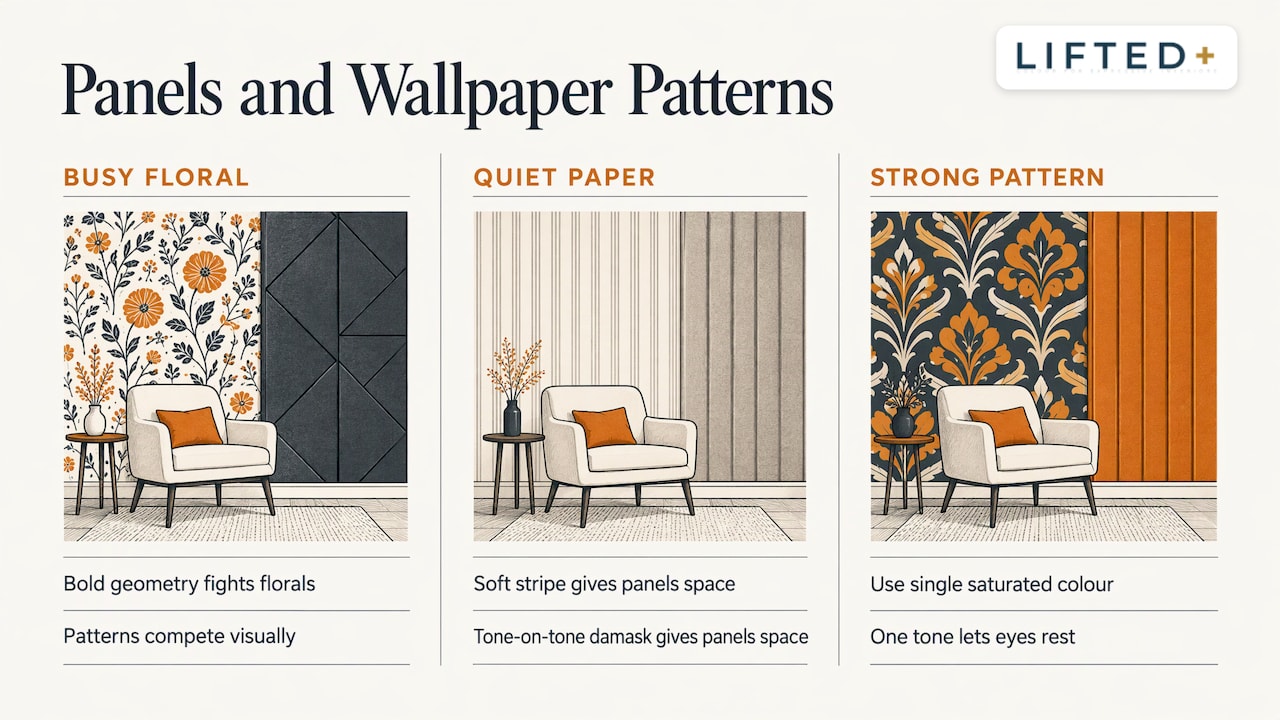
Patterned wallpaper brings its own colour story, and panels sit in front of it, so the two need to talk to each other. A busy floral behind bold geometric felt will fight. A quiet paper in a soft stripe or a tone-on-tone damask gives panels space to lead.
Pick one colour already present in the paper and echo it in one or two panels, then add a contrasting accent. It is the interiors equivalent of wearing one thing that matches your shoes. Our practical guide to mixing colours in interiors is a good companion, and the Colour Library Box lets you hold the felt against your wall in your own light before you commit.
If the paper is strongly patterned across the whole wall, consider panels in a single saturated colour. The calm of one tone gives the eye somewhere to rest.
Ready to try it on your wall?
If your wallpaper has passed the checks, our DwellForms™ Core Kits give you modular, removable PET felt panels, adhesive pads and layout guidance in one set, so you can build a renter-friendly feature wall without drilling or paint. Not sure about the colours or the surface? Begin with a sample, which is credited towards your full kit.
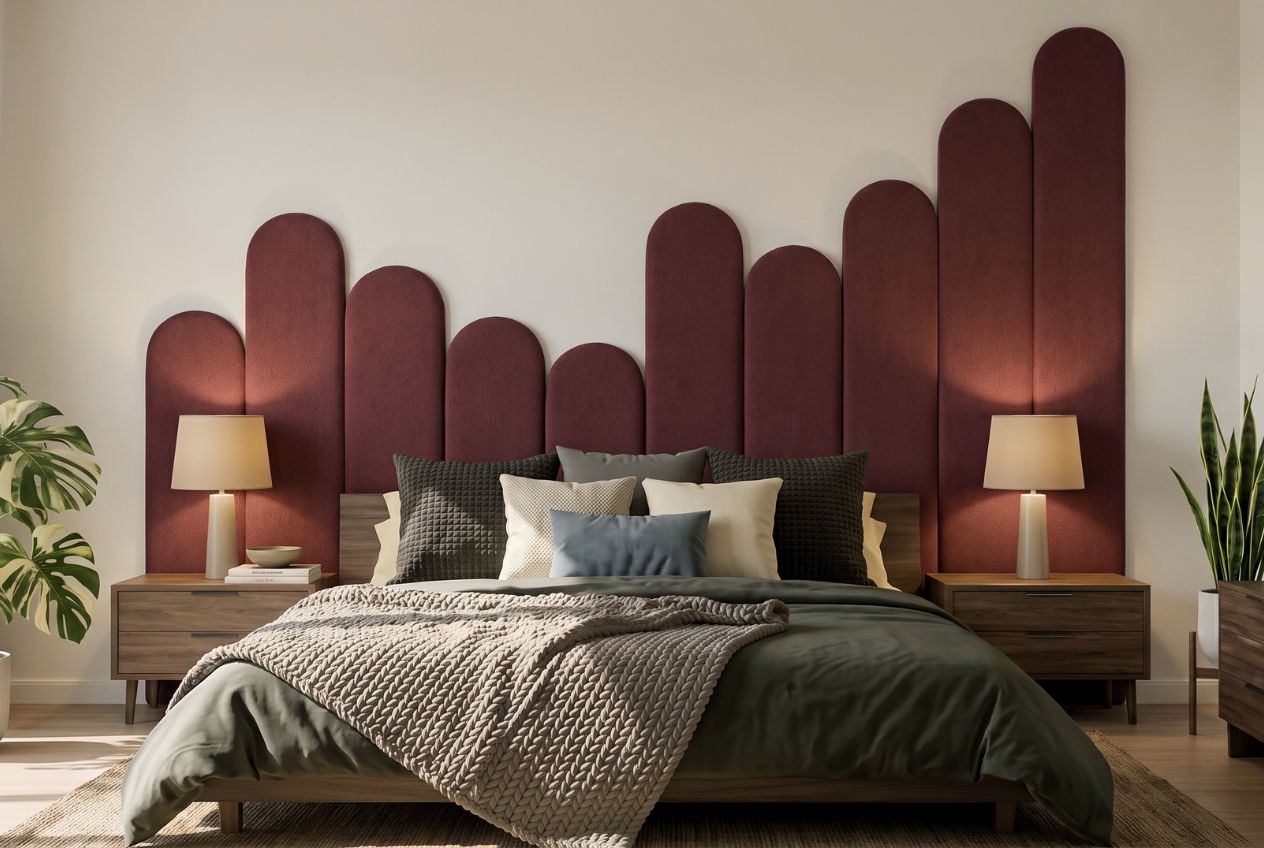
If you prefer to browse before buying, our guide to buying modular wall kits online sets out what to compare.
FAQ
Can you stick wall panels over wallpaper?
Often, yes, if the wallpaper is smooth, clean, dry and firmly bonded to the wall. Seams that lift, bubbles, flocking, deep embossing and damp make it a poor surface. Always do a hidden test patch first, and remember that no adhesive is completely damage-proof.
Will removing panels damage the wallpaper?
It can, because the pad bonds to the paper rather than the wall. Removing slowly, at a low angle and with gentle warmth from a hairdryer reduces the risk, and the test patch shows how your paper behaves. Adhesive also tends to be at its strongest in the first days after fitting, so avoid moving panels early.
Can you put peel-and-stick wallpaper on a textured wall or over old paper?
Texture reduces the contact area adhesive needs, so results are weaker on heavy relief. Smooth, well-bonded old paper is a better base than bumpy plaster or embossed vinyl. For textured surfaces, see our guide to fitting panels on textured walls.
Can you put wallpaper on top of wall panels?
Felt panels are designed as a sculptural feature in their own right, not as a base for wallpaper. If you love a patterned wall, put the paper on the wall and let panels cover a feature section instead, or choose a colour that complements the pattern.
Sources
- What I Learned Testing 12 Peel & Stick Wallpapers on Smooth Walls, Wildfire Interiors
- How to Personalise a Rental NZ: Tenant Guide & Legal Rights, Property Plus
Recommended
- No Drill: 3 Ways To Fit Panels On Textured Walls For Renters
- Panels On Plasterboard: What Works, And What Doesn’t
- Felt Wall Panels Installation: A Renter-Friendly Guide
- How To Remove Adhesive Wall Panels Without Wrecking The Wall
This article is for general information and inspiration only. Product performance and results may vary depending on individual circumstances, surfaces and installation.
