
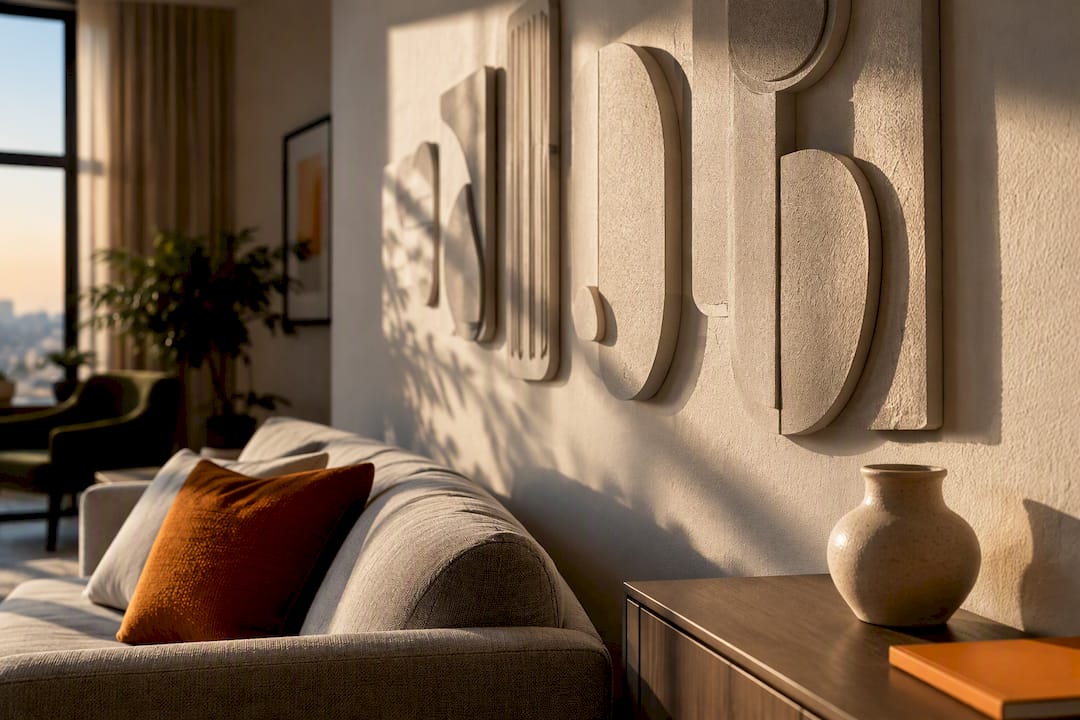
The most versatile approach to 3D wall decor right now is a mix of modular, removable panels and shallow sculptural pieces, chosen for one focal zone rather than an entire wall. This route gives you colour, shadow and texture without paint, plaster or holes, and it suits anyone who rents, moves often, or simply wants room to change their mind. Before you buy or build anything, test your adhesive on a hidden patch of wall and settle on a single feature zone. Scale the piece to that zone, not the other way around.
TL;DR:
- Modular felt panels are ideal for renters because they are lightweight, adhesive-reliant, and easily reconfigured without wall damage.
- Geometric, layered wood, and botanical relief styles are among the most popular 3D wall decor options due to their visual impact and versatility.
- Proper adhesive testing on concealed wall areas can prevent damage when mounting lightweight or DIY relief pieces, especially in rental properties.
- Lighting techniques such as wall washers or LED backlighting can significantly enhance the depth and shadow effects of textured and relief panels.
- Larger, heavier materials like solid wood and metal require proper wall fixings, not just adhesive, to ensure safety and durability over time.
Table of Contents
- 3D wall art ideas organised by visual family
- DIY 3D wall projects that stay renter-friendly
- Materials, finishes and lighting that shape the depth
- Placement and scale: getting the proportions right
- 2026 trends and how to style them without clashing
- A renter-friendly route: modular removable panels
- Keeping 3D wall decor looking good over time
- What 3D wall decor actually costs
- Safety first with heavy or sharp-edged pieces
- Using light to bring 3D decor to life
- Why I’d rather see a wall done imperfectly than not at all
- How DwellForms™ kits help you build a no-drill feature wall
- Sources
- FAQ
3D wall art ideas organised by visual family
Not every three dimensional wall decor style behaves the same way on a wall, and knowing the family you’re working with saves you from an expensive mismatch. Some idea types are architectural and heavy. Others are paper-thin and forgiving. The best 3D wall art ideas tend to fall into ten recognisable families, each with its own scale, room fit and renter-friendly variant.
Modular geometric panels. Hexagon clusters, chevron sets and repeating triangle tiles remain the most reliable entry point into dimensional wall design, largely because they’re built to be arranged and rearranged. Design coverage from Architectural Digest points to geometric panelling as one of the strongest idea families in current wall decor, alongside layered shapes and wave relief. The renter-friendly variant is a shallow felt panel system with a flat back, so it sits close to the wall and relies on adhesive pads rather than fixings.
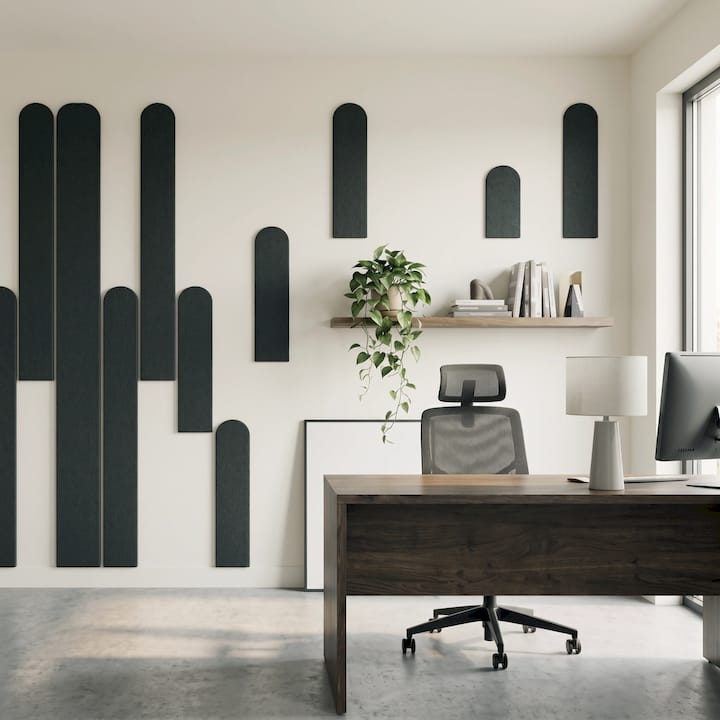
Wave and fluted relief panels. These read as sculptural water or sand ripples across the wall and work brilliantly as a single accent strip rather than floor-to-ceiling coverage. A scaled-down version, sometimes just 60 to 90 centimetres wide, gives you the same rhythm and shadow play without the commitment of a full architectural install.
Layered wood and plywood wave panels. Thin plywood strata, cut and layered to mimic topographic contours, bring genuine depth and warmth to a room. They’re heavier than felt or paper options, so lightweight mounting matters here. Look for versions under a few kilograms per panel and always check what your adhesive is rated to hold before hanging.
Textured canvas and palette-knife relief. A single canvas built up with plaster medium or heavy body paint gives you visible ridges and ambient shadow without any wall-mounted hardware beyond a standard picture hook. It’s framed like flat art, hung like flat art, and reads as sculptural because of the surface, not the mounting.
Metal and mirror sculptures. These pieces earn their keep through how they catch and bounce light rather than through raw size. A brushed-metal starburst or an abstract wire piece will shift character completely between morning and evening light. Weight is the real consideration. Anything in solid metal over roughly one to two kilograms typically needs a proper wall fixing rather than adhesive alone.
Botanical and nature-inspired reliefs. Dried-flower shadow boxes, pressed-leaf triptychs and framed grass compositions bring an organic, biophilic quality that’s currently having a real moment in interior design. These sit flush in shallow frames, making them some of the lightest and easiest 3D pieces to hang in a rental.
LED and backlit shallow reliefs. A thin relief panel with an LED strip behind it throws a soft halo of light around its edges, which dramatically increases the perceived depth without adding physical thickness. For renters, battery-powered LED strips avoid any wiring into the wall itself, and they can be repositioned along with the panel.
Triptychs and gallery clusters. Breaking one large idea into three or more smaller sculptural panels gives you flexibility that a single oversized piece never will. You can adjust spacing, swap out one panel for a new colour, or split the set across two walls if you move. Keep gaps between panels consistent, generally 5 to 10 centimetres, so the cluster reads as one composition rather than three accidents.
Mirror-and-texture compositions. Pairing a textured relief panel with an angled mirror or two amplifies both the light and the apparent size of a small room. This combination works particularly well in hallways and studio apartments where floor space for furniture-based styling is limited.
Mixed-media clusters. Combining one small sculptural object with two or three flat framed pieces creates visual depth without turning the whole wall into a construction project. The trick is restraint. One dimensional anchor piece, surrounded by flat art that repeats its colour or shape, keeps the arrangement cohesive rather than cluttered.
A few practical notes apply across all ten families:
- Measure the projection depth of any relief piece against door swings, light switches and furniture before committing to a spot.
- Heavier materials (solid wood, metal, resin) generally need a proper wall fixing; lighter materials (felt, paper, card) can usually rely on quality adhesive.
- Pick one dominant idea per wall and let everything else in the room support it, rather than competing with it.
- The Spruce recommends matching the 3D style to the room’s function: geometric relief for offices and living rooms, warmer wood and wave textures for bedrooms.
DIY 3D wall projects that stay renter-friendly
You don’t need a workshop to build genuine dimensional interest into a wall. Family Handyman’s guidance on textured walls points to textured canvas, layered paper and wooden-dowel relief as some of the most accessible DIY 3D wall projects going, and each one can be built in an afternoon.
- Textured palette-knife canvas. Apply plaster medium or heavy gesso to a canvas with a palette knife, building ridges and swirls as you go. Let it cure for 24 hours, then paint or leave it raw. Hang with a standard picture hook, or on plaster walls, a tested adhesive strip rated for the canvas weight. Time: 90 to 180 minutes plus drying. Difficulty: easy.
- Layered paper or card relief panels. Cut geometric shapes from card stock in graduating sizes, then stack and glue them with small foam spacers between layers to create shadow gaps. Mount the finished panel on a lightweight backing board before fixing it to the wall. Time: 60 to 120 minutes. Difficulty: easy to medium.
- Wooden-dowel geometric relief. Cut dowels into short lengths and arrange them in a sunburst or grid pattern glued to a plywood backing board. Keep total depth under 3 centimetres so the finished panel stays light enough for removable adhesive strips rather than screws. Time: 120 to 180 minutes. Difficulty: medium.
- Framed dried-flower or shell shadow box triptych. Arrange dried botanicals or shells inside three matching shadow-box frames, then hang as a set with consistent spacing. Because the depth sits inside the frame, these are some of the lightest pieces on this list and among the easiest to level. Time: 45 to 90 minutes. Difficulty: easy.
- Pleated-paper or origami wall tiles. Fold repeating paper tiles into a simple pleat or origami pattern and arrange them into a grid. It’s quick, cheap, and forgiving if you want to swap a section later. Time: 30 to 60 minutes. Difficulty: easy.
- Small LED-backlit shallow panel. Build or buy a shallow relief panel and run a battery-powered LED strip around its rear edge before mounting. Keep the depth shallow enough that the panel still sits securely on adhesive pads, and never hardwire lighting into a rental wall. Time: 60 to 90 minutes. Difficulty: medium.
Pro Tip: Before fixing anything to a rental wall, cut a spare scrap of your backing material to match your adhesive pad size and stick it to a hidden patch, like inside a wardrobe or behind a door, for 48 hours. If it holds cleanly and peels away without marking the paint, you’ve got your answer. If it doesn’t, you’ve saved yourself from a much bigger headache on the visible wall.
Materials, finishes and lighting that shape the depth
The material you choose does more to shape the finished look than almost any other decision, because it decides both how much shadow the piece throws and how you’re able to install it.
- PET felt is light, easy to cut into precise shapes, and forgiving on removable adhesive pads, which makes it the standard choice for modular panel systems designed to be moved or reconfigured.
- MDF and plywood hold crisp geometric edges well but add weight quickly, so larger MDF pieces often need a proper wall fixing rather than adhesive alone.
- Solid wood gives the richest grain and shadow but is the heaviest common option, generally best suited to homeowners rather than frequent movers.
- Resin or acrylic pieces catch light in a glassy, almost liquid way and suit smaller sculptural accents rather than full-wall coverage.
- Metal delivers the sharpest reflective highlights but carries real weight, so check the adhesive’s rated load before committing.
- Textured canvas stays light regardless of how thick the surface texture looks, since the ridges are shallow relief rather than solid mass.
- Peel-and-stick wallpaper with embossed texture gives a flatter but still tactile 3D effect, useful when you want dimension across a large area without the weight of panels.
Finish matters as much as material. A matte surface diffuses light and softens shadow lines, which suits organic and botanical reliefs. A gloss or metallic finish sharpens the shadow edge and makes geometric panels look crisper and more architectural.
Lighting is where a modest piece starts to look genuinely sculptural. TheWallsArt notes that wall washers, ceiling uplights and LED backlight can dramatically change how deep a relief panel appears, simply by shifting where the shadow falls. A single directional lamp angled across a textured panel at night will throw a completely different mood than flat overhead light.
2026 direction: Design coverage points to tactile texture and shadow-led relief as two of the strongest directions shaping wall decor this year, alongside organic biophilic forms and selective bold colour used against otherwise neutral schemes.
On installation, always match your adhesive pad’s rated weight to the material. Picture hooks or wall battens remain sensible for heavier, permanent pieces in homes you own outright, but they’re not the right call in a rental where any wall damage becomes your problem at lease-end.
Placement and scale: getting the proportions right
Most 3D wall decor mistakes come down to scale, not style. A piece that would look stunning above a console table can swamp a small bedroom, and the fix is almost always a tape-marked test before you commit to anything permanent.
In the living room, the classic rule is to size your feature at roughly two-thirds the width of the sofa beneath it, which keeps the composition anchored rather than floating. Be cautious around media walls. A relief panel competing with a television for visual attention rarely settles well.
In the bedroom, treat 3D decor as a headboard alternative rather than a statement piece competing with soft furnishings. Shallower relief, in warmer tones and organic shapes, tends to suit the room’s rest-focused mood better than sharp geometric panels.
In the hallway or entry, vertical strips or a repeated small-panel pattern tell a visual story as people move through the space without overwhelming a narrow walkway. The Spruce’s guidance on keeping relief shallow and using vertical or triptych layouts applies directly here, since hallways rarely have room to spare.
In a home office, geometric or monochrome relief keeps the eye calm rather than distracted, which matters more than it sounds during a video call.
For small apartments, favour narrow vertical features, compact triptychs, or a mirror-and-texture pairing that stretches the room visually rather than filling it.
Before buying or building anything, run this quick checklist:
- Measure the width of the furniture the piece will sit above or beside.
- Mark the intended footprint on the wall with painter’s tape and live with it for a day.
- Check clearance from doors, switches and light fixtures.
- Confirm your adhesive’s rated weight against the finished piece.
2026 trends and how to style them without clashing
Five directions define dimensional wall decor this year: tactile texture, shadow-led relief, biophilic and organic forms, selective bold colour against neutral backdrops, and mixed-material compositions that combine wood, felt or metal in one arrangement.
Applying them well comes down to restraint rather than variety. Pick one dominant idea for the wall, whether that’s a wave relief, a botanical triptych or a bold-coloured geometric cluster, and repeat just one secondary element elsewhere in the room to tie it together, like a matching cushion tone or a second small frame in the same finish. Let lighting do the work of animating texture rather than adding more objects to the wall.
What to avoid: don’t stack multiple deep-relief pieces near doorways or light switches, where projection becomes a hazard rather than a feature, and resist mixing more than two materials on a single wall. Architect and designer commentary consistently favours choosing pieces with personal meaning over forcing a perfectly coordinated look, and a wall that tries to do geometric, botanical and metallic all at once usually reads as busy rather than curated.
A renter-friendly route: modular removable panels
If you take one thing from this article, it’s that dimensional wall decor and rental living aren’t in conflict anymore. Some modular panel systems use precision-cut PET felt, made from recycled plastic, to create colourful, sculptural panel arrangements that install with tested adhesive pads rather than drilling, painting or any permanent renovation.
That matters for three practical reasons:
- No-drill installation. Tested adhesive pads hold the panels in place without touching your landlord’s paint job or plaster.
- Reconfigurable layouts. Panels can be rearranged, added to, or taken down entirely and moved to your next home.
- Sample-first buying. A colour sample lets you check tone and texture against your actual wall before you commit to a full arrangement.
Start small: order a colour sample, choose one focal zone rather than an entire wall, and follow the on-site layout guides for arranging panels into a considered composition rather than a random scatter.
Keeping 3D wall decor looking good over time
Different materials age differently, and a five-minute maintenance habit saves most 3D pieces from looking tired within a year. PET felt panels collect dust in their texture grooves, so a soft brush attachment on a vacuum, used monthly, keeps the surface looking fresh without flattening the fibres. Wood and plywood pieces need occasional dusting with a dry microfibre cloth and should stay away from direct humidity, particularly in bathrooms or steamy kitchens, where timber can warp or delaminate at the joins.
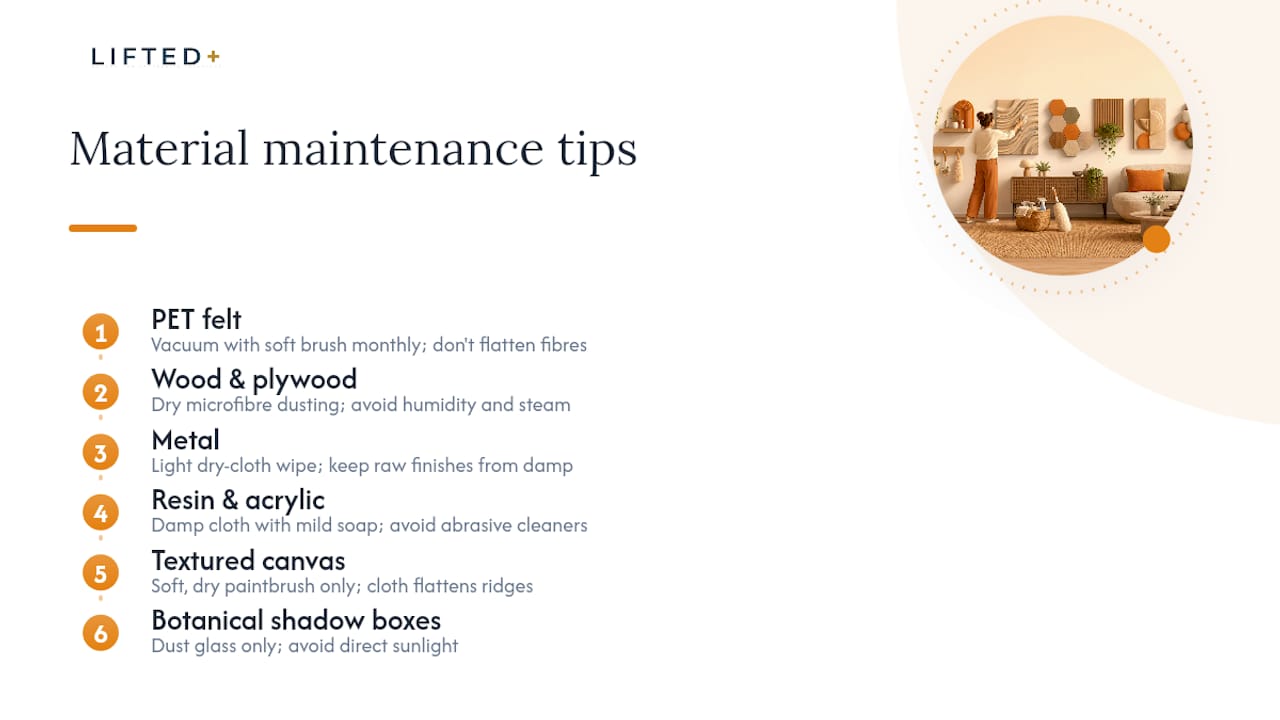
Metal sculptures benefit from a light wipe with a dry cloth to prevent tarnishing, and anything with a raw or unsealed finish should avoid damp cloths altogether. Resin and acrylic pieces are the easiest to maintain: a damp cloth and mild soap handle dust and light marks without scratching, as long as you avoid abrasive cleaners.
Textured canvas is the trickiest surface to clean because the ridges trap dust. A gentle pass with a soft, dry paintbrush works better than a cloth, which can catch and flatten the raised texture. For botanical or dried-flower shadow boxes, skip cleaning altogether beyond dusting the glass front. Direct sunlight will fade dried botanicals faster than almost anything else, so position these pieces away from windows that get strong afternoon light.
Whatever the material, check adhesive pads every six to twelve months if the piece is removable. Adhesive performance can weaken with heat, humidity and time, and a periodic check means you catch a loosening panel before it becomes a fallen one.
What 3D wall decor actually costs
Budgets for dimensional wall decor swing enormously depending on material and whether you buy or build. A DIY textured canvas or paper relief panel can cost as little as the price of plaster medium, card stock and a canvas frame, often well under $50 for a single accent piece using materials already found at a craft store.
Mid-range options, like a modular felt panel kit or a small triptych of framed botanical pieces, generally sit in a moderate bracket that reflects precision-cut materials and ready-to-hang design, without the labour or waste of building from scratch. Solid wood or metal sculptural pieces sit at the top end of the range, driven by material cost and weight-rated hardware, and this is where professional installation sometimes makes more financial sense than DIY, particularly for anything heavy enough to need proper wall fixings.
A sensible way to budget is by wall, not by piece. Decide what you’re willing to spend on a single focal zone, then work backwards: a small DIY project keeps you at the low end, a modular panel kit sits comfortably in the middle, and a bespoke wood or metal commission takes you toward the top. Renters generally get better value from modular or DIY options, since the investment moves with you rather than staying behind with a lease.
Safety first with heavy or sharp-edged pieces
Dimensional wall decor introduces a few safety considerations that flat framed art simply doesn’t. Any piece with sharp edges, exposed dowel ends, or jagged resin or metal work should sit well above the reach of small children and away from high-traffic walkways where a bump could cause a cut.
Weight is the bigger issue. Adhesive pads and picture hooks both carry a rated load limit, and exceeding it risks the piece detaching, which is a genuine hazard if it falls from height onto a bed, sofa or person below. Solid wood, resin and metal pieces over a few kilograms generally call for a proper wall fixing into a stud rather than adhesive alone, even in a home you own outright.
For rentals specifically, always check the adhesive manufacturer’s rated weight against your finished piece before mounting, and never assume a removable product is automatically damage-free on every wall surface. As Family Handyman notes, adhesive performance reacts differently depending on paint type, dust and the age of the wall surface, so a patch test isn’t optional. Finally, keep any battery-powered LED elements away from bedding or soft furnishings, and check battery compartments are properly sealed if the piece sits somewhere it might be knocked.
Using light to bring 3D decor to life
A relief panel or sculptural piece changes character entirely depending on where the light hits it, and this is the cheapest upgrade available to anyone with dimensional wall decor already in place. Directional light, whether from a wall washer, an adjustable uplight or a simple lamp angled across the surface, throws shadow into the grooves and ridges of textured pieces, making shallow relief look considerably deeper than it physically is.
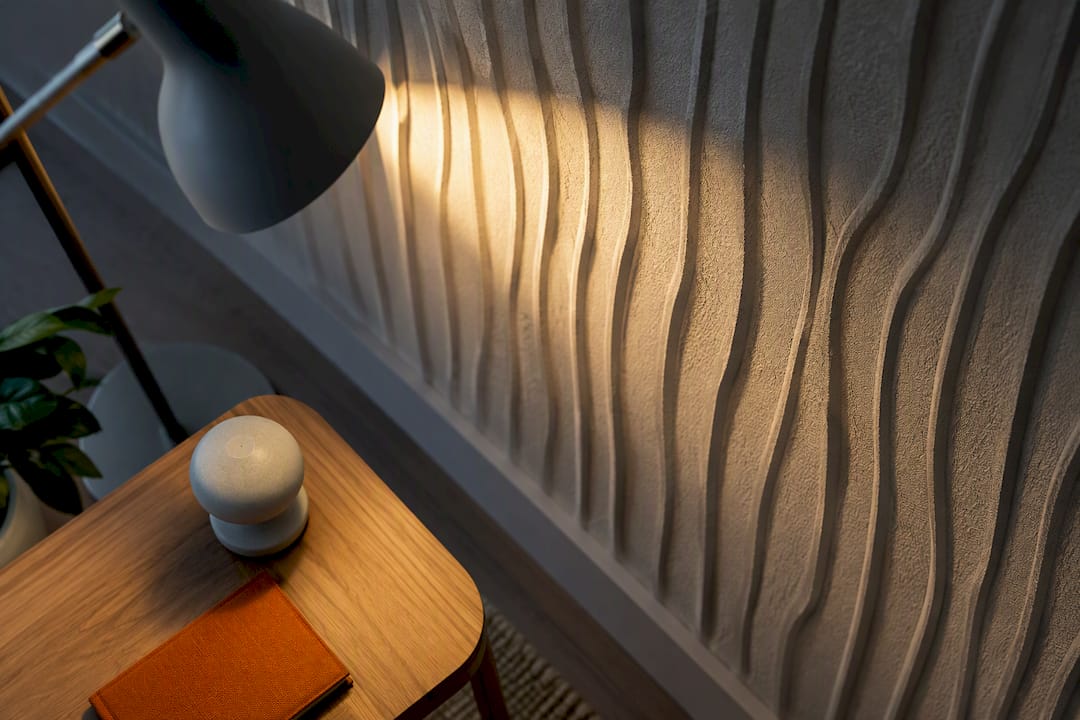
LED backlighting takes this further by creating a halo effect around the edges of a panel, which works particularly well behind shallow felt or timber relief. Battery-powered LED strips are the practical choice for renters, since they avoid any wiring into the wall and can be repositioned along with the panel itself if you move it.
Placement of the light source matters as much as the light itself. A lamp positioned to rake light across a textured surface at a low angle, rather than straight on, exaggerates shadow and depth far more effectively. In rooms with limited natural light, this becomes less about aesthetics and more about function, since flat overhead lighting can flatten even genuinely three dimensional pieces into something that reads as ordinary flat art.
Why I’d rather see a wall done imperfectly than not at all
Most advice about wall decor pushes for perfect matching, and honestly, I think that’s the wrong instinct entirely. Some of the best interiors I’ve seen came from someone choosing a piece because it meant something to them, not because it colour-matched the cushions. Architect and design commentary around wall decor increasingly backs this too: individual, slightly unexpected choices tend to age better in a home than anything chosen purely to coordinate.
If you’re nervous about commitment, start with a sample. Live with one colour or texture for a few days before buying the full arrangement, and swap small pieces in and out until the proportions feel right against your furniture, not against a photo online. Rental walls don’t need to stay blank while you wait for the “right” permanent choice. There isn’t one.
— Michelle
How DwellForms™ kits help you build a no-drill feature wall
Some modular panel kits are designed for colour, texture and dimensional interest without drilling, painting or permanent commitment. These kits use precision-cut PET felt panels made from recycled plastic, installed with tested adhesive pads designed for renter-friendly use rather than screws or construction adhesive.
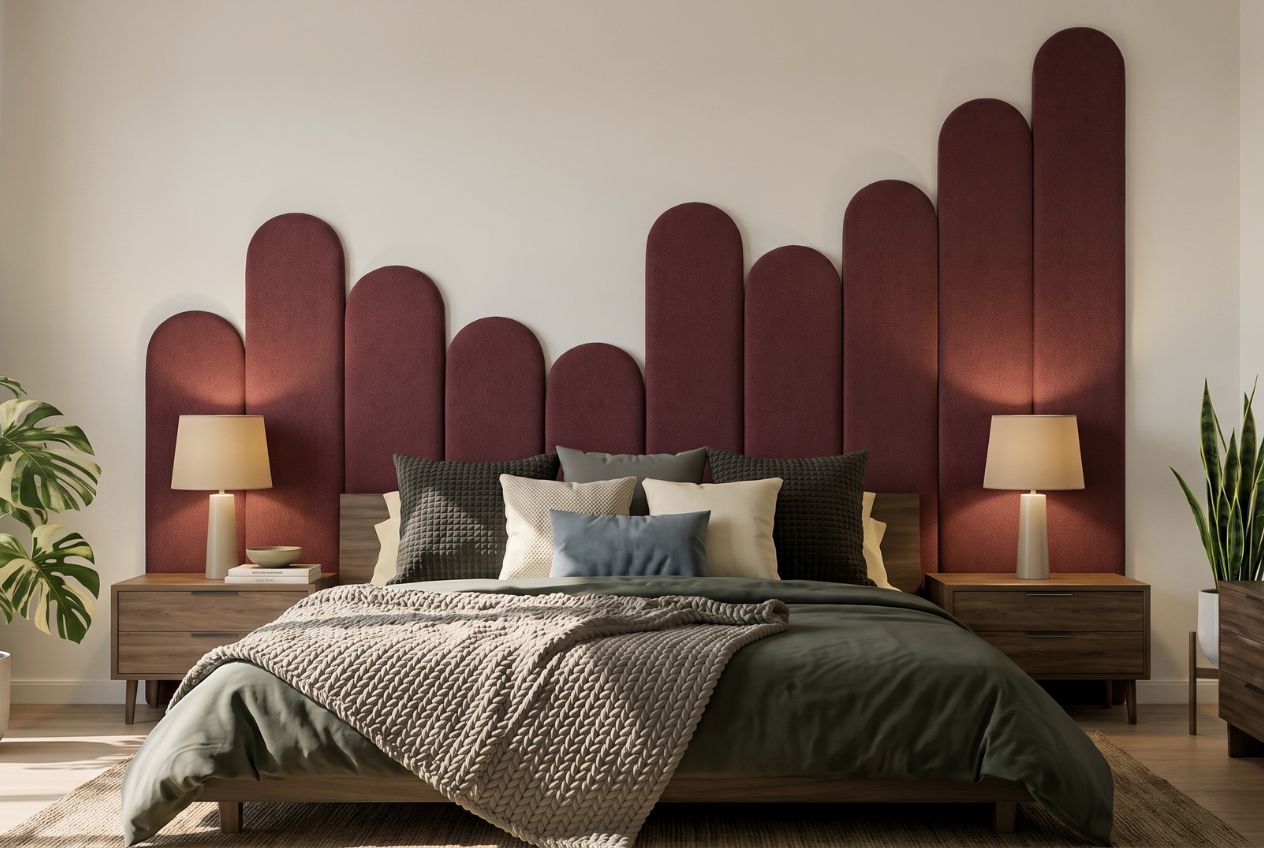
If you’re not ready to commit to a full layout, start with a DwellForms™ Colour Sample and test it against your actual wall for a few days before buying anything larger. When you’re ready to build out a focal zone, a DwellForms™ Core Kit gives you a complete modular arrangement, and an Extension Kit lets you grow the layout later without starting over. Always check your landlord’s rules on wall décor first, and test the adhesive on a hidden patch before committing to the visible wall, since performance can vary between paint types and wall ages. Browse the Core Kits range to see which layout suits your space.
Sources
For broader inspiration, Architectural Digest’s roundup of wall decor ideas covers dozens of dimensional styles across real interiors. Family Handyman offers practical, tool-free guidance on textured DIY walls and adhesive testing. The Spruce breaks texture ideas down room by room, and Liftedplus’s own guide to living room feature walls without renovation covers removable panel layouts in more depth.
- These 53 wall decor ideas bring new life to any room | Architectural Digest
- Textured wall tips | Family Handyman
- 18 wall texture ideas to add dimension to your space | The Spruce
- 3D wall art designs: stunning modern home ideas | TheWallsArt
FAQ
What are the latest trends in 3D wall decor?
Tactile texture, shadow-led relief, organic biophilic forms, selective bold colour against neutral backdrops, and mixed-material compositions are the strongest directions in current wall decor coverage. Modular geometric panels and layered wood remain consistently popular within these directions.
What is the 2/3 rule for wall art?
The 2/3 rule suggests sizing your wall feature to roughly two-thirds the width of the furniture beneath it, most commonly a sofa or bed. This keeps the piece anchored to the furniture rather than floating awkwardly above or overwhelming it.
What are popular 3D wall art styles?
Geometric panels, wave or fluted relief, layered wood, textured canvas, metal sculpture, botanical shadow boxes and mirror compositions all rank among the most popular styles, according to design coverage from Architectural Digest. Removable, modular versions of these styles, such as DwellForms™ panel systems, suit renters who want the same visual impact without permanent installation.
What are some creative ideas for 3D wall design?
Try a triptych of dried-flower shadow boxes, a wooden-dowel sunburst relief, or a mirror paired with a textured panel to enlarge a small room. For a low-effort option, a modular felt panel kit gives sculptural colour and texture without any DIY building required.
Is DIY 3D wall decor damage-free on rental walls?
Not automatically. Adhesive performance varies with paint type, dust and wall age, so Family Handyman recommends testing any adhesive on a hidden patch before mounting anything to a visible rental wall. Always check your lease terms and test first, regardless of what a product claims.