

Last Updated: November 7, 2026
Quick Summary
Felt wall panels mount as modular pieces you can lift off and take with you, while peel-and-stick panels bond to the wall with adhesive backing and stay there. That single difference shapes acoustics, installation, removal, and what your wall looks like on moving day.
- Felt panels are thicker recycled PET felt; peel-and-stick panels are thinner with a decorative face layer.
- Felt panels absorb sound rather than soundproof, and are stronger in mid and high frequencies.
- Installing felt wall panels without drilling takes 1 to 2 hours for a feature wall.
- Peel-and-stick removal can lift paint, leave residue, or take a layer of plaster.
- Compare cost per square metre of covered wall, not cost per tile, including removal and repair.
Table of Contents
- Felt Wall Panels vs Peel Stick: The Core Differences
- Acoustic Performance: Sound Absorption and Noise Reduction
- Peel-and-Stick Acoustic Panels: What They Do Well
- How to Install Felt Wall Panels Without Drilling
- Removable Acoustic Wall Panels and Wall Damage
- Cost, Coverage and Long-Term Value
- Choosing Between Felt and Peel Stick by Room and Goal
- Explore DwellForms™ Kits for Your Space
- Frequently Asked Questions
Felt Wall Panels vs Peel Stick: The Core Differences
The shortest answer to felt wall panels vs peel stick comes down to one question: do you need to get your bond back without an argument? Felt wall panels, like DwellForms™ kits, mount as modular pieces you can lift off and take with you. Peel-and-stick panels bond to the wall with adhesive backing and stay there. That single difference shapes everything else: acoustics, installation, removal, and what your wall looks like on moving day.
Both options are sound-absorbing wall treatments made from recycled PET felt, and both beat bare plasterboard for echo. The split is in how they attach. One is a wall treatment you own. The other is a wall treatment your wall owns.
Materials and Construction Compared
Felt wall panels are thick, dense tiles or shaped pieces cut from recycled PET felt, with a firm handfeel and a matte surface. Peel-and-stick acoustic panels are thinner: a decorative face layer, often a faux-wood print, laminated to a felt backing with adhesive already applied.
That construction gap matters. The thicker felt body does more of the acoustic work. The adhesive layer does none of it, and it is the part that decides how the panel comes off.
For renters comparing both, the renter-specific route is worth a look before you commit to adhesive: make a rental feel like home.
Acoustic Performance: Sound Absorption and Noise Reduction
Felt panels absorb sound; they do not soundproof a room. That distinction gets blurred constantly in product listings, so hold onto it. Sound absorption reduces echo and reverberation inside the room by soaking up reflected sound. Soundproofing stops sound travelling between rooms, and no stick-on panel achieves that.
What the numbers mean matters more than the marketing. Acoustic products are often described using a sound absorption coefficient (α) between 0 and 1, where 0 is a perfect reflector and 1 is perfect absorption. A single number is usually an average across frequencies, but the average hides the story. Porous PET felt is generally stronger in the mid and high frequencies and weaker at low frequencies. Felt covering does not stop low-frequency sound from neighbouring spaces.
Thickness and density influence how low in frequency the absorption reaches. Generally, a thinner panel with less porous material absorbs less sound than a thicker one of the same area. Air gaps and mounting method also change results: a panel held slightly off the wall can behave differently from one bonded flat, and performance depends on how much bare wall remains. Cover one wall and you will notice the change; cover a corner and you will not.
Installation conditions are a variable buyers often overlook. A panel stuck to a smooth, sealed painted wall reflects differently from one on an uneven or fabric-covered surface, and partial coverage leaves hard surfaces to bounce sound back. For a deeper look at why open-plan rooms echo, open plan acoustics explains the absorb, block, cover approach.
Watch out: a product listing that quotes an absorption figure without stating the test method, mounting condition and frequency range is telling you very little. Ask what was measured and how it was fixed before you compare two panels on acoustics.
Peel-and-Stick Acoustic Panels: What They Do Well
Peel-and-stick acoustic panels are quick to install. You peel the backing, press the panel to a clean wall, and you are done. No layout planning, no mounting hardware, no measuring beyond the panel edges. For a single accent wall behind a desk, they deliver a fast visual and acoustic upgrade.
Their limits show up later. The adhesive is permanent-ish: removing it can lift paint, leave residue, or take a layer of plaster with it. Thin panels absorb less than thick ones. And once stuck, the layout is fixed, so a move means starting over. If your lease has a strict no-damage clause, read how to remove adhesive wall panels before you buy a pack.
How to Install Felt Wall Panels Without Drilling
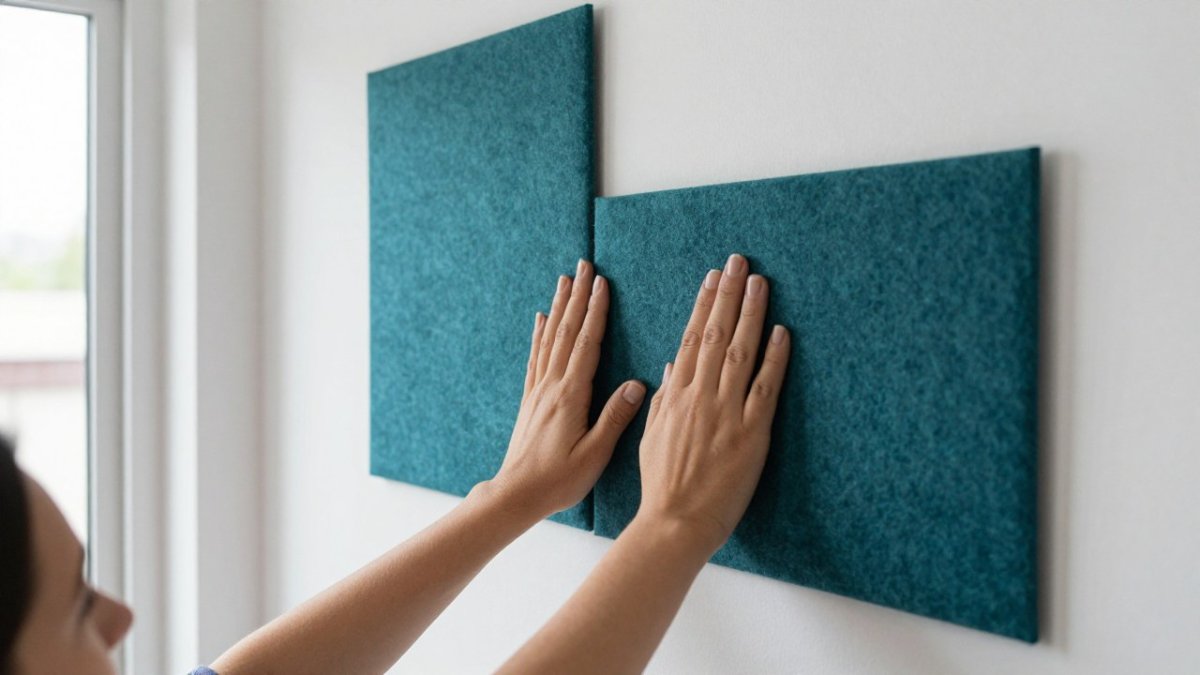
Installation is where the two options part company most clearly. Felt wall panels are designed to mount without drilling, screws or paint. Here is the process we recommend:
Total time: 1 to 2 hours for a feature wall.
- Check the wall. Wipe it clean and dry. Skip greasy, damp, or flaking surfaces.
- Plan the layout on the floor. Arrange panels in your intended pattern before anything touches the wall.
- Mark a level line. A pencil line at the top row keeps everything straight.
- Apply adhesive pads to the back of each panel, following the kit instructions.
- Press and hold. Seat each panel firmly for a few seconds.
- Cut around sockets with a sharp blade before fixing that panel.
Expected result: a level, tight pattern with no holes in the wall. For the full walkthrough, see our felt wall panels installation guide.
Removable Acoustic Wall Panels and Wall Damage
Watch out: the phrase “removable” on a product listing often means “removable by us, once, carefully.” Peel-and-stick panels are removable in theory. In practice, adhesive bonds to paint, and paint bonds to plasterboard. Pull too fast and you take the paint with you.
Felt wall panels designed as removable acoustic wall panels are intended to avoid that risk because they are not glued across the whole back. That is the whole reason this category exists for renters. Before you sign off on any panel, test one in a corner, leave it a week, then remove it slowly. If the paint lifts, you have your answer cheaply.
Cost, Coverage and Long-Term Value
Pricing depends on quantity, coverage area and the kit you choose. For current prices or a quote, visit the Lifted Plus website. Instead, compare the two on total cost of ownership, the number that actually decides whether the cheap option stays cheap.
| Factor | Felt Wall Panels | Peel-and-Stick Panels |
|---|---|---|
| Upfront cost | Higher per panel | Lower per panel |
| Coverage per panel | Thicker, larger format | Thinner, smaller tiles |
| Installation tools | Adhesive pads, blade | None |
| Removal | Lifts off, reusable | Often damages paint |
| Reusability | Reconfigures in a new home | Single-use |
| Bond risk | Low with pads | Moderate to high |
| Acoustic depth | Better mid/high absorption | Lighter absorption |
Total installed cost is more than the pack price. Add the cost of tools, the time to install, and, for peel-and-stick, the cost of the exit. A common pattern is that the lower sticker price is offset by repainting, patching or losing part of a bond when the panels come down. A reusable felt kit moves with you, so the same spend covers the next home rather than being written off at moving day.
Coverage area changes the maths again. Coverage per unit varies by format, so compare cost per square metre of covered wall rather than cost per tile. Compare cost per square metre of covered wall, not cost per tile, and include the removal and repair line before you decide. For current kit pricing, check the product pages directly.
Choosing Between Felt and Peel Stick by Room and Goal
Match the panel to the room, not the other way round.
- Bedroom or living room, renting: felt panels. You want reusability and a clean removal.
- Home office, echo problem: felt panels in a thicker format, covering one full wall.
- Quick weekend refresh, owned home: peel-and-stick works if you accept the removal risk.
- Frequent mover: felt panels, full stop. Peel-and-stick is a one-lease purchase.
- Textured or angled walls: felt panels with pads handle uneven surfaces better than full-back adhesive.
If your goal is a room that sounds as good as it looks, felt wins on both counts. If your goal is the cheapest possible accent wall you never plan to remove, peel-and-stick is fine.
Explore DwellForms™ Kits for Your Space
Our DwellForms™ wall kits are designed for renters and homeowners. Each kit uses 100% recycled PET felt, requires no paint or drilling, and is made to be moved and reconfigured. That means colour, texture, and architectural shape on your wall without paint or drilling.
The modular panels can be rearranged into a new layout, and the felt is intended to help absorb sound within a room.
Your lease should not decide what your walls look like. Choose a wall treatment you can take with you, install in an afternoon, and rearrange whenever the mood shifts. Lifted Plus builds DwellForms™ kits from 100% recycled PET felt, with no-drill mounting, modular panels made to move, and colour and texture that lift a blank rental into a home. Get started with Lifted Plus and turn your blank wall into the best-looking corner of the apartment.
Frequently Asked Questions
Do felt wall panels reduce noise?
Yes, felt wall panels absorb sound and reduce echo and reverberation in a room. PET felt is porous, so it soaks up mid and high frequencies rather than reflecting them off hard walls. They are not soundproofing, though: felt panels will not block noise travelling through a wall from a neighbouring apartment. Treat them as a way to improve room acoustics, not to silence the building.
Are peel-and-stick wall panels soundproof?
No. Peel-and-stick acoustic panels absorb sound within the room, which cuts echo, but they do not block sound passing through walls, floors or doors. True soundproofing needs mass, decoupling and sealed gaps, which a thin adhesive panel cannot provide. If your goal is a quieter home office or less reverberation in a living room, peel-and-stick panels help. If your goal is to stop hearing the neighbours, they will disappoint.
Are felt wall panels easy to remove?
It depends on the mounting method. Modular felt kits are designed to be moved without drilling, which can suit renters and frequent movers. Felt tiles fixed with adhesive backing behave more like peel-and-stick products: removal is slower and can lift paint if the wall was not properly prepared. Ask how the panel attaches before you buy, and check the wall surface first.
Do peel-and-stick panels damage walls when removed?
They can. Adhesive-backed panels bond to paint, and when pulled off they may take a layer of paint, leave a tacky residue, or tear paper-faced plasterboard. Damage is more likely on freshly painted, glossy or poorly primed walls. Warming the adhesive and peeling slowly reduces the risk, but it does not remove it. If your lease requires the wall back in original condition, a no-adhesive modular system is the safer choice.
Can felt wall panels be rearranged after installation?
Modular felt kits are designed to be reconfigured to suit a new room layout. That flexibility is the main practical difference from peel-and-stick, where panels are fixed once and rarely survive removal intact. For renters who move every year or two, rearrangeable kits stretch the same purchase across several homes.

