
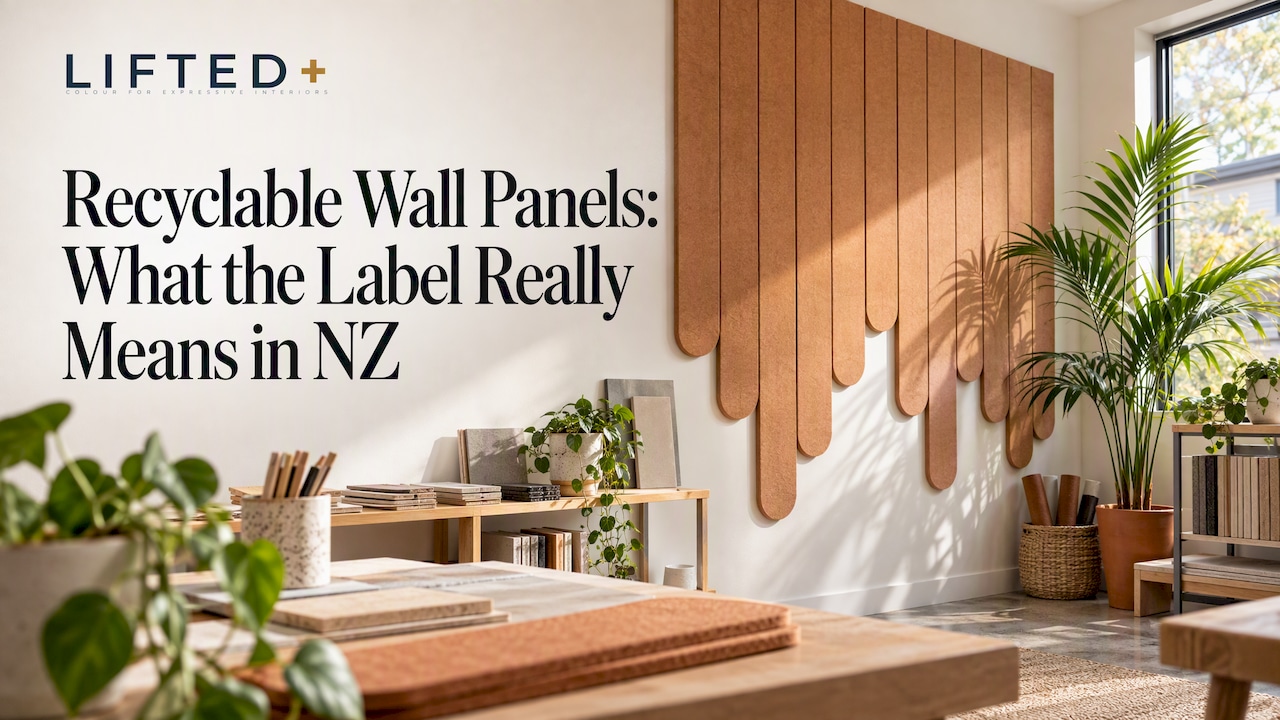
If you are searching for recyclable wall panels, you are really asking two questions at once: what is the panel made from, and where does it go when you are finished with it? The honest answer is that those are different things. A panel can be made from 100% recycled material and still be hard to recycle again, and a panel that is technically recyclable may never reach a facility that will take it.
This guide separates the claims, shows what New Zealand builders and designers are actually using, and explains where a renter-friendly feature wall fits in. That means colour without commitment, texture without renovation and nothing drilled into your landlord’s plasterboard.
Key takeaways
- “Recycled” describes what a panel is made from. “Recyclable” describes what can happen to it afterwards. Look for both claims, and for evidence behind each.
- Locally made options exist for building work, such as recycled-packaging internal linings, but they are fitted products, not something a tenant can use.
- For renters and anyone who moves often, the most sustainable panel is often the one you can take down, reconfigure and reuse in the next home.
- DwellForms™ kits are made from 100% recycled PET felt and installed with tested adhesive pads, with no drilling, paint or wallpaper.
- No adhesive is completely damage-proof. Wall finish, age and preparation all matter.
Table of Contents
- Recycled, recyclable, reusable: three words that get blurred
- What is on the market in New Zealand
- Why PET is a sensible base material
- The case for reuse, especially if you rent
- A renter-friendly feature wall, step by step
- About the adhesive, and what we will not promise
- Caring for felt panels
- Perspective: sustainable should still feel good
- Where DwellForms™ fits
- A checklist before you buy any eco wall panel
- FAQ
- Sources
Recycled, recyclable, reusable: three words that get blurred
Marketing language around wall panels tends to collapse three ideas into one green-sounding phrase. Pulling them apart makes every product page easier to read.
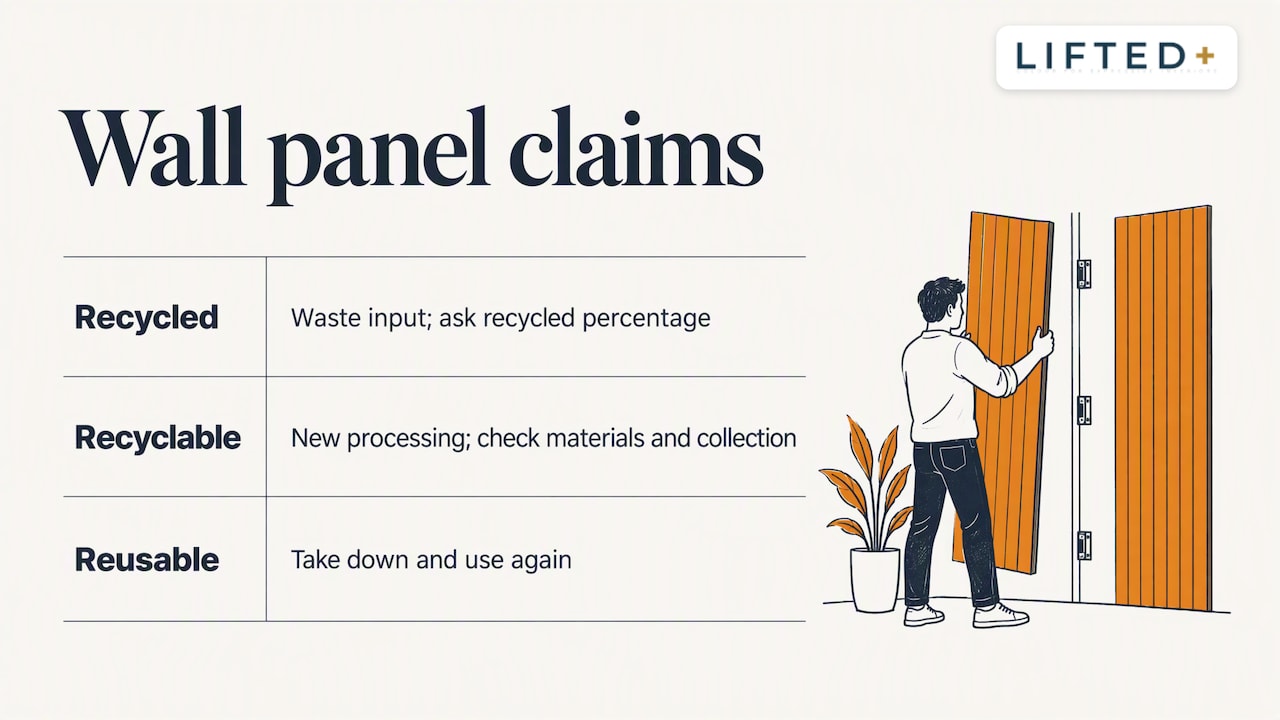
Recycled means the raw material came from waste. A felt made from reclaimed plastic bottles is recycled. This is the claim that is easiest to verify, because a maker can state the percentage.
Recyclable means the material can be processed into something new at the end of its life. This depends on the polymer, on any glues, laminates or metal fixings attached to it, and on whether a collection route exists where you live.
Reusable is the one that gets least attention and often matters most. A panel that moves with you from a flat in Mt Eden to a townhouse in Hamilton has avoided disposal entirely.
When you shop, ask three plain questions. What percentage is recycled content? What happens to the panel at the end of its life? Can it be taken down and used again? A maker who answers the first and dodges the other two is telling you only a third of the story.
What is on the market in New Zealand
The search results for this topic are a mixed bag, and it helps to sort them by what they are designed to do.
Building linings made from waste
Some products are designed for the construction trade. One New Zealand example is saveBOARD, an internal lining made locally from recycled packaging waste. A case study of its exposed internal lining at the Tiu House project describes it as low carbon and made from 99% recycled waste. It is a serious material for people building or renovating, specified by an architect and fixed by tradespeople.
Cladding and composite panels
PVC, WPC and composite slat panels are often described as recyclable because the base polymer can be reprocessed. The caveat is practical: the claim usually assumes clean, separated material with fixings removed, and a processor willing to take it. Check the supplier’s take-back arrangements rather than relying on the word alone.
Reclaimed timber and recycled plastic sheet
Pallet and reclaimed wood walls carry a lovely story, and recycled plastic sheet is common in commercial fit-outs. Both generally require screws, battens or adhesive that is not removable. That makes them a poor match for a tenancy.
Felt panels from recycled bottles
PET felt sits in a different category again. It is lightweight, cuts cleanly into shapes and takes colour well, which is why it appears in everything from slat wall backings to sculptural feature walls. Our deeper guide to recycled PET felt panels for interior design covers the material in detail.
Why PET is a sensible base material
PET is resin code 1, the same plastic used in drink bottles. According to Pink Bins, PET is recyclable and can be turned into new bottles or spun into polyester for items like fleece and carpet. That tells you the polymer itself has a recycling pathway.
It does not tell you that a coloured, cut felt panel will be accepted in your kerbside bin. Kerbside recycling in New Zealand is aimed at packaging: the same source lists stiff plastic bottles, trays and containers in grades 1, 2 and 5 as accepted. A wall panel is not a bottle.
So we are careful with our wording. DwellForms™ panels are made from 100% recycled PET felt, which means plastic that already existed has been given a second, longer life on your wall. We do not describe them as something you can put in the recycling bin, and we would be wary of any maker who implies that without a take-back scheme to point to.
The case for reuse, especially if you rent
New Zealand is a renting nation in its cities, and a great many tenants live with blank, cream walls and a lease that discourages holes. The sustainability conversation for that reader looks different from the one a builder has.
A panel system that requires fixing into the wall ends up in the skip when the tenancy ends. One that comes off cleanly and can be rehung elsewhere does not. For anyone who moves every few years, reuse beats recyclability on practical terms, because the panels stay in service rather than waiting for a processor.
That is the logic behind how DwellForms™ is designed. The modular pieces can be installed, removed, rearranged and taken to a new home. Our guide on how to reuse wall panels without drilling walks through the process, and the piece on removable wall panel ideas for NZ renters shows how layouts adapt to a new room.
A renter-friendly feature wall, step by step
Here is how a typical install runs. Exact steps come with each kit, so treat this as an overview.
- Choose the wall. Pick a flat, clean, dry, painted surface. Not every wall suits adhesive: textured, flaking, dusty or unsealed surfaces are poor candidates, and we do not claim every-wall suitability.
- Order colour samples first. Colour reads differently in morning light and under a warm lamp. A sample kit lets you test it against your floor, curtains and sofa before committing.
- Lay it out on the floor. Arrange the pieces in the pattern you want and photograph it. This is the fastest way to catch an awkward gap.
- Apply the adhesive pads. Our kits use tested nano-adhesive pads, rather than screws, nails, battens or construction adhesive.
- Press the panels into place and step back. Adjust the rhythm before the pads set.
- When it is time to leave, remove the panels slowly and carefully, following the guidance that comes with your kit.
If you want pattern inspiration, the page on colour-led modular wall panel patterns installed in a weekend is a good place to start.
About the adhesive, and what we will not promise
The bond is the part of a no-drill wall that renters worry about most, and rightly so. Your bond is on the line.
We tested several adhesive options before settling on one. We deliberately discounted one popular pull-tab brand, because in our own testing our selected nano-adhesive pads performed significantly better at minimising damage to walls. That is a finding from our testing, not an industry-wide claim, and we would not ask you to treat it as a guarantee.
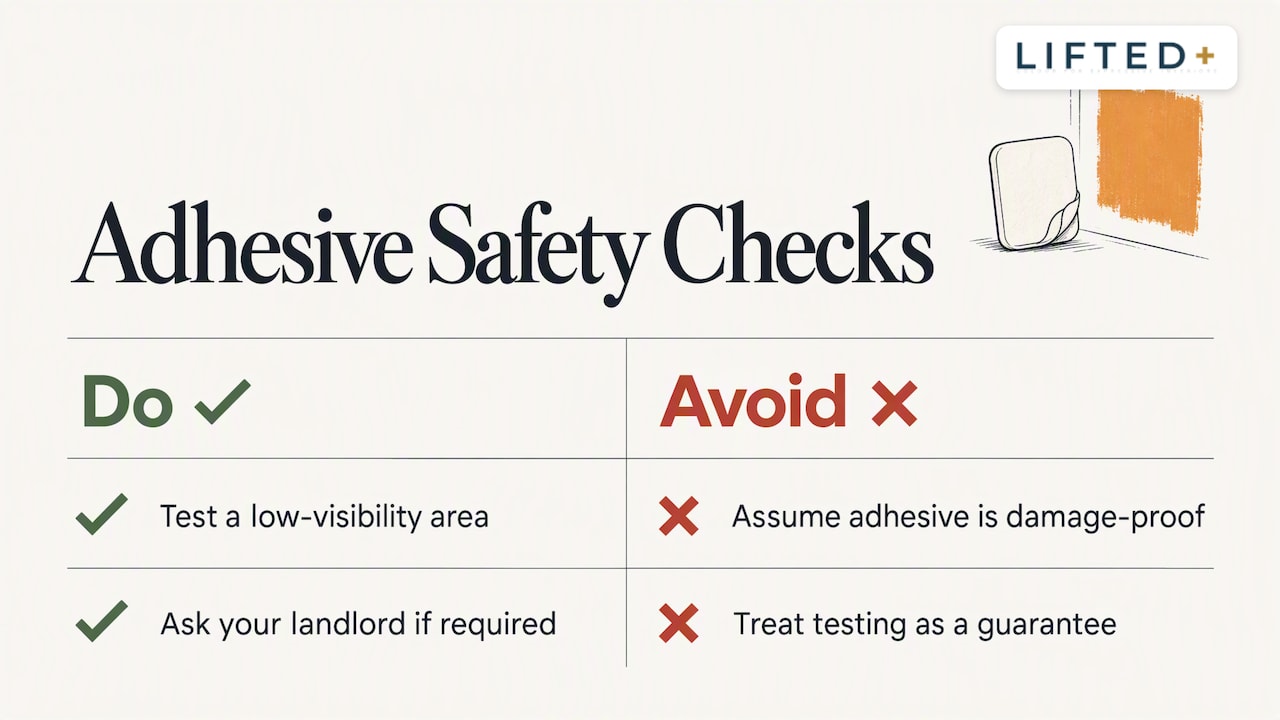
No adhesive is completely damage-proof. Older paint, cheap paint, humidity, heat and how long a panel stays up all play a part. If you are unsure, test a small area in a low-visibility spot, and talk to your landlord or property manager where your tenancy agreement asks you to. Our damage free wall panels guide for renters covers preparation and removal in more depth.
Caring for felt panels
Felt does not demand much. A soft brush or a low-suction vacuum attachment keeps dust off the surface. If you are preparing a flat for a move-out inspection, a thorough clean of the room is sensible anyway, and some households bring in an eco-friendly cleaning service to handle the rest while they concentrate on the packing.
The panels themselves are decorative. We do not market them as soundproofing or commercial acoustic treatment, and we would encourage you to look elsewhere if that is what you need.
Perspective: sustainable should still feel good
We built DwellForms™ because we think the safe, polite middle of neutral interiors does a lot of renters a disservice. Sustainability is too often presented as beige, and we disagree. A wall can be recycled in its material, removable in its method and still bold in its colour.
That is why we focus on three things at once. The felt is made from recycled plastic. The system is built to be taken down and taken with you. And the colour is designed to hold the room, rather than apologise for it.
We also think the industry owes buyers plain language. We will tell you what our panels are made from and how they are installed. We will not stretch “recycled” into promises we cannot support. If you want a wall that feels like yours without a single hole, that is what we make.
— Michelle
Where DwellForms™ fits
If you want a feature wall that is recycled in its material and reusable in its design, start with the DwellForms™ Colour Samples. Sample kit purchases are credited towards a full kit order, so testing colour costs you nothing extra if you go ahead.
When you are ready, the DwellForms™ Core Kits give you the main pattern, and the Extension Kits let you grow it across a bigger wall later. For broader ideas, see our list of eco-friendly, renter-safe wall decor ideas.
A checklist before you buy any eco wall panel
Whatever you choose, run it past these questions.
What is the recycled content, and does the maker state a percentage? Is the material a single polymer, or is it laminated with something that blocks recycling? What fixing does it need, and can it be removed? Does the supplier offer take-back or a clear end-of-life pathway? Is the product suited to your situation: a build, a renovation or a tenancy?
The New Zealand government is watching this space too. The Ministry of Business, Innovation and Employment’s building trends report notes designers are using strategies such as waste reduction, resource recovery and non-toxic, low-impact materials. Those are good yardsticks for anyone choosing interior finishes, whether a home is being built or simply refreshed.
FAQ
Are recycled PET wall panels recyclable?
The PET polymer has a recycling pathway, but a finished, coloured felt panel is not a drink bottle, and kerbside bins are set up for packaging. Ask any maker about take-back before relying on the word recyclable. DwellForms™ panels are made from 100% recycled PET felt, and we do not claim they can go in your household recycling.
Can renters use sustainable wall panels without losing their bond?
Often, yes, if the panels are fixed without drilling and the wall surface is suitable. We use tested nano-adhesive pads, but no adhesive is completely damage-proof. Check your tenancy agreement and test a small area first.
Is reusing a panel better than recycling it?
In most cases reuse keeps the product in service for longer and avoids processing altogether. That is why DwellForms™ is modular and designed to be removed, rearranged and moved to a new home.
Will felt panels soundproof my apartment?
No. DwellForms™ is a decorative system, and we do not promise soundproofing or commercial acoustic performance. Choose it for colour, texture and shape.
Sources
- saveBOARD Exposed Internal Lining, Tiu House (eboss)
- What do the recycle numbers mean on plastic packaging in NZ? (Pink Bins)
- Emerging trends in building design, technologies and materials (MBIE)
Recommended
- Sustainable Wall Panels Made From Recycled PET
- Removable Wall Panel Ideas For NZ Renters In 2026
- Reuse Wall Panels Without Drilling: NZ Renters Can Take Them Along
- Damage Free Wall Panels: A Renter’s Guide For 2026
This article is for general information and inspiration only. Product performance and results may vary depending on individual circumstances, surfaces and installation.
