

Last Updated: October 25, 2026
Quick Summary
Sustainable home decor for small apartments is worth it when pieces pass three tests: reversible, portable and long-lasting. Because you cannot change rental walls or add storage, the most wasteful purchase is decor you cannot take with you, so choose modular, secondhand and no-drill options instead.
- Judge decor on three tests: reversible, portable and long-lasting before buying.
- Recycled felt wall panels press onto walls in a modular grid and lift away without adhesive residue.
- Under the Residential Tenancies Act 1986, tenants are generally liable for damage beyond fair wear and tear.
- Buy fewer furniture pieces and choose multifunction, solid and standard-size items that earn their footprint.
- Check the percentage of recycled content and the removal method before buying any eco-labelled decor.
Table of Contents
- Why Small Apartments Need a Different Approach to Sustainable Home Decor
- Eco-Friendly Apartment Decor That Works Within Four Walls
- Recycled Felt Wall Panels for Home Spaces That Change Shape
- Renter-Friendly Wall Decor That Leaves No Marks Behind
- Sustainable Furniture for Small Spaces: Buy Less, Choose Better
- What to Look For Before You Buy Sustainable Home Decor
- Planning Your DwellForms™ Wall Kit Layout
- Frequently Asked Questions
Why Small Apartments Need a Different Approach to Sustainable Home Decor
Sustainable home decor for small apartments works differently from the version sold to people with four-bedroom houses and a garage full of tools. At Lifted Plus, we design for the constraint most guides ignore: you cannot change the walls, you cannot add storage, and you will probably move again within a couple of years. That changes what “sustainable” actually means.
The usual definition centres on materials. Recycled content, low-impact finishes, natural fibres. All worth caring about. But in a rental, the most wasteful purchase is the one you cannot take with you. A reclaimed timber shelf screwed into a wall is sustainable on paper and landfill-bound the moment the lease ends.
So we judge decor on three tests instead:
- Reversible: can it come down without filler, paint or a repair bill?
- Portable: does it survive a move and fit a different room shape?
- Long-lasting: will it still look good after three flats and two years?
Pass all three and a piece earns its place. Fail one and you are buying single-use decor with a green label. For a wider look at how space constraints reshape decorating choices, these small apartment decor ideas cover the fundamentals.
We judge every piece of decor on three tests before it earns a place in a small rental.
| Test | Question it asks | What passing looks like |
|---|---|---|
| Reversible | Can it come down without filler, paint or a repair bill? | No drill holes or adhesive damage left behind |
| Portable | Does it survive a move and fit a different room shape? | Packs flat and rearranges into new layouts |
| Long-lasting | Will it still look good after three flats and two years? | Still looks good after multiple moves |
Eco-Friendly Apartment Decor That Works Within Four Walls
Eco-friendly apartment decor is decor that reduces waste across its whole life, not just at manufacture. That means materials with recycled content, finishes that avoid harmful chemicals, and products designed to be reused rather than replaced.
The New Zealand Government’s waste strategy treats construction and demolition waste as a priority stream, and furniture and furnishings contribute to it every time a tenant clears out. Buying less, and buying things that move with you, is the practical response.
What this looks like in a small flat:
- Textiles over hard fittings. Cushions, throws and wall-mounted fabric panels pack flat and leave no holes.
- Modular over fixed. Anything that clips, hangs or leans can be reconfigured when your layout changes.
- Secondhand first. Good quality pre-owned furniture is the lowest-carbon option available, full stop.
Renter-safe options go further than most people expect. These renter safe eco wall decor ideas cover removable and no-drill approaches in detail.
Recycled Felt Wall Panels for Home Spaces That Change Shape
Recycled felt wall panels are semi-rigid sheets made from compressed recycled plastic fibre, usually PET recovered from bottles. They press onto a wall in a modular grid, add acoustic softening and colour, and lift away again without adhesive residue.
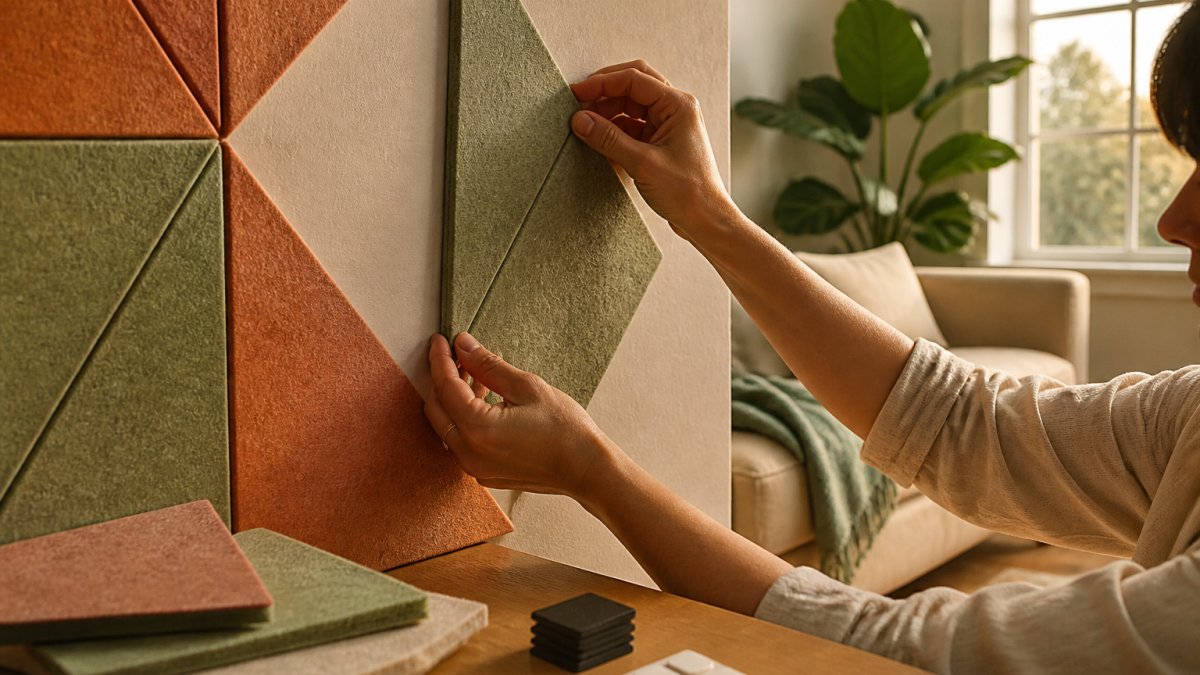
This is the category we build in, so take our enthusiasm with the appropriate salt. The reason we chose felt over timber slats or adhesive tiles is simple: felt is light, it cuts cleanly, it holds colour well, and it does not crack when you move it. A panel that survives three moves is a genuinely different product from one that survives one.
The design advantage matters as much as the material. A flat wall in a 45-square-metre flat is dead space. Panels turn it into a shape, a colour block, a headboard. And when you shift to a room with a different wall, the same panels rearrange into a new composition. Nothing is wasted because nothing is fixed.
For the full case on benefits, installation and reusability, see our guide to felt wall panels for renters.
Renter-Friendly Wall Decor That Leaves No Marks Behind
Renter-friendly wall decor is any wall treatment that installs and removes without drilling, painting or leaving adhesive damage. The test is not whether it holds, but whether the wall looks untouched when it comes down.
Damage is where deposits disappear. Under the Residential Tenancies Act 1986, a tenant is generally liable for damage beyond fair wear and tear, and a wall of filled drill holes is a classic example. Removable decor avoids the argument entirely.
Three options that genuinely pass:
- Felt panel kits. No drill, no adhesive residue, repositionable.
- Tension rods and hanging rails. Load spreads across the wall rather than into it.
- Freestanding screens and leaning shelves. Zero wall contact.
Watch out: peel-and-stick products vary enormously in how cleanly they release. On textured or painted surfaces, cheap adhesive can pull paint. Always test a small patch first, in a hidden spot, and leave it for a week before committing to a full wall.
Sustainable Furniture for Small Spaces: Buy Less, Choose Better
Sustainable furniture for small spaces comes down to a single rule: buy fewer pieces, and buy ones that earn their footprint. A small flat punishes clutter faster than a large one, so every item has to work twice.
Priorities that actually matter:
- Multifunction over volume. A storage ottoman replaces a coffee table and a blanket box.
- Solid over veneer. Repairable frames outlast flat-pack joints.
- Standard sizes. Pieces that fit a range of room shapes move with you.
- Neutral bases, colour accents. Let textiles and panels carry the personality so furniture can travel.
A common mistake is buying to fill a specific wall, then discovering the next flat has no such wall. Measure, then buy for the smallest room you might live in.
What to Look For Before You Buy Sustainable Home Decor
Before buying sustainable home decor, check the material’s recycled content, how it installs and removes, and whether it can be reused in a different space. Marketing language is loose on all three.
Our checklist:
- Does the listing state the percentage of recycled content, not just “eco”?
- Is the installation method described in detail, including removal?
- Are there real customer photos in ordinary rooms, not just styled sets?
- Can the product be reconfigured or expanded later?
- Does it pack flat for a move?
On the material question specifically, ask for the recycled PET story in full. Our page on sustainable wall panels made from recycled PET explains what the material is and how it performs acoustically, which is the detail most product pages skip.
Watch out: “recyclable” and “recycled” are not the same claim. A product that could theoretically be recycled at end of life has a very different footprint from one already made from recovered waste.
Planning Your DwellForms™ Wall Kit Layout
Planning a DwellForms™ wall kit starts with the wall, not the design. Measure the width and height, note where power points and light switches sit, and mark any furniture that will overlap the lower section.
Then work in this order:
- Choose your anchor zone. The wall you see first on entering, or the one behind the bed or sofa.
- Pick two or three colours. One dominant, one secondary, one accent. More than three reads as noise in a small room.
- Sketch the grid on paper. Panels are modular, so a rough scale drawing is enough to test proportions.
- Leave breathing room. A shape that stops short of the ceiling and corners looks intentional. One that touches everything looks like a mistake.
- Plan for the next room. Keep the layout flexible enough to rework into a narrower or wider wall.
When you are ready to build it, you can shop DwellForms™ Core Kits made from 100% recycled PET felt, designed to be installed without drilling and moved with you. Pricing depends on how much wall you are covering, so check the current kit options for your measurements.
Frequently Asked Questions
How can I decorate a small apartment sustainably without drilling or painting?
Focus on pieces that attach without fixings and can move with you. Modular felt panels, tension rods, freestanding shelves and removable hooks all personalise a rental without touching the walls. Choose items made from recycled or rapidly renewable materials so the decor carries a lower footprint, and buy fewer, larger pieces rather than lots of small ones. Sustainable home decor for small apartments works best when every item earns its space and can be reconfigured in the next place.
Are recycled felt wall panels a good option for small apartments?
They suit small apartments well because they add colour and texture on the wall itself, so you do not lose floor area to extra furniture. Panels made from 100% recycled PET felt are lightweight, cut around awkward angles and can be rearranged when you move. Check the mounting method first: a no-drill system protects your bond, while textured or angled walls may need extra care during installation. Measure the wall and order enough panels to cover the area you want before you start.
What should I look for when buying sustainable home decor?
Ask what the item is made from, where it was made and whether it can be repaired or moved. Recycled content, low-VOC finishes and FSC-certified timber are useful markers. For rentals, confirm the mounting method leaves no marks. Also check dimensions in millimetres against your actual wall and ceiling height, since small rooms punish oversized pieces. Sustainable home decor should last through several moves, so prioritise modular designs over one-off statement pieces.
How much does it cost to cover a bedroom wall with modular panels?
Pricing depends on the wall size, the number of panels and the kit you choose, so check Lifted Plus’s website for current prices or request a quote. Measure the width and height in metres, subtract doors and windows, then compare that figure with the coverage each kit states. Ordering a full kit for one wall usually works out better value than buying panels piece by piece, and you can add to it later if you move to a larger room.
Small apartments are unforgiving of decor that cannot adapt. If your walls are off-limits and your lease is short, the answer is decor that clips on, lifts off and travels. Lifted Plus builds DwellForms™ kits for exactly that: 100% recycled PET felt panels, no drilling or painting, and a modular system you can rearrange in every new space. Get started with Lifted Plus and turn a blank rental wall into something that actually feels like yours.

